
The fish on your dinner plate almost certainly grew up in a farm, not the open ocean. In 2024, aquaculture crossed 100 million tonnes of production for the first time, officially overtaking wild-caught fish as the main source of seafood on Earth. That single fact changes the entire conversation around aquaculture sustainability facts, because we are no longer debating a niche industry. We are debating how half the planet’s fish supply gets made.
I have spent two decades studying coastal ecosystems, and the question I get asked most at dinner parties is blunt: is farmed fish actually good for the ocean, or is it just a prettier kind of damage? The honest answer is “it depends enormously on the farm,” and this guide walks through exactly why.
Key Takeaways
| Question | Short Answer |
|---|---|
| Is fish farming sustainable? | It can be, but quality varies hugely by species, system, and country |
| Biggest environmental risk | Nutrient pollution and reliance on wild fish for feed |
| Biggest environmental benefit | Takes pressure off overfished wild stocks |
| Best current systems | Recirculating Aquaculture Systems (RAS) and offshore/open-ocean pens |
| Global scale (2024) | 103 million tonnes produced, worth over $391 billion including algae |
| What shoppers can do | Look for ASC, BAP, or Global G.A.P. certification labels |
TL;DR: Aquaculture now supplies more than half the world’s seafood and has genuinely reduced pressure on wild fish stocks, but it isn’t automatically “sustainable” just because it isn’t wild-caught. The real answer to “is fish farming sustainable” depends on the species, the system (open-net pen versus closed RAS), and how the feed is sourced. Certified, well-managed farms are a legitimately better choice; poorly regulated ones can pollute coastal waters and spread disease.
Coral Restoration Projects: How Scientists Are Regrowing Reefs
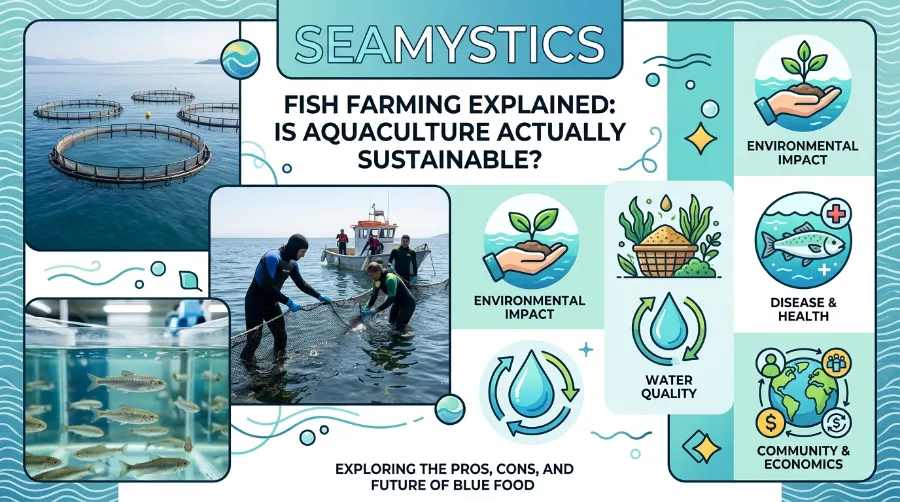
What Aquaculture Actually Means
Aquaculture is simply farming aquatic animals and plants, fish, shrimp, oysters, seaweed, instead of catching them wild. Humans have done this for thousands of years; carp farming in China dates back over 2,000 years. What has changed is the scale and the technology.
Marine Protected Species Laws: What’s Actually Protected in the US
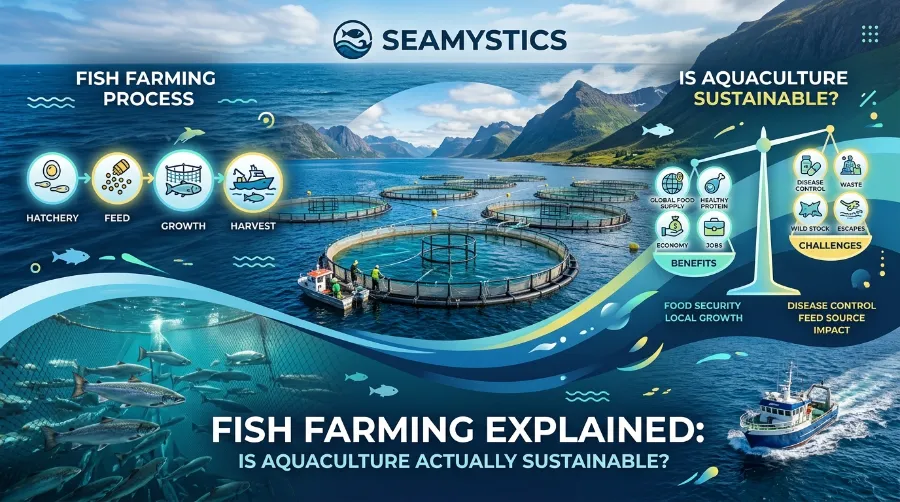
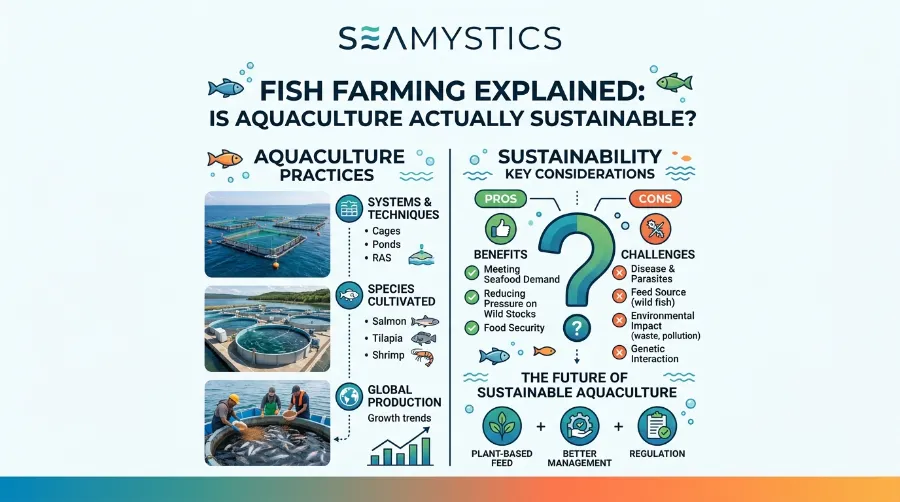
Today, aquaculture explained simply comes down to three broad systems:
- Open-net pens — cages floating in the open sea or a lake, exposed to natural currents
- Land-based ponds — the traditional method, still dominant for carp, tilapia, and shrimp
- Recirculating Aquaculture Systems (RAS) — closed, indoor tanks that filter and reuse water
Each system carries a completely different sustainability profile, which is exactly where most online debates go wrong by treating “fish farming” as one single thing.
How Big Is the Industry Right Now?
According to the UN Food and Agriculture Organization’s 2026 State of World Fisheries and Aquaculture report, the numbers are staggering:
- Global aquaculture production hit 103 million tonnes in 2024, officially more than wild capture fisheries
- Including farmed algae, total output was 141 million tonnes, valued at $391 billion
- Aquaculture now provides 59% of all aquatic animal food consumed worldwide
- The broader seafood trade rivals the global meat trade in value, at $184 billion
- More than 600 million people worldwide depend on the fisheries and aquaculture sector for their livelihood
For comparison, global aquaculture output was only around 30 million tonnes in 1990. That is roughly a 240% increase in production capacity in a little over three decades, driven almost entirely by Asia, which still produces roughly 90% of the world’s farmed fish.
Ocean Cleanup Technology: Do These Devices Actually Work?
Fish Farming Pros and Cons: The Honest Breakdown
Let’s get past the marketing language on both sides. Environmental groups sometimes paint all fish farms as toxic feedlots, and industry groups sometimes paint all fish farms as flawless climate solutions. Neither is accurate.
The Pros of Aquaculture
- Relieves pressure on wild stocks. Roughly 37.6% of wild fish stocks are now classified as overfished by the FAO. Aquaculture is the only realistic way to meet rising seafood demand without pushing that number higher.
- Lower carbon footprint than land meat. Farmed fish, particularly filter feeders like mussels and oysters, typically produce a fraction of the greenhouse gas emissions of beef per kilogram of protein.
- Reliable, traceable supply. Unlike wild catch, which fluctuates with weather and migration, farmed production can be planned, monitored, and, in the best operations, fully traced from hatchery to plate.
- Economic lifeline for coastal communities. In countries like Vietnam, aquaculture contributes a meaningful share of national GDP and supports jobs that traditional fishing can no longer sustain alone.
- Nutrition access. Farmed fish makes protein-rich seafood affordable and available in regions where wild catch would be too expensive or seasonal.
The Cons of Aquaculture
- Nutrient pollution. Uneaten feed and fish waste are rich in nitrogen and phosphorus. When they escape into surrounding water, they trigger algal blooms that can starve nearby ecosystems of oxygen, creating dead zones.
- Disease and parasite spread. Crowded open-net pens, especially in salmon farming, are notorious for sea lice outbreaks that can spread to wild salmon populations swimming nearby.
- The fish-in, fish-out problem. Carnivorous farmed species like salmon and shrimp are often fed fishmeal made from wild-caught forage fish, which means farming one species can still draw down another.
- Habitat conversion. Historically, shrimp farming in Southeast Asia and Latin America has destroyed large areas of mangrove forest, some of the most effective natural carbon sinks on the planet.
- Escapes and genetic mixing. Farmed fish that escape enclosures can interbreed with or outcompete wild populations, altering genetic diversity in ways scientists are still studying.
Aquaculture Environmental Impact: What the Data Actually Shows
Here is where nuance matters most. A well-run oyster farm and a poorly managed shrimp pond both fall under “aquaculture,” yet their environmental footprints are almost opposite.
| Farming Type | Typical Environmental Impact | Notes |
|---|---|---|
| Bivalves (oysters, mussels) | Net positive — filters water, no feed input needed | Considered one of the most sustainable protein sources on Earth |
| Seaweed/algae | Net positive — absorbs CO2 and nitrogen | Fastest-growing segment of aquaculture globally |
| Closed-system RAS salmon | Low — minimal water use, contained waste | Can cut water use by roughly 90% versus open pens |
| Open-net salmon pens | Moderate to high | Risk of sea lice, waste dispersal, and escapes |
| Intensive shrimp ponds | High, historically | Linked to mangrove loss in parts of Southeast Asia |
Intensive aquaculture as a whole is estimated to contribute around 10% of nitrogen pollution from global agriculture, which is a real cost that deserves acknowledgment rather than spin. At the same time, aquaculture’s carbon footprint averages roughly 0.7 kg of CO2 per kilogram of fish produced, compared to around 11 kg CO2 per kilogram for beef, so the climate comparison to land-based meat is genuinely favorable in most cases.
Microplastics Seafood Research: What the Data Actually Shows
So, Is Fish Farming Sustainable? The Real Answer
The honest, unhelpful-sounding answer is: it depends on which farm you mean. But that isn’t a cop-out, it’s the actual finding of every credible fisheries scientist working in this field, including researchers like Stanford’s Dr. Rosamond Naylor, who has spent years studying exactly this economic-biophysical-social intersection.
A more useful framework is to ask three questions about any farmed seafood product:
- What is it fed? Filter feeders and herbivorous species (tilapia, carp) score far better than carnivorous species dependent on wild fishmeal
- What system is it grown in? Closed or offshore systems consistently outperform crowded coastal net pens
- Is it certified? Third-party certification from bodies like the Aquaculture Stewardship Council (ASC) or Best Aquaculture Practices (BAP) means independent auditing, not just a company’s own marketing claim
Industry groups such as the National Aquaculture Association and technology-focused operators like Inve Aquaculture have both pushed toward exactly these kinds of measurable standards over the past decade, which is a meaningfully different posture than the industry had in the 1990s.
Ghost Fishing Gear: The Silent Ocean Killer Explained
What’s Actually Changing the Industry Right Now
A few real, dated shifts are worth knowing, because they show the direction of travel rather than a static snapshot:
- Offshore farming is expanding. Open Blue Sea Farms grows cobia in open ocean waters off Panama, using strong currents to continually flush waste away from the pens, a very different model from crowded coastal cages
- Feed formulas are shifting away from fishmeal. Since the mid-2000s, the amount of wild fish used per tonne of farmed fish has been declining as formulators substitute soy, maize, and insect-based proteins, even as total farmed output keeps climbing
- RAS technology is scaling up. Recirculating systems now account for around 15% of global salmon farming capacity and can reduce water use by roughly 90% compared to traditional open pens
- By-product recycling has grown. Processing offal and trimmings now account for roughly a third of fishmeal and over half of fish oil production, reducing the need to catch additional wild fish specifically for feed
These changes matter because they show the industry responding to legitimate criticism instead of ignoring it, though progress is uneven across regions and species.
Shark Finning Impact: Why This Practice Still Threatens Ocean Health
How to Choose More Sustainable Farmed Seafood
If you want the short, practical version of everything above, here is what actually helps at the grocery store or restaurant:
- Look for ASC, BAP, or MSC labels on packaging
- Favor bivalves and farmed seaweed when available; they’re near-universally sound choices
- Check the country of origin; countries with stronger regulatory frameworks (Norway, parts of the EU, the US) generally enforce stricter waste and disease standards
- Ask restaurants where their farmed fish comes from; transparency itself is a decent proxy for accountability
- Diversify your seafood choices rather than relying heavily on one high-demand species like Atlantic salmon or shrimp
Further reading worth trusting on this: the sourcing overview at Worldwide Aquaculture’s blog covers supply chain practices in more detail, and our own guide to choosing sustainable seafood walks through certification labels label by label.
Illegal Fishing Explained: How It Threatens Global Fish Stocks
FAQ: Aquaculture Sustainability Facts
Is farmed fish less nutritious than wild fish?
Not meaningfully. Farmed fish often has comparable or even higher omega-3 content depending on feed formulation, though wild fish can have a slightly different fat profile.
Which farmed fish is considered most sustainable?
Bivalves like oysters and mussels, along with farmed seaweed, are generally considered the gold standard because they require no feed input and can actually improve local water quality.
Does fish farming cause pollution?
It can, particularly in crowded open-net pen systems where waste and uneaten feed accumulate faster than the surrounding water can process it. Closed and offshore systems substantially reduce this risk.
Is salmon farming bad for wild salmon?
It can be, mainly through sea lice transmission and the risk of farmed fish escaping and interbreeding with wild populations. This is one of the most studied and debated issues in aquaculture science.
Will aquaculture keep growing?
Yes. The FAO projects continued growth through 2030 and beyond, since wild fisheries have essentially plateaued and cannot meet rising global seafood demand on their own.
Quick Quiz: Test What You Just Learned
- What percentage of global aquatic animal production now comes from aquaculture?
a) 25% b) 53% c) 80%
Answer: b) 53% - Which farmed species type generally has the lowest environmental impact?
a) Shrimp b) Salmon in open-net pens c) Bivalves like oysters and mussels
Answer: c) Bivalves like oysters and mussels - What does the “fish-in, fish-out” ratio measure?
a) How many fish escape a farm annually b) How much wild fish is used to feed farmed carnivorous fish c) Farm profitability
Answer: b) How much wild fish is used to feed farmed carnivorous fish - What technology can reduce water use in salmon farming by around 90%?
a) Recirculating Aquaculture Systems (RAS) b) Open-net pens c) Manual water changes
Answer: a) Recirculating Aquaculture Systems (RAS) - Roughly what share of wild fish stocks does the FAO classify as overfished?
a) 10% b) 37.6% c) 60%
Answer: b) 37.6%
Conclusion
Aquaculture sustainability facts don’t fit neatly into a single headline, and that’s actually the most important thing to understand about the industry. Fish farming has genuinely eased pressure on collapsing wild stocks and now feeds more people than ocean fishing ever could at this scale, but it carries real environmental costs that vary enormously by species, system, and country. The most useful thing you can do, whether you’re a shopper, a policymaker, or just curious, is stop asking “is aquaculture sustainable” as a yes-or-no question and start asking which farm, which fish, and which system. That distinction is where the real answer lives.
For more on how ocean ecosystems intersect with the seafood industry, explore our marine conservation hub and our breakdown of certification labels that actually mean something, or browse more reporting at seamystics.com.
References
- FAO, State of World Fisheries and Aquaculture (SOFIA) 2026
- National Aquaculture Association, Aquaculture Sustainability — https://www.nationalaquaculture.org/aquaculture-sustainability/
- Inve Aquaculture, Sustainability Overview — https://www.inveaquaculture.com/sustainability/
- Worldwide Aquaculture Blog — https://worldwideaquaculture.com/blog/
- Stanford SPICE, Introduction to Aquaculture: Pros and Cons of Fish Production
- Columbia Climate School, Making Fish Farming More Sustainable