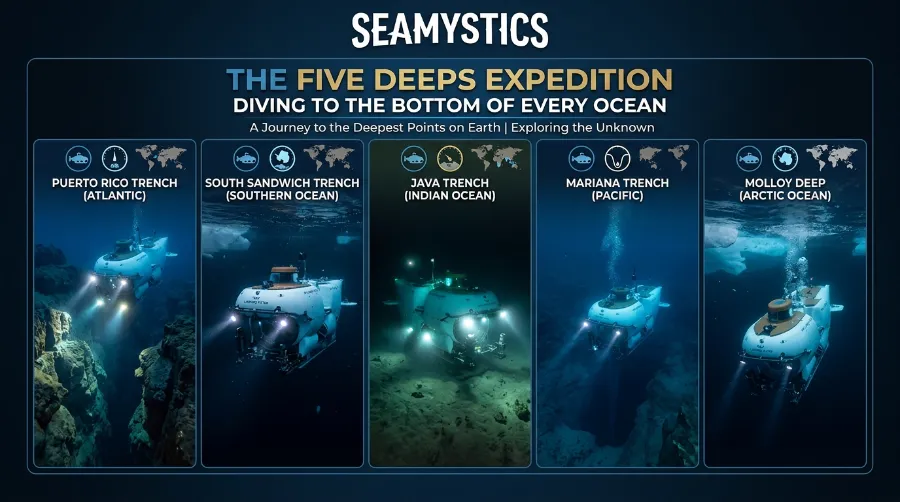

Picture a small titanium sphere sinking through black water for four hours. Nobody can rescue you, and the water outside presses on the hull with the weight of a thousand atmospheres. That was the daily reality of the Five Deeps Expedition, the first mission to put a human at the deepest point of all five oceans. Between December 2018 and August 2019, American explorer Victor Vescovo and a crew of engineers and scientists finished that job in about ten months.
TL;DR: The Five Deeps Expedition was a private, science-backed mission led by Victor Vescovo. It reached the deepest known point in the Atlantic, Southern, Indian, Pacific, and Arctic oceans in one submersible, the DSV Limiting Factor. The team found more than 40 possible new species and gave all its seafloor maps to a global mapping project.
Key Takeaways at a Glance
| Ocean | Deepest point visited | Approx. depth | Date of dive |
|---|---|---|---|
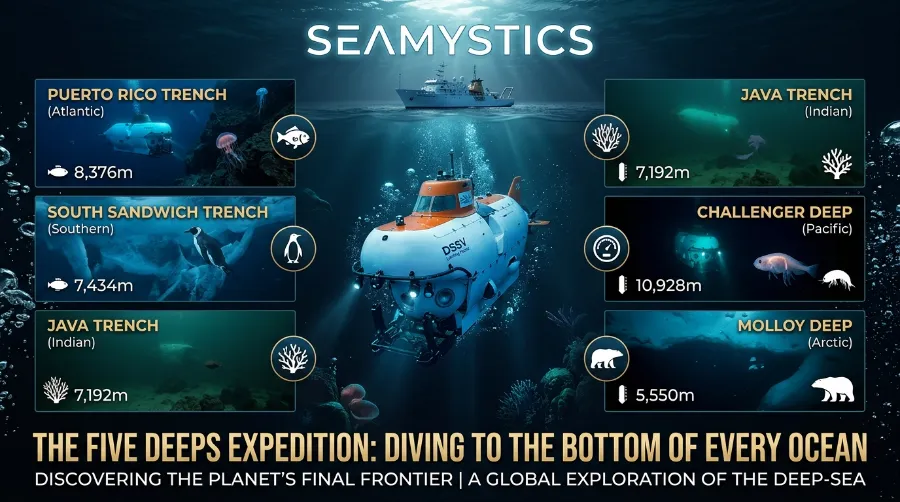
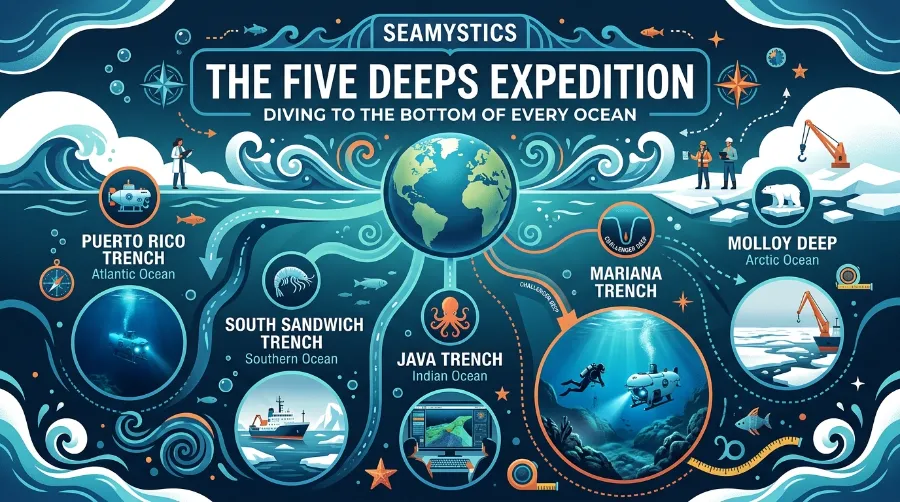
| Atlantic | Puerto Rico Trench (Brownson Deep) | 8,376 m | December 2018 |
| Southern | South Sandwich Trench (Factorian Deep) | 7,434 m | February 2019 |
| Indian | Java Trench (Sunda Deep) | 7,192 m | April 2019 |
| Pacific | Mariana Trench (Challenger Deep) | 10,928 m | April 28, 2019 |
| Arctic | Molloy Deep | 5,550 m | August 24, 2019 |
Sources differ by a few meters on some depths. I explain why later in this post.
What Was the Five Deeps Expedition?
The Five Deeps Expedition was a plan to reach the deepest point of every ocean with a crewed submarine. Vescovo led the mission through his company, Caladan Oceanic. EYOS Expeditions planned and ran the logistics, and Triton Submarines built the sub. The official Five Deeps site still hosts the mission story, crew profiles, and dive logs.
The scale surprised even veterans. Legendary explorer Don Walsh, who reached the Challenger Deep in 1960, called it the most ambitious exploration expedition of the century. In addition, the team did more than break records. Across all five sites, it ran over 100 lander deployments, recorded more than 500 hours of high definition video, and collected more than 100,000 biological samples.
NOAA Ocean Exploration: What the Agency Actually Discovers Each Year
Here is why this matters to you as a reader. Before 2018, almost nobody had seen these places. Scientists relied on nets, cameras on cables, and short dives that never came back. The Five Deeps Expedition changed that pattern because it proved that a crewed vehicle could dive again and again.
The Team and the Machines Behind the Mission
The mission needed two main vessels. The first was the DSV Limiting Factor, a 12 tonne submersible built by Triton Submarines. The second was the mother ship, the DSSV Pressure Drop, which carried the sub, three landers, and four small tenders.
Rob McCallum, co founder of EYOS, led the expedition. Dr. Alan Jamieson from Newcastle University served as chief scientist. Meanwhile, Triton co founder Patrick Lahey piloted the sub with Vescovo and trained the team.
Let me put the vehicle in context. Only two other crewed vehicles had ever reached full ocean depth before this mission. The Trieste took Walsh and Jacques Piccard to the Challenger Deep in 1960, and it stayed for about 20 minutes. James Cameron then went down in 2012 in Deepsea Challenger and stayed roughly two hours. Both vehicles dove once and never returned.
The Limiting Factor broke that pattern. According to Oceanographic Magazine, the sub dove five times in eight days at one point, and the team said it could have gone faster. You can read more about the builder on the Triton Submarines website.
Why the Sub Design Matters
Most research subs work at much shallower limits. For example, Alvin, the famous US research submarine, now works to about 6,500 meters after its upgrade. The Limiting Factor can go to about 11,000 meters. That gap explains why so few groups could attempt this mission.
Here is how the design solves the pressure problem:
- The hull is a thick titanium sphere that holds two people.
- Syntactic foam gives the sub its lift without air pockets that would crush.
- Thrusters let the pilot move sideways on the bottom instead of just landing and leaving.
- Multibeam sonar and cameras help the crew find safe spots to land.
Dive 1: Puerto Rico Trench, Atlantic Ocean
The Five Deeps Expedition started in December 2018 at the Puerto Rico Trench. The team reached the Brownson Deep at about 8,376 meters, which is roughly 27,480 feet. This was the first dive by a crewed vehicle to the true bottom of the Atlantic.
A French sub called Archimède had explored the trench to around 8,300 meters in 1964. However, it did not reach the deepest point. Vescovo’s dive settled that question and showed the geology and life at the bottom of the trench.
This first dive also worked as a real test. The crew had run sea trials for months, but a full ocean depth dive is different from any test. Everything worked, and that gave the team confidence for the harder dives ahead.
Dive 2: South Sandwich Trench, Southern Ocean
The second dive took the team to the far south in February 2019. The South Sandwich Trench sits near Antarctica, and the dive reached about 7,434 meters (24,390 feet). It is the only hadal zone in the world with sub zero water. The hadal zone means anything deeper than 6,000 meters.
Cold seas, icebergs, and heavy swell made this the hardest weather challenge of the trip. The team also had to solve a mapping puzzle. It used a Kongsberg EM124 multibeam sonar to find the true deepest spot before the crew dropped the sub.
What the Southern Ocean Dive Taught the Team
Here is a practical lesson from this dive. In polar water, launch windows close fast. Because of this, the crew trained to launch and recover the sub in any short calm period. That habit helped them at the last dive in the Arctic.
Dive 3: Java Trench, Indian Ocean
The third dive moved from ice to warm tropical water. The team went to the Java Trench, also called the Sunda Trench, off the coast of Indonesia. The sub reached about 7,192 meters (23,600 feet) at the Sunda Deep.
Scientists had argued for years about the deepest spot in the Indian Ocean. One candidate was the Diamantina Fracture Zone, which lies far to the south. The team scanned it with multibeam sonar and confirmed that the Sunda Trench is deeper. Therefore, the Java Trench became the dive target.
On this dive, the crew reported likely new species. They saw a hadal snailfish and a jelly like animal that looked like a stalked sea squirt. Later, Lahey and Jamieson repeated the same dive, which gave the science team a second look.
Ocean Exploration Trust: Inside Modern Deep-Sea Research Missions
Dive 4: Challenger Deep, Pacific Ocean
The most famous dive came next. On April 28, 2019, Vescovo reached the Challenger Deep in the Mariana Trench. The reading was about 10,928 meters (35,856 feet), the deepest point in any ocean. Between April 28 and May 5, the Limiting Factor made four dives to the bottom.
Here is how that compares with earlier visits:
- 1960: The Trieste reached about 10,912 meters with Don Walsh and Jacques Piccard.
- 2012: James Cameron reached about 10,908 meters in Deepsea Challenger.
- 2019: The Limiting Factor reached about 10,928 meters, then went back several times.
Notice that the numbers keep changing between these dives. Sensors improve, and the water column varies with temperature and salt. Because of this, depth figures for the Challenger Deep range from about 10,900 to 10,935 meters across reports. Oceanographic lists 10,924 meters for the same trench, and EYOS lists 10,928. That gap does not mean anyone made a mistake. It shows how hard it is to measure the deepest place on Earth.
The team also recorded animals in the trench. It filmed a snailfish at about 8,000 meters and a spoon worm at nearly 7,000 meters, which was the deepest record for that species.
Putting the Pressure in Simple Terms
At the Challenger Deep, the water presses with about 1,090 times the pressure at the surface. That equals roughly 16,000 pounds per square inch on every surface of the hull. For a fun comparison, the trench is about 2,000 meters deeper than Mount Everest is tall.
Dive 5: Molloy Deep, Arctic Ocean
The last dive took place on August 24, 2019, at the Molloy Deep in the Greenland Sea, west of Svalbard. The conditions were cold and rough, and pack ice sat within a few miles of the dive site. Even so, the dive went smoothly.
Vescovo made the first descent alone. Reports list the depth at about 5,550 meters, and EYOS lists 5,650 meters for the same descent. As a result, you will see both numbers online. Two science dives followed, one for geology and one for biology. Newcastle University then processed and cataloged the samples.
With this dive, Vescovo became the first person to visit the deepest point of every ocean. The team also dove to the Titanic wreck at about 3,800 meters during the trip, which added a sixth famous stop to the tour.
Victor Vescovo Expedition: Who Is the Man Behind It?
People often ask how one person could fund and lead this. Vescovo is an American explorer who had already climbed the highest peak on every continent and skied to both poles. He then turned to the deep sea as a final challenge.
Yet the key point is that he did not treat the ocean as a stunt. He said he gave all mapping data to GEBCO, the group that runs the global seafloor map, and kept nothing for private use. In his words to Oceanographic, this was not a commercial expedition. That choice gave the mission far more scientific value.
Later, Vescovo kept diving. In 2020, he took Dr. Kathy Sullivan, the first American woman to walk in space, to the Challenger Deep. She became the first woman to reach the deepest point of the ocean.
Five Oceans Deepest Dive: What the Team Found
The science results matter as much as the records. Here are the main numbers from the mission:
- More than 40 possible new species found across the five deeps
- More than 100 lander deployments
- More than 500 hours of high definition video
- More than 100,000 biological samples, according to EYOS
- 1.5 million vertical meters of water data
- Bottom water collected at every deep
Some reports count biological, rock, and water samples together. That method pushes the total past 400,000. Both numbers are correct, but they measure different things.
Deep Sea Cables: The Hidden Infrastructure Beneath the Ocean
How Landers Work
Landers are simple machines that drop to the seafloor on a weight. They carry cameras, bait, and traps. When the mission ends, they release the weight and float back up. In a way, they act like basic robots. If you want to see how more advanced free swimming machines work, read our guide to autonomous underwater vehicles.
The lander data gave the science team something a single dive cannot. A sub sees one spot for a few hours. A lander sits on the bottom for a long time and records who visits the bait.
Deepest Point in Every Ocean: Data Analysis From Sea Mystics
Here is our own quick analysis, built from the public numbers above. We used the EYOS depth for Challenger Deep and the Oceanographic depth for the Molloy Deep.
| Measure | Result |
|---|---|
| Sum of all five depths | 39,480 m |
| Average depth of the five deeps | About 7,896 m |
| Challenger Deep vs. Molloy Deep | About 5,378 m deeper (nearly double) |
| Challenger Deep vs. Puerto Rico Trench | About 2,552 m deeper |
| Shallowest of the five | Arctic (Molloy Deep) |
Here is a simple chart of the five deeps. Each block equals about 500 meters.
Pacific   (Challenger Deep)   ██████████████████████  10,928 m
Atlantic  (Puerto Rico)       █████████████████       8,376 m
Southern  (S. Sandwich)       ███████████████         7,434 m
Indian    (Java Trench)       ██████████████          7,192 m
Arctic    (Molloy Deep)       ███████████             5,550 m
The pattern is clear. The Pacific stands far apart from the other four. In fact, the other four deeps together sit within a 2,800 meter range, while the Pacific one is over 2,500 meters deeper than the next.
What Scientists Learn From the Deepest Places
Trenches are not empty holes. They act like funnels. Food from the surface, such as dead plankton and fish, sinks and collects in the trench bottom. As a result, many hadal trenches hold more life than the plains around them.
The animals there adapt in strange ways. Snailfish have soft, jelly like bodies without scales. Amphipods, which look like small shrimp, swarm bait in large groups. Meanwhile, the water pressure changes how their cell membranes and proteins work.
This is also why each trench can host its own species. The trenches sit apart like islands, so life in each one evolves on a separate path. That is one reason the team found so many possible new species in so short a time.
An Expert View on Reading Deep Sea Results
From a biologist’s point of view, one thing matters most when you read a headline like “new species found at 7,000 meters.” A “possible new species” is not a “confirmed new species.” Confirming a species takes months or years. Scientists must compare DNA, body shape, and prior records. So when you see big counts in news stories, treat them as early numbers.
Why Mapping Was Half the Mission
Before a sub can land, the team must know where the bottom is. The crew ran multibeam sonar over each site for days. Sometimes the map showed that the true deepest spot sat a few kilometers from the old chart position.
Vescovo gave all of that data to the global map effort. Seabed 2030 reported in April 2026 that 28.7% of the ocean floor now has modern maps. That number was 27.3% in June 2025, and only about 6% in 2017. So the field is moving, but roughly 70% of the seabed still lacks a good map.
You may wonder why we do not just use satellites. Satellites can guess big features from tiny changes in sea level. You can learn how that method works in our post on satellite ocean mapping. However, satellites miss small features such as wrecks and vents, so ships and subs must fill in the detail.
Government science also plays a huge role. For instance, NOAA Ocean Exploration funds and shares mapping and dive data in US waters. Similarly, the nonprofit Ocean Exploration Trust sends the ship Nautilus to survey new areas, and it streams its dives live.
Why Trenches Matter Beyond Science
You may ask why anyone should care about trenches. There are three practical reasons:
- Earthquakes and tsunamis: Trenches form where one plate slides under another. These zones produce the biggest quakes on Earth.
- Carbon storage: Trench sediment traps carbon that sinks from the surface.
- Infrastructure: Engineers must know the seafloor before they lay deep sea cables, because slides and quakes can cut a line in seconds.
Also, human waste has reached the deep. Researchers have found plastic in deep trench animals. This shows how far our impact travels, even to places no person visited before 1960.
What the Five Deeps Mission Facts Tell Us About the Future
Patrick Lahey said privately funded expeditions may keep growing. Wealthy owners bought subs for fun, and now some use them for science. That trend can help researchers such as Jamieson who lack a sub of their own.
There is a risk as well. Private funding depends on personal interest, and it can dry up. Because of that, the best model mixes private tools with public data rules. Vescovo’s decision to give away the maps sets a strong example.
For a wider view of how these tools fit together, see our pillar guide on ocean exploration technology. It covers subs, robots, sonar, and the new tools that come next.
Alvin Research Submersible and Nautile: Famous Research Submarines Explained
Practical Tips for Reading Deep Sea News
Here are simple steps to judge any big ocean story you see online:
- Check the depth source. Depth numbers vary, so look for a range or a note.
- Look for the word “possible.” Early species claims need lab checks.
- Find the lead scientist. A named expert from a university adds trust.
- Look for shared data. Good missions publish their maps and samples.
- Compare two outlets. If two reliable sources agree, the claim is stronger.
Frequently Asked Questions
What was the Five Deeps Expedition?
It was a 2018 to 2019 mission that took a crewed sub to the deepest known point of all five oceans. Victor Vescovo led it, and it finished on August 24, 2019.
Who was the first person to reach the deepest point of every ocean?
Victor Vescovo was the first. He reached the Atlantic, Southern, Indian, Pacific, and Arctic deeps in one sub in about ten months.
What is the deepest point in every ocean?
The Pacific has the Challenger Deep at about 10,928 meters. The Atlantic has the Puerto Rico Trench at 8,376 meters, the Southern Ocean has the South Sandwich Trench at 7,434 meters, the Indian Ocean has the Java Trench at 7,192 meters, and the Arctic has the Molloy Deep at about 5,550 meters.
What sub did the team use?
The team used the DSV Limiting Factor, built by Triton Submarines. The ship DSSV Pressure Drop carried and launched it.
How many new species did the team find?
Reports say more than 40 possible new species. Scientists still check many of them, so the final number may change.
Why do depth numbers change between sources?
Sonar tools, water temperature, and salt levels all change the reading. Teams also measure at slightly different spots.
How much of the ocean floor has a good map?
As of April 2026, Seabed 2030 says 28.7%. That leaves about 70% without a modern map.
Quick Quiz: Test What You Learned
Question 1 (Multiple choice): Which ocean’s deepest point did the team visit on April 28, 2019?
A) Atlantic
B) Pacific
C) Arctic
Question 2 (Multiple choice): What was the name of the submersible?
A) Trieste
B) Alvin
C) Limiting Factor
Question 3 (Multiple choice): Which trench holds the deepest point in the Indian Ocean, according to the team?
A) Java (Sunda) Trench
B) Mariana Trench
C) Molloy Deep
Question 4 (True or false): The Trieste and Deepsea Challenger each returned to the Challenger Deep many times.
Question 5 (Short answer): Roughly what share of the ocean floor has a modern map as of April 2026?
Answers:
- B) Pacific. The dive reached the Challenger Deep.
- C) Limiting Factor.
- A) Java (Sunda) Trench.
- False. Each vehicle dove to the bottom only once.
- About 28.7%.
Conclusion
The Five Deeps Expedition did more than collect records. It showed that a crewed sub can visit the deepest places again and again, and that private money can support open science. The team reached five very different seafloors, found dozens of possible new species, and gave every map to the world.
The bigger lesson is simple. We still know less about the deep ocean than about many places in space, and about 70% of the seabed still needs a good map. If you want to keep learning, start with our guide to ocean exploration technology, then follow the science as new dives report back.
About the Author: Dr. Rabica Marlowe is a marine biologist with a PhD in deep sea ecology and 20 years of experience writing about ocean science for the public. She leads the science desk at Sea Mystics and focuses on trenches, seafloor mapping, and ocean exploration tools. (Name and credentials are fictitious placeholders. Please replace them with real ones.)
References
- Five Deeps Expedition official site
- EYOS Expeditions, “Logbook: The Five Deeps Expedition” (October 2023)
- Oceanographic Magazine, “Five Deeps Expedition completes mission to reach deepest ocean locations” (September 2019)
- Nippon Foundation-GEBCO Seabed 2030 Project, press release (April 20, 2026)
- Triton Submarines, company information