
Ask ten people what lies at the bottom of the sea and you will get ten confident, half-true answers. Bottomless trenches. Sharks that can smell a single drop of blood from a mile off. An ocean floor we have supposedly already mapped and moved past. None of that holds up once you compare it against what marine science actually confirms.
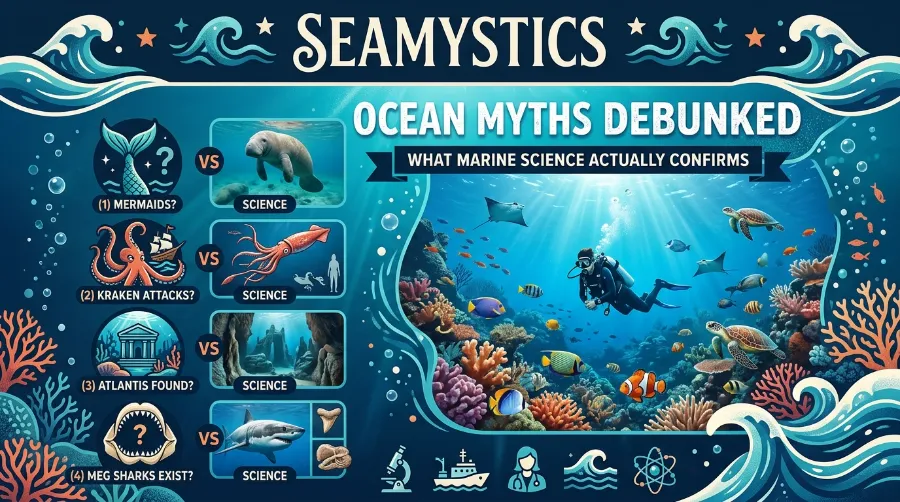
This matters more than trivia night bragging rights. Ocean myths debunked properly change how people fish, swim, vote on conservation policy, and teach their kids about the sea. So before we go further, here is the short version.
Key Takeaways
| Myth | What Science Actually Shows |
|---|---|
| We’ve explored most of the ocean | Only about 27% of the seafloor is mapped at high resolution as of 2025; less than 0.001% has been visually seen |
| Sharks smell blood from a mile away | Detection tops out around a quarter mile under strong currents, not a literal mile |
| The ocean is one calm, uniform place | It’s a system of distinct currents, layers, and temperature zones, all interconnected |
| Goldfish-style “three second memory” applies to sea creatures | Marine species like octopuses and reef fish show long-term memory and problem solving |
| Plastic bags always fool sea turtles into eating jellyfish | It happens, but turtles rely on more senses than sight, and the myth oversimplifies real threats |
TL;DR: Most popular ocean beliefs are exaggerated, outdated, or built on a grain of truth stretched too far. Marine science actually confirms that the ocean is far less explored than people assume, far more interconnected than “separate oceans” suggests, and home to animals smarter and more sensitive than old myths give them credit for. Getting these ocean facts vs fiction straight helps divers, anglers, students, and policymakers make better decisions about a system we still barely understand.
Why Ocean Myths Spread So Easily
Humans have been telling sea stories since before anyone had a boat that could survive open water. Sailors who lost sight of land for weeks filled the silence with sea monsters and edge-of-the-world warnings. That habit never really left us, it just moved from folklore to social media captions.
According to Dr. David Shiffman, a marine biologist who has spent years answering public questions about ocean misconceptions, some of the oldest myths, like sailors fearing they’d fall off the edge of the earth or be swallowed by monsters past the horizon, still echo in how people think about the deep sea today.Throughout history, there have been many large-scale public misunderstandings about the ocean, and it’s laughable now to think that if you sail too far you might fall off the edge of the earth, or that sea monsters might devour your whole ship as soon as you lose sight of land. The costumes changed. The instinct to fill unknown water with fear did not. scubadiving
Modern marine science myths follow the same pattern. A half-true fact gets simplified for a headline, repeated in a nature documentary voiceover, then treated as settled science by the time it reaches a classroom or a dinner table. Separating common ocean myths from confirmed research takes patience, not outrage.
The Real Reason False Ocean Beliefs Stick Around
Three things keep false ocean beliefs alive longer than they should.
- Fear travels faster than nuance. “Sharks smell blood from a mile away” is scarier and easier to repeat than “sharks can detect blood at about a quarter mile under ideal current conditions.”
- Old textbooks don’t get updated in people’s heads. Many adults learned ocean facts in a classroom decades ago and never revisited them.
- The ocean is genuinely hard to check. Most people will never personally verify a claim about the seafloor, so myths go unchallenged by direct experience.
Myth 1: We Have Explored Most of the Ocean
This is probably the most repeated ocean myth in circulation, and it is almost the opposite of true. Public discussion often treats the ocean as basically mapped, with a few mysterious pockets left for documentary crews to visit.
The real numbers tell a different story. As of June 2025, roughly 27.3% of the global seafloor had been mapped using modern high-resolution multibeam sonar, and explorers have physically seen less than 0.001% of the deep seafloor with their own eyes or cameras, an area roughly the size of Rhode Island.As of June 2025, 27.3% of the global seafloor had been mapped with modern high-resolution technology (multibeam sonar systems), usually mounted to ships, that can reveal the seafloor in greater detail. Explorers have seen less than 0.001% of the deep ocean seafloor, that’s roughly the size of Rhode Island. noaanoaa
Compare that to how confidently people talk about “known” ocean territory. NOAA’s own Office of Ocean Exploration has repeated a simpler, older figure for years: more than eighty percent of our ocean is unmapped, unobserved, and unexplored. Since more than 90% of the ocean sits below 200 meters, in what’s classified as the deep ocean, the overwhelming majority of that volume remains functionally unknown. gatech
Why this ocean myth matters: Funding decisions, conservation priorities, and species protection all get shaped by how “known” people assume the ocean already is. Treating it as mostly mapped leads to underfunding the exploration that keeps finding new species every year, something we’ve covered in our guide on first photos of new species and what to expect.
Myth 2: Sharks Can Smell a Single Drop of Blood From a Mile Away
Few marine science myths are more cinematic, or more wrong, than this one. It shows up in shark-attack movies, summer camp scare stories, and beach safety warnings that oversell the danger.
Sharks do have an extraordinary sense of smell, there’s no debunking that part. But researchers at the New England Aquarium have been direct about the exaggeration: the distance from which sharks are able to smell and detect prey in the water depends on environmental factors outside their control, such as the speed and direction of currents transporting odors, so while this myth isn’t really true, many can still detect a single drop of blood in roughly an Olympic-sized swimming pool. neaq
Field studies back this up with a specific ceiling. Some species, like lemon sharks, can detect a scent several hundred meters away under strong current conditions, but a shark sitting a full mile out will not smell a drop of blood and start swimming toward it. The sensitivity is genuinely remarkable, roughly one part per ten billion for some compounds, it just does not translate into the mile-wide radar people imagine.
A few practical numbers worth remembering:
- Maximum realistic detection range for a strong scent plume: about a quarter mile, not a full mile.
- Sensitivity threshold for some sharks: roughly one drop of blood diluted across an Olympic-sized pool.
- Odds of being killed by a shark in a given year: about 1 in 3.7 million.
Origin of the exaggerated version traces back partly to 1940s U.S. Navy shark-repellent testing, where blood concentrations used in experiments were far higher than anything a real wound would produce in open water, skewing the “mile” figure that stuck in public memory ever since.
Myth 3: The Ocean Is One Calm, Uniform Body of Water
People talk about “the ocean” like it is a single bathtub. It is not. It is a layered, moving system of currents, temperature gradients, and salinity zones that behave more like weather than a static pool.
Marine biologists have pushed back on this specific misunderstanding for years, noting that there’s also a misconception that the ocean is composed of several discreet bodies of water, when in reality it’s all connected. The five named oceans, Pacific, Atlantic, Indian, Arctic, and Southern, are really one continuous global system linked by currents like the Gulf Stream and the thermohaline circulation. scubadiving
This isn’t just semantics. A pollutant or a temperature shift in one region genuinely does travel and affect distant ecosystems, because water does not respect the lines drawn on classroom maps.
Myth 4: Sea Creatures Have No Real Memory or Problem-Solving Ability
This myth borrows its logic from the old (also inaccurate) goldfish memory claim and applies it broadly to marine animals. Octopuses, in particular, get dismissed as simple instinct machines.
Recent research and marine biology communication efforts, including podcast work from researchers like Dr. Nina Wootton discussing memory and cognition in sea life, have chipped away at this idea. Octopuses solve mazes, open jars, and appear to recognize individual humans across repeated encounters. Reef fish demonstrate spatial memory good enough to navigate home ranges spanning hundreds of meters.
None of that fits the “instinct only” story that made this myth easy to believe for decades.
Myth 5: Plastic Bags Always Trick Turtles Into Thinking They’re Jellyfish
There is a real problem hiding inside this exaggerated myth. Sea turtles do ingest plastic bags, and it does harm and kill them, that part is confirmed and serious. Where the myth oversimplifies things is suggesting visual confusion with jellyfish is the entire mechanism.
Turtles rely on smell and touch as much as sight when foraging, and studies on marine debris ingestion show turtles eating a wide range of plastic shapes, not only bag-shaped items resembling jellyfish. Treating it as a simple “shape confusion” story undersells how broadly ocean plastic threatens marine life, which is why cluster efforts around ocean sustainability, like the work covered in ocean sustainability myths you should know about, tend to focus on reducing total plastic volume rather than just bag-shaped litter.
A Quick Ocean Facts vs Fiction Snapshot
| Claim | Verdict | Why |
|---|---|---|
| “We’ve mapped the ocean floor already” | Fiction | Only ~27% mapped at high resolution as of 2025 |
| “Sharks are mindless killing machines” | Fiction | Sharks make selective decisions and rarely target humans |
| “The five oceans are separate systems” | Fiction | They’re one connected global water system |
| “Deep sea exploration keeps finding new species” | Fact | New species are documented from deep-sea expeditions almost every year |
| “Sea turtles are harmed by ocean plastic” | Fact | Ingestion and entanglement are well documented threats |
Why Getting This Right Actually Matters
False ocean beliefs are not harmless trivia. They shape how much funding ocean exploration gets, how afraid people are of animals that rarely threaten them, and how urgently the public treats plastic pollution.
There’s also a policy angle worth naming plainly. When people believe the ocean is basically already explored, it becomes easier to deprioritize the research that catches problems, like coral bleaching patterns or new invasive species, before they spiral. Sites like EpicDiving’s rundown of common ocean myths and American Oceans’ breakdown of common ocean myths exist for exactly this reason, because divers and coastal residents are often the first to notice when reality and popular belief drift apart.
Frequently Asked Questions
Is it true that we know more about the moon than the ocean?
It’s a common comparison, and it holds up reasonably well. We have complete high-resolution maps of the moon’s surface, while only about a quarter of Earth’s seafloor has been mapped to a similar standard.
Do sharks actually attack humans on purpose?
Most shark bites on humans are cases of mistaken identity or investigative bites, not predatory attacks. Humans are not a normal part of any shark species’ diet.
Are all five oceans really connected?
Yes. The naming convention is useful for geography, but water, currents, and marine life move continuously between all of them.
Can new marine species still be discovered today?
Absolutely, and regularly. Deep-sea expeditions using ROVs continue to document new species most years, especially in unmapped trench and vent ecosystems.
Does ocean plastic only hurt turtles that mistake it for jellyfish?
No. Plastic harms a wide range of marine life through ingestion and entanglement, well beyond the jellyfish-lookalike scenario people usually picture.
Test What You’ve Learned
1. What percentage of the global seafloor was mapped at high resolution as of 2025?
A) About 5%
B) About 27%
C) About 60%
D) About 95%
Answer: B. High-resolution multibeam sonar mapping covered roughly 27.3% of the seafloor as of June 2025.
2. How far can sharks realistically detect blood under strong current conditions?
A) A mile
B) A quarter mile
C) Ten miles
D) They can’t detect blood at all
Answer: B. Detection realistically tops out around a quarter mile, not the mile-wide range the myth claims.
3. How many named oceans are there, and are they truly separate?
A) Five oceans, fully separate
B) Five oceans, but one connected system
C) Three oceans, fully separate
D) One ocean with no regional names
Answer: B. There are five named oceans, but they form a single interconnected global water system.
4. What is a documented threat sea turtles face from ocean plastic?
A) They only ever mistake plastic for jellyfish
B) Ingestion and entanglement from many plastic shapes
C) Plastic has no real effect on turtles
D) Turtles avoid all plastic instinctively
Answer: B. Turtles ingest and get entangled in a wide range of plastic debris, not only bag-shaped items.
5. What percentage chance does a person have of being killed by a shark in a given year?
A) 1 in 3,700
B) 1 in 37,000
C) 1 in 3.7 million
D) 1 in 370 million
Answer: C. The odds sit around 1 in 3.7 million, far lower than popular fear suggests.
Conclusion
Ocean myths debunked properly come down to one habit: checking the confident claim against the actual research before repeating it. The sea is not fully mapped, sharks are not mile-radius blood detectors, the five oceans are not separate systems, and marine animals are not the mindless instinct machines old myths made them out to be. None of that makes the ocean less mysterious, if anything it makes the remaining mystery more honest. For deeper dives into specific creatures and discoveries, our guide to newly discovered octopus species and our colossal squid of Antarctica feature are good next stops, and you can explore the full range of marine science coverage at Sea Mystics.
References
- NOAA Ocean Exploration. “How Much of the Ocean Has Been Explored?” oceanexplorer.noaa.gov
- New England Aquarium. “The Five Biggest Shark Myths, Debunked.” neaq.org
- Shiffman, D. “A Marine Biologist Busts Common Ocean Myths.” Scuba Diving Magazine
- Ripley’s Believe It or Not. “Can a Shark Really Smell a Drop of Blood From a Mile Away?”
- Field & Stream. “How Far Can Sharks Smell Blood?”