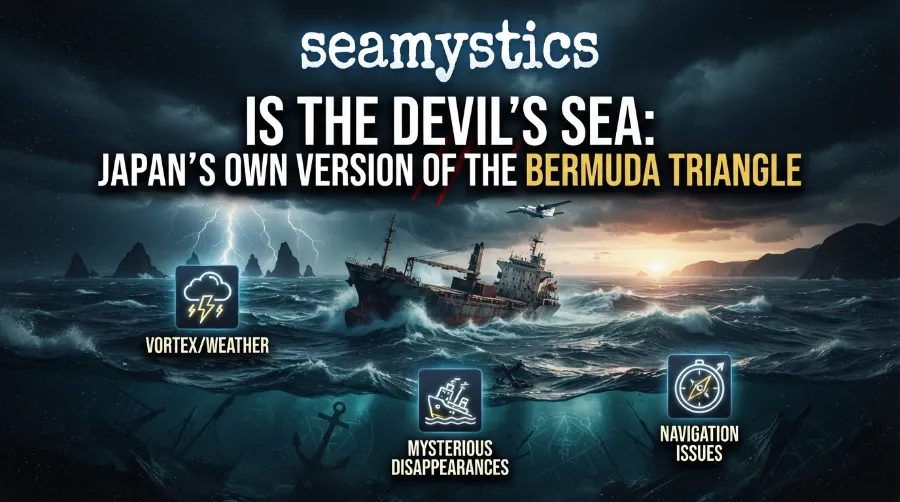

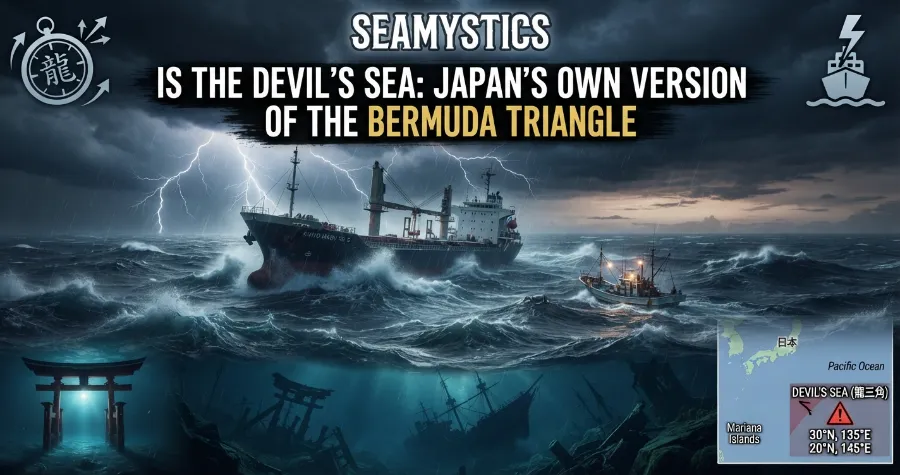
Most people know the Bermuda Triangle, but far fewer know the Devil’s Sea Japan story. It sits in the Pacific, south of Tokyo, and sailors have feared it for a long time. I have studied ocean hazards for years, and this place is a good lesson in how a real danger turns into a legend. In this guide, I will separate the facts from the fiction, and then show you a modern threat in the same waters that does far more harm than any monster.
TL;DR: The Devil’s Sea is a stretch of Pacific water near Miyake Island, and its fame comes mostly from one real event, the 1952 loss of the research ship Kaiyo Maru No. 5. Volcanoes, storms and rough weather explain the real losses better than any paranormal idea. The quiet killer in these waters today is ghost fishing gear.
Key Takeaways
| Question | Short answer |
|---|---|
| Where is it? | South of Tokyo, near Miyake Island and the Izu and Bonin islands |
| Japanese name | Ma no Umi (魔の海), meaning “Sea of the Devil” |
| Most famous event | Loss of Kaiyo Maru No. 5 on 24 September 1952 |
| Likely cause of that loss | An undersea volcano eruption at Myojin-sho |
| Who made it famous? | Writer Charles Berlitz, in 1974 and 1989 |
| Who questioned the story? | Researcher Larry Kusche, in 1975 |
| Bigger modern danger | Ghost nets and lost fishing gear |
What Is the Devil’s Sea Japan Legend?
The Devil’s Sea has no official borders. Because no world map plots the Dragon’s Triangle, each author draws its edges in a different place. Most versions put it near Miyake Island, about 100 kilometers south of Tokyo, and stretch it toward the Bonin Islands and Iwo Jima. Wikipedia
The area has many names. You will see it called the Dragon’s Triangle, the Formosa Triangle and the Pacific Bermuda Triangle. Wikipedia lists these names and notes that people sometimes treat the place as paranormal, though the claims are questioned. Wikipedia
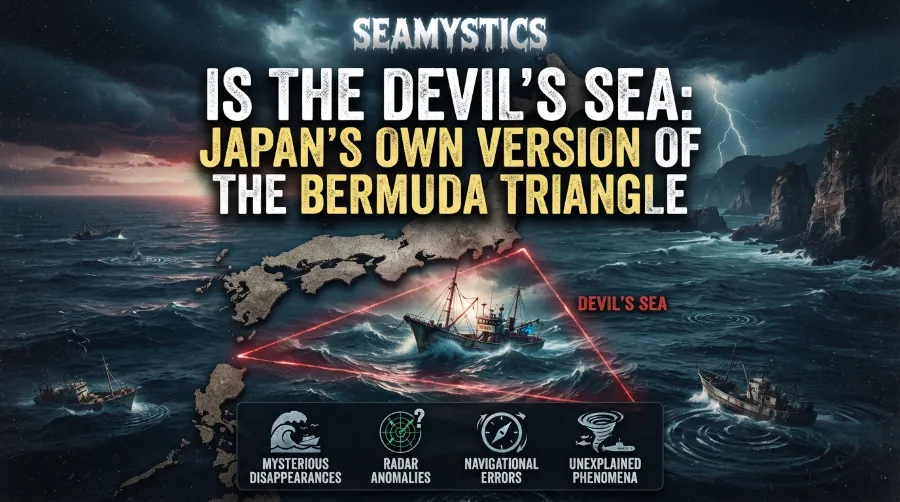
So why does it feel so scary? Part of the answer is the sea itself. The region sits on the Pacific Ring of Fire, where volcanoes and earthquakes are normal. One popular article describes underwater volcanoes that erupt without warning and islands that rise and sink again. That is not a ghost story. That is geology. skillsetmag
Unmapped Ocean Zones: Why Some Deep-Sea Areas Have Never Been Charted
If you want a fast overview from another writer, the Dragon Triangle summary on Pasión por el Mar covers the main legends in a short read. It also points out that Japanese people do not see these waters as more dangerous than other coastal areas of their country. pasionporelmar
Dragon’s Triangle Japan: Where the Name Comes From
The name “Dragon’s Triangle” is older than the modern disappearance stories. An old Chinese myth says dragons live deep under the surface, and their movement can stir up waves, whirlpools, fog and sudden storms. Sailors in many cultures explained rough water this way. A dragon was easier to picture than a pressure system. encyclopedia
Then the legend got a modern makeover. In 1974, Charles Berlitz wrote The Bermuda Triangle and included the Devil’s Sea in it. In 1989, he claimed the Devil’s Sea is also called the Dragon’s Triangle, in a book with that title. Since then, the two names have been used as if they mean the same thing. Wikipedia
Here is a simple way to see how the story grew:
- Old sea myths described dragons and storms.
- Japanese fishing boats were lost during the 1940s and 1950s, which was common at the time.
- In 1952, a research ship was lost near an erupting volcano.
- In the 1970s and 1980s, authors tied these events together and added paranormal ideas.
The Kaiyo Maru No. 5: The Case That Made the Legend
Every Devil’s Sea mystery article leans on one ship, so let me treat it like a case study. The Kaiyo Maru No. 5 was a Japanese research vessel. It was lost with all hands on 24 September 1952. Wikipedia
Here is what the paranormal version says. Berlitz wrote that Japan sent a big research crew to find out why ships were vanishing, and that this ship vanished too. His account claims the ship carried up to 100 scientists, and that Japan then labeled the area a danger zone. pasionporelmar
Here is what the record shows. The ship went to the Myojin-sho area to study an undersea volcano, and the volcano eruption accounts for the loss. Kusche found only 31 people on board, and some wreckage was recovered. One account says the island had sunk again when the ship arrived, then the volcano erupted just as the ship floated above the crater. Devil’s Sea +2
The Rogue Wave Phenomenon: Freak Ocean Waves Science Once Doubte
That is a sad story, but it is not a mystery. It is a research team that got too close to an active volcano.
My expert read on this case is simple. When a ship goes to study a hazard and the hazard hits it, the ship was not a random victim. It was in the right place for the wrong reason. If you remove the idea that the ship was “investigating disappearances,” the supernatural angle falls apart.
Berlitz vs. Kusche: Who Got the Facts Right?
This is the part many blogs skip, and it matters most. Two writers shaped what people believe about the Devil’s Sea, and they disagree.
Berlitz claimed that about 700 people died between 1952 and 1954. Kusche argued that the “military vessels” in that story were fishing boats, and that losing such boats near Japan was normal at the time. He published The Bermuda Triangle Mystery Solved in 1975, and he found that Japanese government offices did not know about any special Devil’s Sea danger. pasionporelmarWikipedia
Here is how the two views compare:
| Claim | Berlitz version | Kusche version |
|---|---|---|
| Ships lost | Several modern military ships | Mostly fishing boats |
| People lost | About 700 | Not supported by records |
| Kaiyo Maru crew | Up to 100 | 31 |
| Kaiyo Maru location | Vanished in the triangle | Destroyed by the Myojin-sho eruption |
| Official danger zone | Declared by Japan | No clear record found |
I trust the version with records behind it. A number like 700 sounds strong, but a number without a source is a rumor.
One more detail helps here. Two of the nine ships in the classic list were lost near Miyake Island and Iwo Jima, which sit about 750 miles apart. That is a very wide area to call one “triangle.” If you draw a big enough circle in a busy fishing zone, you will always find lost boats inside it. Wikipedia
Not every source agrees on every detail, either. One popular site gives the crew as 17, and others say 31. When numbers conflict like this, I go with the figure that appears in the more careful research, and I tell readers that the record is messy. You can see the American Oceans version in their Devil’s Sea fact page, which also lists the main scientific ideas in one place.
Sunken City Ruins: Real Underwater Cities Found Beneath the Sea
Devil’s Sea Mystery: The Real Scientific Explanations
Let me walk through the main natural causes. Each one is simple, and each one is well supported by what we know about this part of the Pacific.
Undersea volcanoes. The Ring of Fire runs right through this region. Eruptions can shake the water, throw up steam and gas, and build or erase small islands. The Myojin-sho case proves the risk is real.
Methane hydrates. These are ice-like blocks of gas on the seabed. When they break down, they can release large amounts of gas and disturb the water, and some researchers think this could even sink a ship. This idea is still debated, so I treat it as a possible factor and not a proven one. americanoceans
Currents and weather. The area sits where warm and cool currents meet, and it lies in the path of typhoons. Rough seas in a busy fishing zone lead to lost boats. americanoceans
Rogue waves. Very tall waves can hit without warning. Small fishing boats from the 1950s had little protection against them.
Human limits. In the early 1950s, many boats had weak radios, little weather data and basic navigation. Today, a ship with satellite tracking rarely vanishes without a signal.
You can think of it as a stack of normal risks sitting in one spot. None of them needs a paranormal story.
The Vile Vortices Idea
Some writers say the Devil’s Sea is one of twelve “vile vortices.” Biologist Ivan T. Sanderson and his group suggested that Earth has twelve zones of magnetic disturbance, and some of them could explain disappearances. As a scientist, I give this idea low weight. No strong measurements show a unique magnetic effect that sinks ships, and the pattern looks like a list drawn after the fact. pasionporelmar
Can Sound Clues Help Solve Ocean Mysteries?
Here is something I find useful in my own research habits. When people hear that a place is “mysterious,” I ask what the sensors say. Ocean sound is one of our best clues. Hydrophones pick up volcanoes, ice breaking and ship traffic from huge distances.
Strange sounds sometimes fuel legends too. For example, the Julia sound mystery shows how one odd recording can raise many wild ideas before the real source is found. Likewise, the Upsweep sound is a long, rising noise that scientists link to volcanic activity on the Pacific seafloor. Both cases show the same pattern we see in the Devil’s Sea: a real natural process first, a legend second.
Other sound stories work the same way. Read about the slow down sound and the train sound in Antarctica to see how a puzzling noise can have a plain explanation.
Why Mapping the Seafloor Matters
In 1952, the crew of the Kaiyo Maru had very little data on what sat below them. Today, we have much better tools, and good maps change the story. If you want a deeper look at how scientists chart the deep, start with our pillar guide on ocean floor mapping.
Here is why that matters for the Devil’s Sea:
- Sonar can find submarine volcanoes before ships reach them.
- Satellites track sea surface changes and storms.
- Ship tracking systems record routes and last known positions.
- Seafloor surveys show where gas vents and hydrates may sit.
So the same waters that once felt unknowable now have far more data. When a mystery shrinks as the maps get better, that tells you something.
Japan Sea Disappearances: Putting the Numbers in Context
People often ask how dangerous the Devil’s Sea really is. The honest answer is that it is a busy, stormy, volcanic zone, and that is all. Compare it with the story you hear online:
| Topic | Legend version | Evidence-based view |
|---|---|---|
| Area boundaries | Fixed triangle | No official map; authors disagree |
| Cause of losses | Paranormal | Volcanoes, storms, small boats |
| Kaiyo Maru | Mysterious vanishing | Eruption at Myojin-sho |
| Official status | Danger zone | No clear official record |
| Today’s danger | Monsters and portals | Weather, volcanoes, lost gear |
Also keep this in mind: fishing was a huge activity in these waters in the 1950s. More boats at sea means more boats lost, especially when typhoons hit. A count of lost ships means little unless you also count how many ships were sailing.
Pacific Triangle Mystery: Other Ideas People Raise
Writers have linked the Devil’s Sea to many other themes. Let me look at three popular ones and tell you where I land.
Nuclear testing. The Pacific saw heavy nuclear testing in the 1940s and 1950s. Some readers connect that era to strange events at sea. I treat it as a separate story with real, documented harm, and you can read more in our guide on ocean nuclear testing.
Sunken ruins. Japan has underwater structures near Yonaguni that spark debate about lost cities. The topic is exciting, but the Yonaguni site is far from the main Devil’s Sea area, and scientists still argue over whether the shapes are natural or man made. Our article on sunken city ruins walks through that debate.
Aliens and portals. Berlitz claimed the Devil’s Sea is a gateway to another dimension and that disappearances come from extraterrestrial activity. No evidence supports this. I include it only so you know where the idea came from. americanoceans
Ghost Nets: The Silent Killers Drifting Through the Deep Ocean
Now for the part I care about most as a marine biologist. If you want a real threat in the Pacific, forget the dragons. Look at fishing gear.
Ghost nets are fishing nets, lines and traps that people lose or leave behind. They keep catching animals long after the fishermen have gone. Estimates say about 640,000 tonnes of this gear enter the ocean each year. That is more than a tonne every minute. worldanimalprotection
Here is what makes them so deadly:
- They last a long time. Most are plastic, with a life span of up to 600 years. worldanimalprotection
- They keep fishing. Animals get tangled, cannot surface or cannot feed, and die slowly.
- They travel. Currents carry them far from where they were lost.
- They break into microplastics. Over the decades, they break into small particles that cause more problems. oceansaware
The harm to animals is large. Ghost gear traps, injures or kills more than 136,000 seals, sea lions and small whales each year. It affects turtles, seabirds, sharks and fish too. One report says more than 817 species are affected by this kind of marine litter. worldanimalprotectionworldanimalprotection
How Much Gear Gets Lost?
A 2019 study estimated that each year, about 5.7% of all nets, 8.6% of traps and 29% of lines are lost around the world. Here is that as a table: oceansaware
| Gear type | Estimated share lost each year |
|---|---|
| Fishing nets | 5.7% |
| Traps | 8.6% |
| Fishing lines | 29% |
I want to add one honest note. The 640,000 tonne figure is widely used, but it is an older estimate, and researchers keep refining it. Treat it as a strong sign of scale, not an exact count.
Why Ghost Nets Matter in Typhoon Waters
Here is my analysis for this region. Storms are the main cause of gear loss in many fisheries, and typhoons hit the western Pacific every year. A busy fishing zone plus frequent storms plus volcanic seabeds where gear snags and tears is a recipe for lost gear. The Devil’s Sea has all three.
So I would say this: if a fishing boat gets in trouble today near these waters, the sea state is a bigger worry than any legend. But the long term harm to marine life comes from what stays behind after boats leave.
What Is Being Done About It
There are real solutions, and they work:
- Global partnerships. World Animal Protection launched the Global Ghost Gear Initiative in 2015 to reduce ghost gear. You can learn more on the World Animal Protection ghost gear page. worldanimalprotection
- Gear marking. Tags on nets help track owners and cut illegal fishing.
- Retrieval programs. Teams of divers and boats pull nets from reefs and wrecks.
- Recycling. Old nets can become new products instead of waste.
If you live near the coast, you can help too. Support local cleanups, choose seafood from fisheries with gear loss rules, and report entangled animals to local wildlife groups.
AI Overviews and Quick Answers: What Is the Devil’s Sea in One Paragraph?
Here is a clear answer you can quote. The Devil’s Sea, or Ma no Umi, is an unmarked area of the Pacific south of Tokyo, near Miyake Island. It became famous after the research ship Kaiyo Maru No. 5 was lost in September 1952, most likely to an eruption at the Myojin-sho volcano. Later authors added paranormal claims, but volcanic activity, storms and small fishing boats explain the real losses.
My Verdict on the Devil’s Sea Japan Mystery
As a marine biologist, I read these stories the way I read field data. I ask where the numbers come from, who checked them and what simpler cause fits. Here is my honest ranking of ideas, from most to least likely:
- Volcanoes and storms
- Weak ships and weak communication in the 1950s
- Gas hydrate events (possible, not proven)
- Magnetic or “vortex” ideas (unproven)
- Paranormal ideas (no evidence)
If you want to go deeper into why some ocean stories grow bigger than the facts, I suggest comparing the Devil’s Sea with other cases, such as the Bermuda Triangle. You will see the same pattern each time: a real hazard, a few sad events, a bold book, and a legend.
Frequently Asked Questions
Is the Devil’s Sea real?
Yes, the place is real, and Japanese sailors call it Ma no Umi. But its borders are not official, and the “triangle” shape comes from writers, not from maps used by governments.
Where is the Devil’s Sea Japan area?
It sits in the Pacific, south of Tokyo, around Miyake Island. Many versions extend it toward the Bonin Islands and Iwo Jima.
Is the Devil’s Sea the same as the Dragon’s Triangle?
Mostly yes. Writers use both names for the same legend, though the exact edges differ from one author to the next.
What happened to the Kaiyo Maru No. 5?
The research ship was lost in September 1952 while studying an undersea volcano near Myojin-sho. The eruption is the accepted explanation.
Is it dangerous to sail there today?
It has volcanoes, typhoons and rough seas, like much of the western Pacific. Modern ships with weather data and satellite tracking face far less risk than boats did in the 1950s.
What are ghost nets?
Ghost nets are lost or abandoned fishing gear that keeps trapping marine animals. They can last for hundreds of years in the sea.
Why is the Devil’s Sea compared to the Bermuda Triangle?
Charles Berlitz put them in the same book and used the same style of story. Both places also have heavy ship traffic and strong weather.
Quick Quiz: Test What You Learned
1. What does Ma no Umi mean?
a) Sea of Dragons
b) Sea of the Devil
c) Sea of Storms
2. When was the Kaiyo Maru No. 5 lost?
a) 1944
b) 1952
c) 1974
3. What most likely caused its loss?
a) An alien event
b) A magnetic vortex
c) An undersea volcano eruption
4. Who wrote The Bermuda Triangle Mystery Solved in 1975?
a) Charles Berlitz
b) Larry Kusche
c) Ivan Sanderson
5. About how much fishing gear is thought to enter the ocean each year as ghost gear?
a) 640,000 tonnes
b) 64 tonnes
c) 6 million tonnes
Answers: 1) b, 2) b, 3) c, 4) b, 5) a
Conclusion
The Devil’s Sea Japan story is a great example of how one real tragedy can grow into a global legend. The Kaiyo Maru was lost near an erupting volcano, and the rest of the story came later from bold books and loose numbers. The waters are rough and volcanic, but they are not magical.
The real lesson is bigger than one ship. Ocean hazards are real, but human activity often does more lasting harm, and ghost nets prove it. If this guide helped you, share it, and take a look at our Sea Mystics homepage for more ocean mysteries that have real answers.
References
- Wikipedia, “Devil’s Sea”
- American Oceans, “The Devil’s Sea”
- Pasión por el Mar, “Have you ever heard about the Devil’s Sea? Discover the Dragon Triangle mysterious theories” (25 July 2025)
- All That’s Interesting, “The Mystery of the Dragon’s Triangle”
- Encyclopedia.com, “Japan’s Dragon’s Triangle” (Gale Encyclopedia of the Unusual and Unexplained)
- World Animal Protection, “Ghost gear” and Global Ghost Gear Initiative materials
- Oceans Aware, “Marine pollution: ghost gear” (citing the 2019 gear loss rate meta-analysis)
- Kusche, L., The Bermuda Triangle Mystery Solved (1975)
- Berlitz, C., The Bermuda Triangle (1974) and The Dragon’s Triangle (1989)