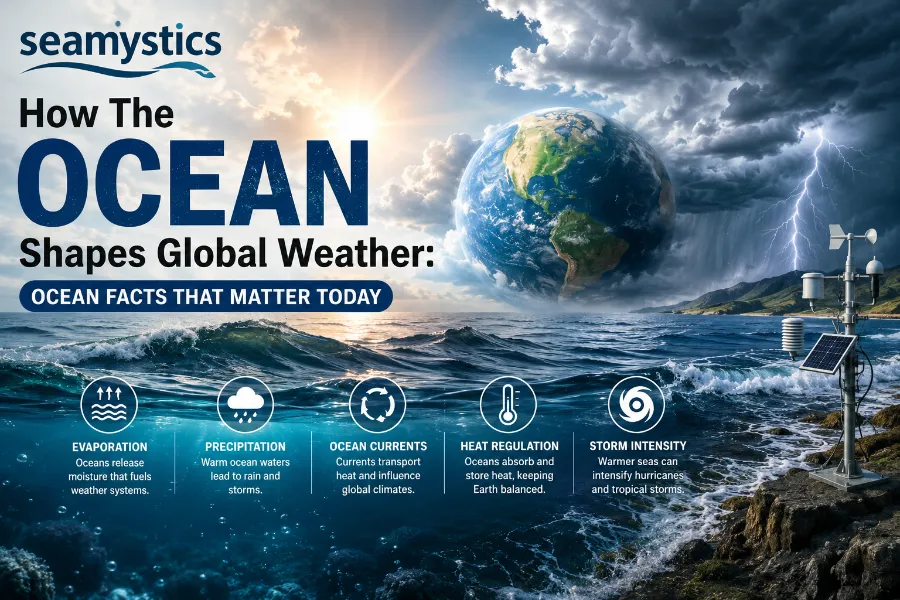

Have you ever wondered why a storm forming thousands of miles away can flood your street? The answer lies beneath the waves. How the ocean shapes global weather is one of the biggest stories in climate science today, and most people never hear about it. The ocean covers over 70 percent of our planet, and it works like a giant engine that moves heat, moisture, and energy across the globe every single day. Once you understand a few basic ocean facts, weather patterns start to make a lot more sense.
This connection is not just a fun fact for science class. It affects your grocery bills, your travel plans, and even where you can safely build a home. Because the ocean absorbs and releases so much energy, small shifts in sea temperature can trigger massive changes in rainfall, storms, and drought thousands of miles inland. Below, we break down exactly how this works, backed by the latest research and real numbers.
Key Takeaways
| Fact | What It Means |
|---|---|
| Oceans absorb over 90% of excess heat from greenhouse gases | The ocean is the planet’s main heat storage system |
| Global ocean heat content hit a new record in 2025 (23 zettajoules higher than 2024) | Warmer oceans fuel stronger storms and heavier rain |
| 2025 was the third warmest year on record globally | Ocean warmth directly raises air temperatures |
| Hurricane Melissa (2025) intensified rapidly over warm Atlantic waters | Warm oceans can turn small storms into major disasters fast |
| Ocean currents like the Gulf Stream move heat across entire continents | Currents keep places like Europe warmer than they should be |
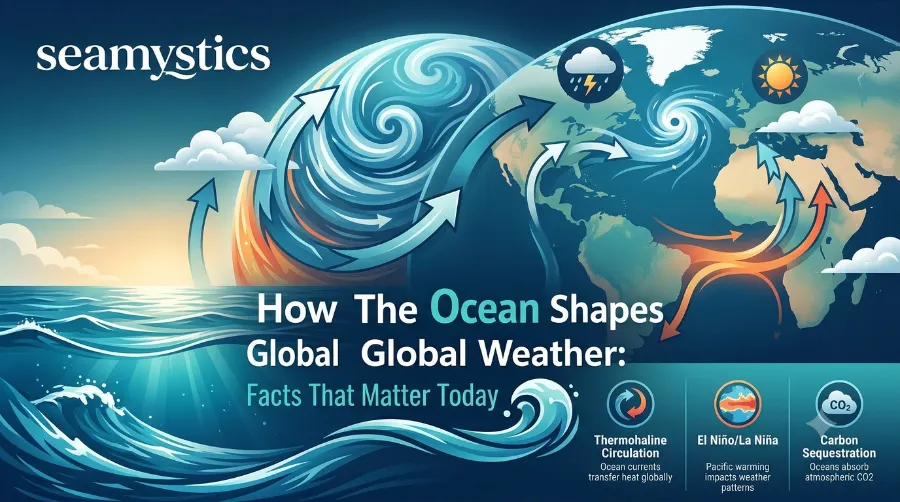
| El Niño and La Niña cycles shift rainfall patterns worldwide | Ocean temperature swings can cause floods in one region and drought in another |
What Is the Ocean-Weather Connection?
The relationship between the sea and the sky is simple once you break it down. Water absorbs heat from the sun much slower than land, but it also holds onto that heat far longer. As a result, oceans act like a massive battery, storing energy during the day and releasing it slowly over time.
This stored heat does not stay in one place. Warm water evaporates into the air, forming clouds and eventually rain or snow. Meanwhile, cooler ocean currents pull heat away from tropical regions and send it toward the poles. This constant exchange is what drives many of the weather patterns we experience on land, and it is one of the most fascinating amazing ocean facts most people overlook.
Why Ocean Facts Matter More Than You Think
Understanding basic ocean facts helps explain events that otherwise seem random. For instance, why does the United Kingdom stay relatively mild despite sitting at a similar latitude to freezing parts of Canada? The answer is warm ocean currents, not luck. Similarly, farmers in the Midwest United States depend on moisture that travels from the Gulf of Mexico, carried inland by wind patterns shaped by ocean temperature.
How Ocean Currents Move Heat Around the Planet
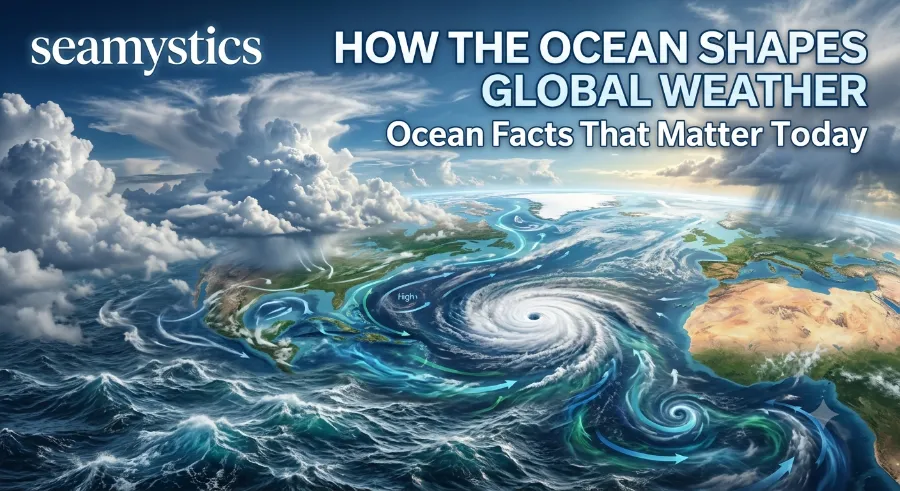
Ocean currents work like conveyor belts, and they never stop moving. Warm water from the equator travels toward the poles, while cold water sinks and flows back toward the tropics. This is often called the global conveyor belt, and it takes roughly 1,000 years to complete one full cycle.
The Gulf Stream is perhaps the most famous example. It carries warm water from the Gulf of Mexico across the Atlantic Ocean toward Western Europe. Because of this current, cities like London and Paris enjoy milder winters than cities at the same latitude in North America, such as Montreal. If you want to understand the forces behind this movement in more detail, check out this breakdown of what actually drives ocean currents.
The Domino Effect of Ocean Heat
When ocean currents shift even slightly, the effects ripple across continents. Scientists have tracked this pattern for decades, and recent data confirms it is accelerating. According to a peer-reviewed study published in early 2026, global ocean heat content in the upper 2,000 meters rose by roughly 23 zettajoules in 2025 compared to the year before, marking the ninth year in a row that this record was broken.
That number might sound abstract, but here is a simple way to picture it. A zettajoule is equal to a sextillion joules of energy, which is more power than humans use worldwide in an entire year. Therefore, when scientists say the ocean absorbed 23 extra zettajoules in one year, they are describing an almost unimaginable amount of stored heat now shaping our skies.
Ocean Temperature and Extreme Storms
Warmer oceans do not just sit quietly. They actively fuel hurricanes, typhoons, and heavy rainstorms. Hurricanes need warm water, generally above 26.5 degrees Celsius (about 80 degrees Fahrenheit), to form and grow strong. As ocean surface temperatures rise, storms have more fuel to work with.
A clear real-world example happened in 2025. Hurricane Melissa rapidly intensified over unusually warm Atlantic waters before striking Jamaica and Cuba, causing widespread damage. Scientists pointed directly to record ocean heat as a major factor behind the storm’s rapid strengthening. This is not an isolated case either; heavy monsoon rains in Pakistan and severe flooding across the Central Mississippi Valley in the same year were also linked to the same pattern of ocean-driven moisture and heat.
2025 Ocean and Weather Snapshot
| Metric | 2025 Value | Comparison |
|---|---|---|
| Global ocean heat content increase | +23 zettajoules | Highest on record, 9th straight record year |
| Global average sea surface temperature | 0.5°C above 1981–2010 average | Third warmest on record |
| Global surface temperature | 1.17°C above 20th-century average | Third warmest year overall |
| Named tropical storms worldwide | 101 storms | Above the long-term average |
| Arctic sea ice extent | Second lowest on record | Only 2020 was lower |
These numbers come directly from recent NOAA and peer-reviewed climate assessments, and they paint a clear picture. As ocean heat climbs, storm activity and extreme weather tend to follow closely behind.
El Niño, La Niña, and the Ocean’s Mood Swings
Beyond long-term warming, the ocean also goes through natural short-term cycles that shake up weather worldwide. The two most well-known are El Niño and La Niña, both centered in the Pacific Ocean.
During El Niño, surface waters in the central and eastern Pacific warm up more than usual. This shifts rainfall patterns, often bringing:
- Heavier rains and flooding to parts of South America and the southern United States
- Drier, warmer conditions across parts of Southeast Asia and Australia
- Weaker hurricane activity in the Atlantic, but stronger activity in the Pacific
La Niña does the opposite. Cooler than average Pacific waters tend to bring drought to South America while often fueling a more active Atlantic hurricane season. In 2025, the climate system shifted toward La Niña conditions after several years of El Niño, and scientists are already watching closely for the ripple effects across 2026 weather patterns.
Deeper Ocean Facts That Shape Our Climate
Weather is not only influenced by surface temperature. Several deeper ocean properties play a quiet but powerful role behind the scenes.
- Salinity and density drive circulation. Saltier, denser water sinks, helping power the global conveyor belt described earlier. You can learn more about why the sea holds so much salt in this guide to why the ocean tastes salty.
- Depth affects temperature layers. Deeper water stays colder and moves more slowly, which affects how heat is distributed over time. This is explained further in our piece on how ocean depth affects temperature.
- Tides interact with coastal weather. Tidal patterns influence coastal flooding risk during storms, especially when a high tide lines up with a hurricane’s arrival. For a full breakdown, see our guide on tides explained through ocean science.
Even the ocean’s true depth plays a role in how much heat it can store over time, which you can explore in our article on the true depth of the ocean explained. Meanwhile, the reason the sea appears blue is tied to how sunlight interacts with water, a topic covered in the real reason the ocean is blue.
Why This Should Matter to You
Ocean-driven weather is not a distant problem confined to coastlines. It touches everyday life across the United States and Europe in ways that are easy to miss.
- Farmers rely on ocean-driven rainfall patterns to plan planting seasons.
- Insurance costs in coastal cities often rise after major ocean-fueled storms.
- Airlines and shipping companies adjust routes based on ocean and storm forecasts.
- Energy grids face added strain during ocean-linked heatwaves and cold snaps.
Because the ocean covers so much of the Earth, and because scientists have only mapped a small fraction of it in detail, there is still a lot left to learn. In fact, you can read more about how much of the sea remains a mystery in our article on the percentage of ocean still unexplored.
How Scientists Track These Changes
Researchers use a mix of tools to monitor ocean-weather connections, and the technology has improved significantly over the past decade. Satellites measure sea surface temperature from space, while a global fleet of over 3,000 robotic Argo floats drift through the ocean recording temperature and salinity data every ten days. This data feeds directly into climate models used by agencies like NOAA and the Copernicus Climate Change Service in Europe.
According to Columbia University’s Earth Institute, the ocean plays a central role in driving both everyday weather and extreme climate events, acting as a buffer that absorbs heat and later releases it in ways that intensify storms and rainfall. This detailed research from Columbia Climate School confirms what oceanographers have suspected for years: the sea is not a passive backdrop to weather, it is an active driver of it. Similarly, ocean science education groups such as the National Ocean Sciences Bowl highlight how shifting sea temperatures reshape rainfall and storm patterns across entire continents, reinforcing just how connected these systems truly are. Springer
Frequently Asked Questions
Does the ocean really control the weather, or just influence it?
The ocean does not control weather directly, but it heavily influences it. Because oceans store and release such large amounts of heat, they shape wind patterns, rainfall, and storm intensity across the entire planet.
Why do hurricanes get stronger over warm water?
Warm ocean water evaporates faster, feeding more moisture and energy into storm systems. This is why hurricanes often weaken quickly once they move over land or cooler water.
What is the difference between El Niño and La Niña?
El Niño involves warmer than average Pacific Ocean surface temperatures, while La Niña involves cooler than average temperatures. Both shift global rainfall and storm patterns in opposite directions.
Is ocean warming a new phenomenon?
No, ocean warming has been tracked since the 1950s, but the pace has increased sharply since the 1990s. Recent data shows the ocean has now set a heat record for nine consecutive years.
How does ocean depth relate to global weather patterns?
Deeper water holds and moves heat more slowly than surface water, creating long-term climate stability. However, when deep ocean layers absorb extra heat over time, it changes how much energy is eventually released back into the atmosphere.
Conclusion
The ocean is far more than a scenic backdrop or a source of seafood and vacations. It is one of the most powerful forces shaping the weather we experience every single day, from gentle summer rain to devastating hurricanes. As global ocean heat continues breaking records year after year, understanding this connection becomes more important, not less. The more we learn about how the ocean shapes global weather, the better prepared communities across the United States and Europe can become for what lies ahead. For more fascinating ocean facts and deep dives into how our seas work, explore the full collection at Sea Mystics.
References
- Columbia Climate School, “How Does the Ocean Drive Weather and Climate Extremes?” https://news.climate.columbia.edu/2016/08/30/how-does-the-ocean-drive-weather-and-climate-extremes/
- National Ocean Sciences Bowl, “Oceans Shaping Weather” https://nosb.org/portfolio-items/oceans-shaping-weather/
- NOAA National Centers for Environmental Information, “Assessing the Global Temperature and Precipitation Analysis in 2025” https://www.ncei.noaa.gov/news/global-climate-202513
- Pan, Y., Cheng, L., Abraham, J. et al. “Ocean Heat Content Sets Another Record in 2025,” Advances in Atmospheric Sciences (2026)
- Eos, “In 2025, the Ocean Stored a Record-Breaking Amount of Heat, Again” https://eos.org/research-and-developments/in-2025-the-ocean-stored-more-heat-than-weve-ever-recorded