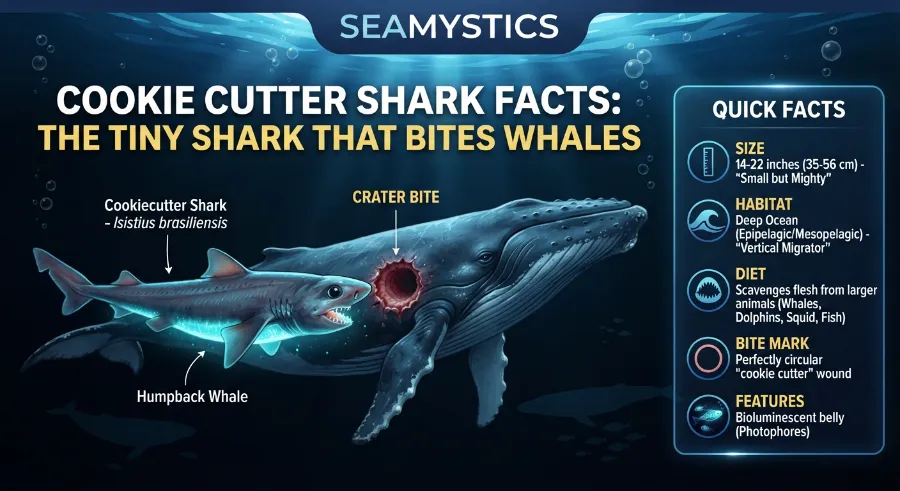

Some sharks scare people because of their size. The cookiecutter shark does it with a mouth shaped like a cookie cutter. This animal grows to about 20 inches long, yet it takes round plugs of flesh from tuna, dolphins, seals, and even whales. These cookiecutter shark facts explain how such a small fish became one of the strangest hunters in the open ocean. I’m Dr. Rabica, and I have spent years reading bite scars on marine mammals, so I want to show you what the science really says.
TL;DR: The cookiecutter shark (Isistius brasiliensis) is a small, glowing deep-sea shark. It rises at night, latches onto larger animals with its suction lips, and twists out a round chunk of flesh. It is not a serious danger to people, but its bite leaves scars that scientists use to track whales and dolphins.
Key Takeaways
| Topic | Quick answer |
|---|---|
| Scientific name | Isistius brasiliensis |
| Adult size | About 14 to 22 inches (35 to 56 cm) |
| Habitat | Warm open oceans worldwide, usually near islands |
| Depth pattern | Deep by day, near the surface at night |
| Bite shape | Round wound, about 2 inches wide |
| Main prey | Tuna, marlin, dolphins, seals, squid, whales |
| Danger to humans | Very low, a few rare bites reported |
| Conservation status | Least Concern (IUCN) |
What Makes These Cookiecutter Shark Facts So Strange?
Most sharks bite off what they can and swallow it. The cookiecutter shark works differently. It acts like a parasite and a predator at the same time. Scientists call this style micropredation, because the shark takes a small piece and leaves the victim alive.
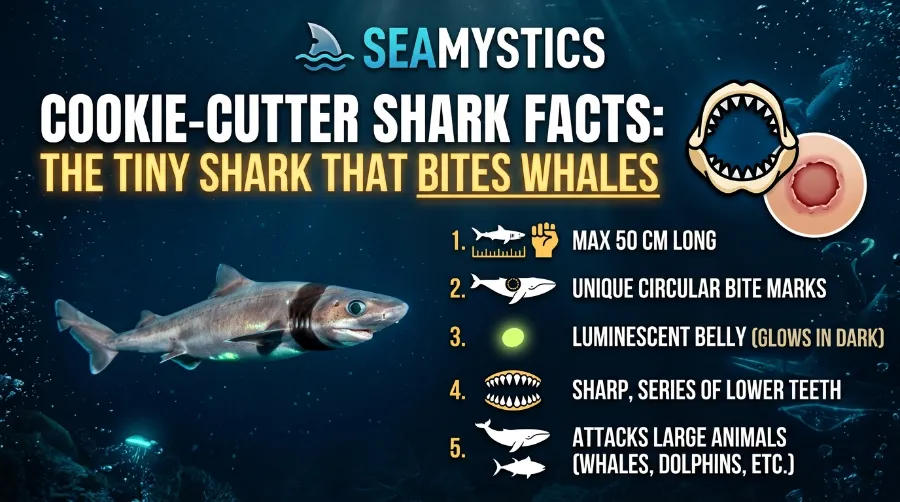
The shark’s body is cigar shaped, brown to gray, and rarely longer than 22 inches. Females grow larger than males. Its eyes are big and green, which helps it see faint light in the dark water. It also has a short, blunt snout and a set of thick, fleshy lips.
If you like the wild side of shark biology, you may also enjoy our guide to tiger shark facts. Tigers eat almost anything, but the cookiecutter has a far more specialized menu.
Lionfish Facts: Why This Beautiful Fish Is an Ocean Threat
Cookiecutter Shark Habitat: Where Does It Live?
The cookiecutter shark habitat covers warm tropical and subtropical waters around the globe. Researchers have recorded the species in the Atlantic, Pacific, and Indian Oceans. It often gathers near islands such as Hawaii, the Bahamas, and the Cape Verde region, where deep water sits close to shore.
Here is the part that surprises most readers. This shark makes one of the longest daily trips in the sea, relative to its size. During the day it stays deep, often between about 3,000 and 12,000 feet (roughly 1,000 to 3,700 m). At night it swims up toward the surface, sometimes within 300 feet or less of the top.
Scientists think the shark rises because that is where its prey feeds at night. It follows squid, fish, and whales into shallower water.
| Time of day | Typical depth | What the shark does |
|---|---|---|
| Daytime | Deep, over 3,000 ft | Rests in the dark |
| Dusk | Rising | Starts its climb |
| Night | Near the surface | Hunts and bites |
| Dawn | Sinking | Returns to depth |
Note: depths are approximate ranges from published tagging and catch records. Individual sharks vary.
How Does the Cookiecutter Shark Bite Work?
The cookiecutter shark bite is a well designed tool. Each step has a purpose:
- The shark finds a large animal and swims close.
- Its lips press against the skin and form a tight seal, like a suction cup.
- The narrow upper teeth hold the shark in place.
- The large lower teeth cut into the flesh.
- The shark spins its body, and the teeth carve out a round plug.
The lower jaw holds only about 25 to 31 triangular teeth in a single row. They are very sharp, and they are big for a small shark. The shark loses the entire row at once, then swallows the old teeth. This recycles calcium, which is scarce in the open ocean.
The wound is usually about 2 inches wide and up to about 2 inches deep. On a whale, that is a tiny mark. On a tuna, it can be serious. Scientists have found the crater shaped scars on many species, and they fade into white oval patches as they heal.
For a comparison with a much larger predator, see our great white shark facts. A great white kills for a big meal, while a cookiecutter takes a snack and moves on.
The Glowing Trick: How a Tiny Shark Fools Big Fish
This is my favorite part of the story. The cookiecutter shark glows. Its belly gives off a soft green light through special organs called photophores. This light matches the faint glow from above, which hides the shark’s outline from anything looking up.
Around its throat, though, there is a dark patch that does not glow. Researchers, including marine biologist Edith Widder, have proposed that this dark band looks like a small fish from below. A big predator swims up to eat the “fish,” and the cookiecutter shark attacks first.
This idea is a hypothesis, not a proven fact, and I think it is important to say so. The lure theory fits the shark’s body well, but nobody has filmed it working in the wild. It is still a strong example of how deep sea animals use light to survive.
Small Shark Whale Bite: Who Gets Bitten?
A small shark whale bite sounds impossible, yet the scars are common. Scientists have found cookiecutter marks on many animals, including:
- Spinner and spotted dolphins
- Sperm whales and beaked whales
- Elephant seals
- Tuna, marlin, and swordfish
- Squid and even other sharks, such as the megamouth
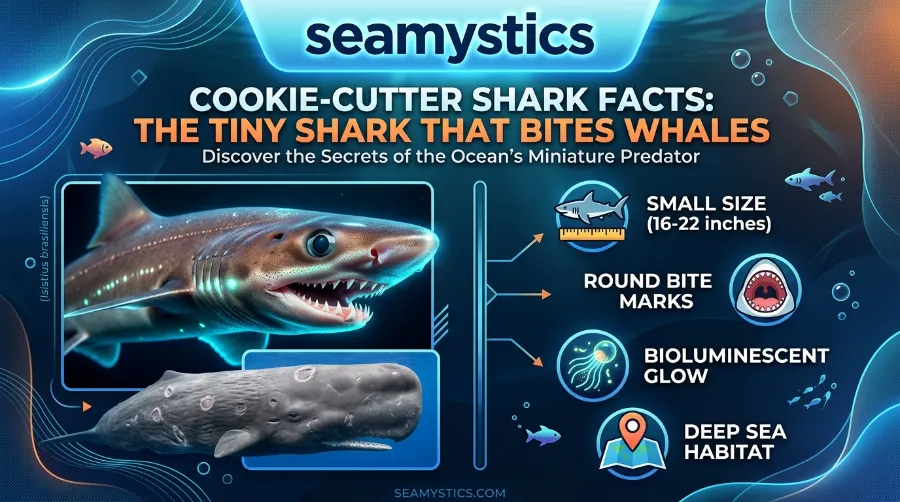
Here is a useful point from field work. Many Hawaiian dolphins and whales carry these scars, and researchers use the bites as a natural tag. A whale with many old scars has likely spent time in warm, deep water where the sharks live. A whale with few scars may have stayed in cooler regions. That gives scientists a low cost way to study migration without any tracking device.
Photo identification teams also count the healed bites. In some populations, most adults show at least a few marks. That tells us the sharks are common, even though almost nobody ever sees one alive.
Do Cookiecutter Sharks Attack Submarines?
Yes, and this is one of the funniest true stories in marine science. In the 1970s, the U.S. Navy found bite damage on the rubber sonar domes of some submarines. The domes protect sensitive equipment, and the holes affected the gear. Engineers then studied the bites and traced them to cookiecutter sharks.
Electric Eel Facts: How It Generates a Lethal Shock
Researchers also reported bites on underwater cables, and on some ocean equipment. The sharks seem to test anything that moves or gives off a faint glow. Some crews solved the problem by adding fiberglass covers to the domes.
Are Cookiecutter Sharks Dangerous to Humans?
For most people, no. The shark lives far from beaches, and it stays deep in daylight. Confirmed attacks on people are very rare. One well known case happened in 2009, when long distance swimmer Mike Spalding was bitten while crossing a deep channel in Hawaii at night. He survived and needed medical care.
Swimmers at greatest risk are those who cross deep open water in the dark. A regular beach visitor has almost no risk. You are far more likely to meet a jellyfish or a rip current than a cookiecutter shark.
If you want to compare risk levels across ocean animals, our ocean predator ranking puts them side by side.
Life Cycle and Reproduction
Female cookiecutter sharks give birth to live young. The pups grow inside eggs that hatch within the mother’s body. Scientists have found that litters are small, often around six to nine pups. The mother feeds them from the yolk sac, not through a placenta.
Because the species lives so deep, we know little about its growth rate. Nobody has yet followed one shark from birth to old age. That gap in knowledge is one reason the cookiecutter shark still counts as a weird shark species.
Weird Shark Species: How the Cookiecutter Compares
| Shark | Size | Main feeding method | Special feature |
|---|---|---|---|
| Cookiecutter shark | About 20 in | Bites round plugs | Glowing belly |
| Great white shark | 15 to 20 ft | Ambush and bite | Powerful jaws |
| Hammerhead shark | 10 to 20 ft | Hunts along the seabed | Wide head |
| Goblin shark | Up to about 10 ft | Shoots out jaws | Long snout |
Sharks vary widely, and the cookiecutter is easily the smallest of these. To read about a very different hunter, visit our hammerhead shark facts.
Why Scientists Study This Animal
The cookiecutter shark teaches us three things.
First, small animals can shape big ones. Bite scars affect skin health in whales and dolphins. Second, the shark shows how life adapts to darkness. Its glow, its daily migration, and its tooth recycling are all solutions to a hard environment. Third, its scars give researchers a way to study whales that dive too deep to watch.
Some researchers also point out a practical lesson. If a tuna or a swordfish arrives at the dock with round marks, that tells fishers the fish spent time in deep, warm water. Fisheries scientists sometimes use these marks in their notes about where a catch came from.
Are Cookiecutter Sharks Endangered?
No. The IUCN lists the species as Least Concern. The shark is widespread, and it is not a target for most fisheries. Its main threats are accidental catch and, perhaps, changes in ocean temperature that shift where prey lives.
Goblin Shark Facts: The Living Fossil With a Retractable Jaw
Still, we know very little about the population size. A “Least Concern” label partly reflects how hard the animal is to study. More deep sea research would give us a clearer picture. You can read the wider status system at the IUCN Red List.
Where to Learn More
Several good sources cover this animal from different angles. The fossil and tooth details are explained well on Fossils Online’s cookiecutter shark article. For a conservation view, see Shark Angels’ species profile. A simple, friendly overview is also available from Wildlife Nomads. For a broad scientific summary, the Wikipedia entry on the cookiecutter shark lists many original studies.
Other ocean animals also use surprise and precision to hunt. Our guide to moray eel facts shows a second mouth inside the throat, and our barracuda facts explained covers a fast, sharp toothed fish that sometimes shares waters with the cookiecutter. You can also browse more articles on the Sea Mystics homepage.
Frequently Asked Questions
What is the cookiecutter shark famous for?
It is known for cutting round plugs of flesh from larger animals, including whales, and for its glowing belly.
How big is a cookiecutter shark?
Most adults measure about 14 to 22 inches. Females are larger than males.
Where does a cookiecutter shark live?
It lives in warm oceans worldwide, often near islands. It stays deep by day and rises toward the surface at night.
Can a cookiecutter shark kill a whale?
No. The bites are small and heal over time. Whales carry the scars for years and survive.
Is a cookiecutter shark dangerous to swimmers?
The risk is very low. The few known bites involved night swimmers in deep open water.
Why does the cookiecutter shark glow?
The light hides its outline from below. The dark throat patch may also work as a lure, though this is still a theory.
Quick Quiz: Test Your Cookiecutter Shark Knowledge
1. How does the cookiecutter shark make its round bite?
A) It swallows prey whole
B) It seals its lips, then spins its body to cut a plug
C) It rams prey and tears a hole
D) It uses poison
2. Where does the cookiecutter shark spend most of the daytime?
A) On the beach shallows
B) In freshwater rivers
C) In deep water
D) In polar ice
3. What did the shark damage on some U.S. Navy submarines?
A) The propellers
B) The rubber sonar domes
C) The radio antenna
D) The fuel tanks
4. True or False: A cookiecutter shark is a major threat to beach swimmers.
5. True or False: The shark’s dark throat patch may help it look like a small fish.
Answers: 1) B. 2) C. 3) B. 4) False. 5) True (this is a leading hypothesis).
Conclusion
The cookiecutter shark proves that size does not decide who matters in the ocean. This small, glowing hunter climbs from the deep every night, takes a neat round bite from animals hundreds of times larger, and then slips back into the dark. Its scars help researchers track whales, its teeth show smart recycling, and its story reminds us how much of the sea remains unexplored. Now that you know these cookiecutter shark facts, you can see why marine biologists call it one of the most fascinating weird shark species alive.
References
- Widder, E. A. (1998). A predatory use of counterillumination by the squaloid shark, Isistius brasiliensis. Environmental Biology of Fishes, 53, 267 to 273.
- Papastamatiou, Y. P., Wetherbee, B. M., et al. (2010). Cookiecutter shark research on diel movement and feeding. Environmental Biology of Fishes.
- IUCN Red List of Threatened Species: Isistius brasiliensis.
- Jones, E. C. (1971). Isistius brasiliensis, a squaloid shark, the probable cause of crater wounds on fishes and cetaceans. Fishery Bulletin, 69, 791 to 798.