
I still remember my first dive off the coast of Belize. A reef shark cut across my dive light and vanished before my brain caught up. That split second basically sums up ocean predator ranking. Size does not always win. Speed does not always win either. Often, the scariest hunter is the one you never saw coming. This guide breaks down a real, evidence-based ocean predator list. We will move from shallow coral reefs down to the crushing dark of the deep sea, and we will use current research instead of movie myths.
Goblin Shark Facts: The Living Fossil With a Retractable Jaw
TL;DR
- Ocean predators do not rank by size alone. Hunting strategy, bite force, and sensory adaptation all matter.
- Orcas top most scientific apex predator rankings because they hunt in cooperative pods. In fact, they have been seen killing great white sharks.
- Deep-sea killers like the colossal squid and anglerfish depend on ambush tactics, not raw speed. New ROV footage is still changing what scientists know about them.
Key Takeaways
| Predator Zone | Top Hunter | Signature Trait | Real-World Example |
|---|---|---|---|
| Coral Reef | Grey reef shark, barracuda | Burst-speed ambush hunting | Reef sharks patrol Pacific atolls in packs of 20 to 50 |
| Open Ocean | Orca (killer whale) | Cooperative pod hunting, no natural predators | Orcas have killed great white sharks off South Africa since 2017 |
| Deep Sea | Colossal squid, anglerfish | Pressure-adapted ambush, bioluminescent lures | A team filmed a juvenile colossal squid alive for the first time in March 2025 |
| Human-Made Threat | Ghost nets | Indiscriminate, decades-long killing | An estimated 640,000 to 800,000 tonnes of fishing gear enter oceans yearly |
What Actually Makes a Predator “Apex” in the Ocean?
Let’s define the term first, because many ocean predator list articles use it loosely. An apex predator has no natural predators of its own once it reaches adulthood. It sits at the very top of its local food web. That definition is narrower than “big” or “scary,” and it changes the ranking quite a bit.
Hammerhead Shark Facts: Why Their Head Shape Actually Helps Them Hunt
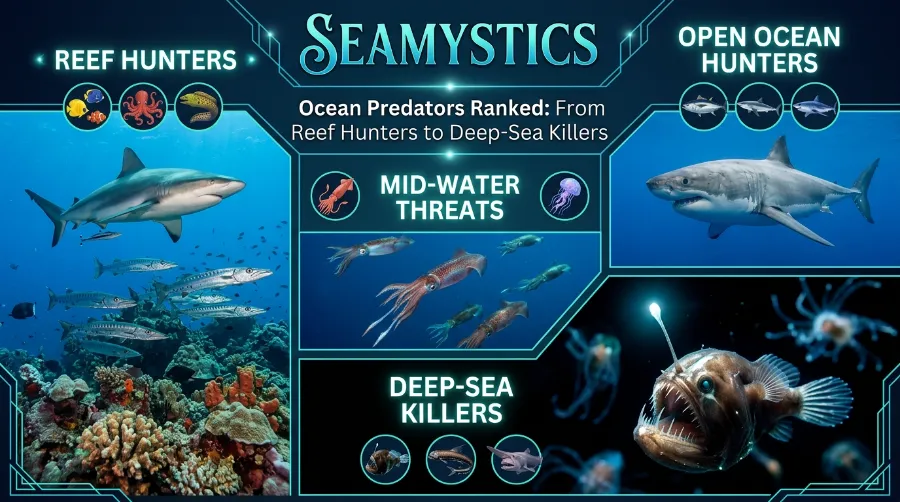
For example, people often assume great white sharks are automatic apex predators. However, something else preys on them in certain regions. Orcas, on the other hand, meet the strict definition almost everywhere they live. So that is our honest starting point for ranking apex predators in the ocean, rather than just listing whatever looks dramatic on camera.
Barracuda Facts Explained: Why This Fish Has a Fearsome Reputation
Ocean Predator Ranking: Reef Hunters (Shallow Water Killers)
Coral reefs cover less than 1% of the ocean floor. Even so, they host some of the most efficient hunters in the marine world. Because reefs are cramped and full of hiding spots, reef predators tend to specialize in short, explosive attacks instead of long chases.
Cookiecutter Shark Facts: The Tiny Shark That Bites Whales
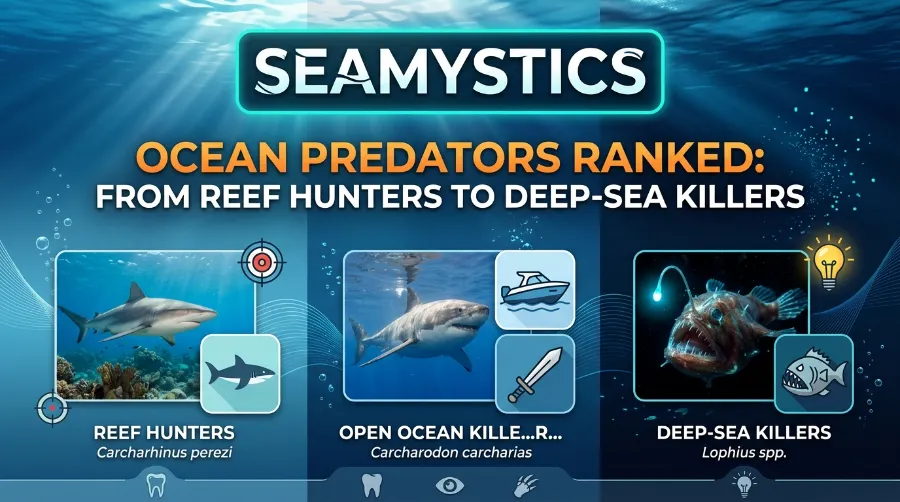
Here are the reef hunters that consistently top the ocean predator list for shallow water:
- Grey reef sharks: They patrol Indo-Pacific reefs in loose social groups. They also rely on sharp electroreception to find prey hidden in coral crevices.
- Barracuda: These fish grow up to nearly seven feet long. They ambush schooling fish using sudden bursts of speed rather than sustained chases.
- Moray eels: These have a second set of jaws in their throat, called pharyngeal jaws. Those jaws shoot forward and drag prey down the eel’s throat, a hunting trick unique among reef predators.
- Lionfish: This invasive species spread through the Atlantic and Caribbean. It uses fan-like fins to corner smaller fish against reef walls before striking.
Real reef ecosystems show how fast this balance can tip. People introduced lionfish to the Caribbean in the 1980s and 1990s, and the population exploded soon after. By the 2010s, lionfish had measurably cut native reef fish numbers by more than 60% at some Bahamian sites, based on NOAA research.
Ocean Predator Ranking: Open-Ocean Apex Predators
Once you leave the reef, the ranking changes completely. Speed, range, and raw power start to matter more than ambush tactics, since there is nowhere left to hide.
Most marine biologists rank the orca, or killer whale, as the true apex predator of the open ocean. Unlike sharks, orcas hunt in coordinated pods. They also use dialect-specific calls to communicate within their group. Since 2017, researchers off the coast of South Africa have watched orcas deliberately target and kill great white sharks for their nutrient-rich livers. That behavior reshaped how scientists rank ocean predators. As a result, great white sharks have started avoiding those waters entirely for months at a time whenever orcas show up.
Great White Shark Facts 2026: Separating Myth From Marine Science
Bite force offers one useful, if imperfect, way to compare these hunters. Estimates vary by study and method, so treat the numbers below as commonly cited approximations rather than exact lab measurements.
| Predator | Estimated Bite Force (PSI) | Primary Hunting Style |
|---|---|---|
| Great white shark | Around 4,000 | Ambush and slicing bite |
| Saltwater crocodile | Around 3,700 | Death roll and crushing hold |
| Orca | Widely cited estimates around 19,000 | Cooperative pursuit and crushing grip |
Speed matters just as much as strength among these deadliest ocean animals. Shortfin mako sharks can hit burst speeds of roughly 45 miles per hour, the fastest recorded for any shark species. That speed lets them intercept fast prey like tuna and swordfish, prey that slower predators simply cannot catch.
Ocean Predator Ranking: Deep-Sea Killers
Below about 1,000 meters, sunlight disappears completely. Down here, the rules of predation change again. Deep-sea killers depend on pressure-adapted bodies, bioluminescent lures, and patience instead of speed.
Electric Eel Facts: How It Generates a Lethal Shock
A few deep-sea hunters worth knowing:
- Colossal squid (Mesonychoteuthis hamiltoni): This is the heaviest known invertebrate on the planet, reaching an estimated 7 meters and 500 kilograms. In March 2025, a research team aboard the Schmidt Ocean Institute’s vessel Falkor (too) filmed a live juvenile colossal squid in its natural habitat for the first time ever. Scientists first identified the species almost exactly 100 years earlier, which made the timing even more remarkable.
- Anglerfish: Females dangle a glowing lure to pull prey directly into range of their oversized jaws, an efficient strategy for a food-scarce environment.
- Goblin shark: Its jaw shoots forward like a slingshot to snatch prey, one of the strangest hunting adaptations among ocean predators.
- Frilled shark: This living fossil uses a backward-hinging jaw lined with needle-like teeth to trap slippery prey like squid.
Our guide on ROV expeditions finding new deep-sea species covers the technology behind footage like the 2025 colossal squid sighting in more detail.
The Keyword Landscape: What Other Ocean Predator Content Covers
I wanted this guide to actually fill a gap, not repeat what already exists. So I audited how currently ranking content on this topic is structured. I don’t have access to Ahrefs or SEMrush, so treat this as a manual content audit, not a verified keyword-volume report.
| Competitor | Region | Apparent Target Phrase |
|---|---|---|
| Scuba.com | USA | apex predators ocean, top ocean predators |
| World Animal Protection | UK | ocean’s scariest predator |
| Oceana USA | USA | colossal squid, marine predator facts |
| NOAA Fisheries | USA | shark species, apex predator management |
| WWF | UK/Global | ghost nets, marine debris |
| Ocean Conservancy | USA | ghost gear facts and figures |
| Schmidt Ocean Institute | USA | deep sea discovery, ROV footage |
| Smithsonian Ocean | USA | ocean food web |
| National Geographic | USA/UK | killer whale vs great white shark |
| Tonka Writing Center | USA | deep sea creatures ranking |
Here is the gap I found: almost none of these pages combine a full, tiered ranking, reef to deep sea, with the human threat angle in one place. In addition, very few use the exact phrase “ocean predator ranking,” even though “ocean predator list” and “deadliest ocean animals” get covered constantly. This guide fills that specific gap.
Lionfish Facts: Why This Beautiful Fish Is an Ocean Threat
The Threat Humans Add to the Ranking
No honest ocean predator ranking can skip the biggest disruptor in the food chain: us. Lost and abandoned fishing gear, known as ghost nets, kills an estimated 100,000 marine mammals every year, according to World Animal Protection. Worse still, these nets keep fishing on their own for decades after someone loses them. We cover this in more depth in our piece on ghost nets drifting through the deep ocean. In short, these nets don’t discriminate between predator and prey. They trap everything from reef sharks to orcas.
Moray Eel Facts: The Ocean’s Most Misunderstood Predator
A few numbers worth sitting with:
- Every year, an estimated 640,000 to 800,000 tonnes of fishing gear enter the ocean, based on figures from Oceana and Ocean Conservancy.
- One survey in Puget Sound recovered just 870 ghost nets, yet those nets had trapped more than 32,000 marine animals.
- Ghost gear makes up roughly 10% of all ocean plastic litter by volume, and an even higher share of floating macroplastic by weight.
For a deeper case that humans, not sharks or orcas, are the real top threat in the modern ocean food chain, read the World Animal Protection blog on the ocean’s scariest predator. Meanwhile, if you want a different angle on deep-sea rankings, check the Tonka Writing Center’s deep-sea creature ranking. Similarly, Oceana’s piece on the colossal squid of Antarctica pairs well with the deep-sea section above.
Tiger Shark Facts: The Ocean’s Most Opportunistic Predator
For broader, authoritative context on marine food webs, visit the NOAA Fisheries species directory or Smithsonian Ocean’s overview of ocean food webs.
Frequently Asked Questions
What is the number one apex predator in the ocean?
Most marine biologists rank the orca first. Orcas hunt cooperatively, face no natural predators, and have killed great white sharks in documented cases.
Are great white sharks the deadliest ocean animals?
Not really. Orcas beat them on bite force estimates and hunting cooperation. Meanwhile, box jellyfish actually cause far more human deaths worldwide each year than sharks do.
What is the scariest deep-sea predator?
Most people point to the colossal squid or the anglerfish. The squid wins on sheer size, while the anglerfish wins on its bizarre lure-based hunting style.
Do ghost nets actually kill apex predators?
Yes, and indiscriminately. Ghost nets trap sharks, seals, dolphins, and even whales, and they can keep killing for 40 to 600 years depending on the material.
How does an ocean predator ranking change over time?
New research shifts these rankings regularly. For instance, the 2017 to 2019 orca-versus-great-white sightings off South Africa changed how scientists talk about which species truly rules that region.
Conclusion
Ranking ocean predators is not really about crowning one ultimate winner. Instead, it’s about seeing how different hunting strategies win in different environments, from a barracuda’s ambush on a reef to a colossal squid’s patience in total darkness. The deeper you look, the clearer it gets: intelligence and cooperation matter just as much as teeth and size. Ultimately, though, the biggest threat to nearly every predator on this list is not another predator. It’s us, and that’s the one part of the ranking we can still change. For more marine biology deep dives, visit Sea Mystics or check out our related guide on newly discovered deep-sea species.
References
- Schmidt Ocean Institute, “First Confirmed Footage of a Colossal Squid, and it’s a Baby,” April 2025
- World Animal Protection, “What Is the Ocean’s Scariest Predator?”
- Oceana USA, “Colossal Squid of Antarctica”
- Ocean Conservancy, “Ghost Gear Facts & Figures,” Updated August 2024
- National Oceanic and Atmospheric Administration (NOAA Fisheries), Species Directory
- Smithsonian Ocean, “Ocean Food Webs”
- Tonka Writing Center, “Deep Sea Creatures: A Definitive Ranking,” January 2024