

If you have ever seen a hammerhead shark glide past a reef, you know the shape stops you mid-breath. That flat, wing-like head looks almost like a mistake of evolution, yet it is one of the most efficient hunting tools in the ocean. These hammerhead shark facts explain exactly why that strange head works so well, and why hammerheads are still among the most misunderstood predators in the sea.
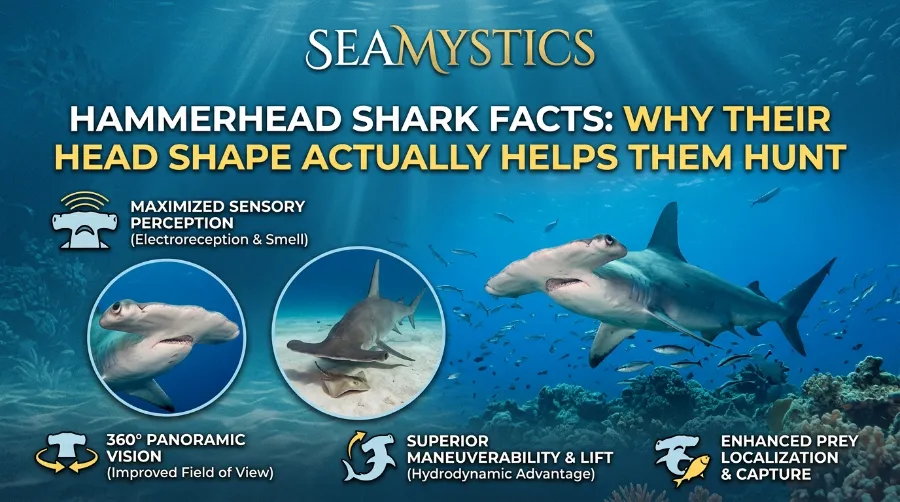
Quick answer: A hammerhead’s wide head, called a cephalofoil, spreads its eyes, nostrils, and electrical sensors far apart. This gives it wraparound vision, sharper smell direction, and a much wider strip of ocean floor to scan for hidden prey such as stingrays.
TL;DR
- Hammerhead sharks belong to the family Sphyrnidae, and scientists currently recognize at least nine living species.
- Their hammer-shaped head, called a cephalofoil, boosts vision, smell, and electrical sensing all at once, not just one sense.
- Most hammerhead species are now listed as Endangered or Critically Endangered, largely due to bycatch and the fin trade.
Key takeaways
| Fact | Detail |
|---|---|
| Family name | Sphyrnidae |
| Number of species | At least 9 recognized, including one discovered in 2013 |
| Largest species | Great hammerhead, up to 6.1 to 6.2 meters (20 feet) |
| Head structure | Cephalofoil, spreads sensory organs across a wide arc |
| Main hunting target | Stingrays, pinned to the seafloor |
| Conservation status | Most species Endangered or Critically Endangered (IUCN) |
What Is a Hammerhead Shark? A Quick Look at the Species
Hammerhead sharks are not one animal. They are a whole family, and understanding the different hammerhead shark species helps explain why some are giants and others barely reach a meter long. Scientists currently place at least nine living species inside the Sphyrnidae family, ranging from the small, common bonnethead to the massive great hammerhead.
The great hammerhead is the largest, capable of reaching 6.1 to 6.2 meters and weighing over 230 kilograms. On the other end, the winghead shark carries the most exaggerated cephalofoil relative to its body, which researchers believe points to an even stronger sensory role for the shape. Meanwhile, one species almost slipped past science entirely: the Carolina hammerhead was only formally separated from its lookalike, the scalloped hammerhead, in 2013, after genetic testing revealed it had been hiding in plain sight along the southeastern United States coast for years.
Barracuda Facts Explained: Why This Fish Has a Fearsome Reputation
That discovery still matters today. A 2019 study published in Biology Letters documented natural hybrids between scalloped and Carolina hammerheads in the western North Atlantic, which is a rare finding among sharks and a sign that these two closely related species overlap more than anyone expected.
Why the Hammerhead Head Shape Actually Helps Them Hunt
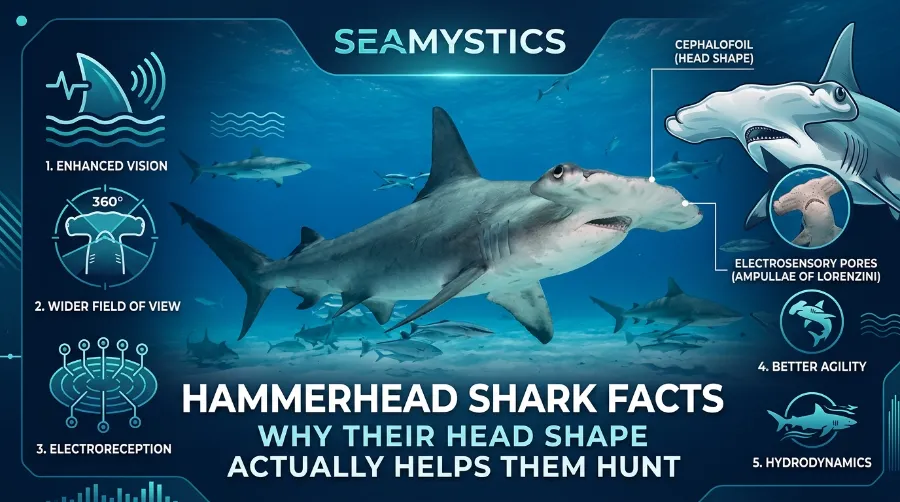
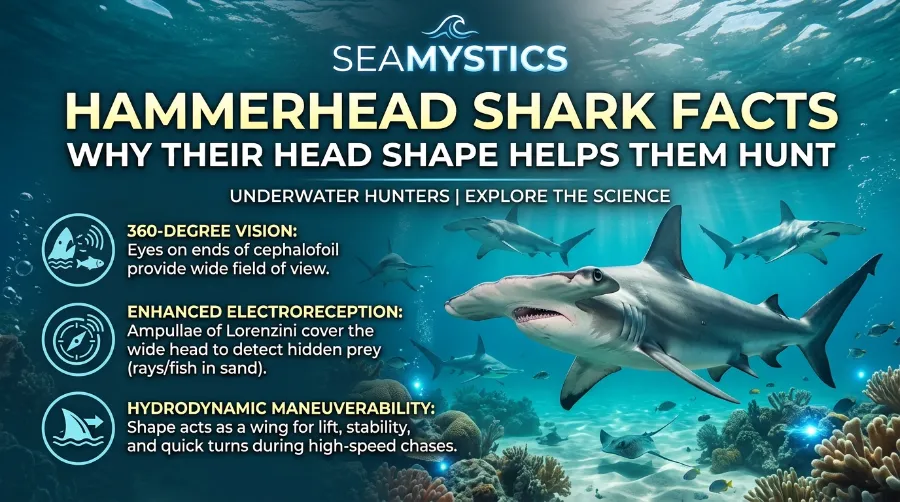
This is where most hammerhead shark facts get it half right. The head is not just for looking strange. Every part of that flattened structure, known scientifically as a cephalofoil, earns its keep.
Wraparound vision
Because the eyes sit at the very ends of the head, a hammerhead gets close to 360 degree vision in the vertical plane. In practice, that means it can watch the water above and below itself at the same time, without needing to turn its body. Divers off the coast of the Bahamas have documented hammerheads tracking prey overhead and below in the same pass, something a typical shark simply cannot do.
A built in metal detector
Like every shark, hammerheads sense weak electrical fields through pores called the ampullae of Lorenzini. However, because the cephalofoil is so wide, these pores are spread across a far larger surface than on a narrow-headed shark. As a result, the hammerhead effectively sweeps a bigger strip of sand with every pass, which is exactly how it finds stingrays buried and hidden from view.
Goblin Shark Facts: The Living Fossil With a Retractable Jaw
Sharper smell, better direction
The hammerhead’s nostrils, called nares, are pushed further apart by the same head shape. Consequently, the shark can tell which nostril picked up a scent first, and turn straight toward the source instead of swimming in slow circles the way a narrower-headed predator might.
Pinning the prey
Once the target is found, the hammerhead uses that same broad head as a weapon. It presses down hard on a stingray, holding it against the seafloor while it maneuvers in for a bite, a hunting behavior that has been filmed repeatedly around dive sites in the Galapagos and the Bahamas.
Hammerhead Hunting Behavior in the Wild
Hammerhead hunting behavior changes depending on the time of day and the size of the group. During daylight hours, several species, especially the scalloped hammerhead, gather into large schools that can number in the dozens near seamounts and offshore reefs. Once the sun sets, though, that social structure breaks down and each shark heads off alone to hunt.
Lionfish Facts: Why This Beautiful Fish Is an Ocean Threat
Researchers believe schooling serves a purpose beyond safety in numbers. In these groups, female hammerheads appear to use the crowd to control which males get close to them, essentially filtering out unwanted attention before nightfall, when hunting takes priority over socializing.
A few patterns show up again and again in field studies:
- Hammerheads hunt mostly alone at night, relying on electroreception more than sight in low light.
- Stingrays and other bottom-dwelling fish make up a large share of the diet, though squid and smaller sharks are also taken.
- Larger species, particularly the great hammerhead, will occasionally prey on smaller sharks and even other hammerheads.
If you want to see how this hunting style stacks up against other apex predators, our ocean predator ranking guide breaks down how hammerheads compare to sharks that rely on speed and raw bite force instead.
Hammerhead Shark Habitat: Where They Live
Hammerhead shark habitat spans warm coastal and temperate waters nearly worldwide, generally between 40 degrees north and 35 degrees south latitude. In the western Atlantic, populations range from North Carolina down through the Gulf of Mexico, the Caribbean, and as far south as Uruguay. On the eastern side of the Atlantic, they turn up from the Mediterranean down to Namibia.
Most species prefer continental shelves and coastal shallows, which is exactly why divers can encounter them without heading into open ocean. During summer months, large schools migrate toward cooler water, and because they spend so much time in shallow, sunlit areas, hammerheads are one of the few sharks known to actually tan from sun exposure.
Moray Eel Facts: The Ocean’s Most Misunderstood Predator
Are Hammerhead Sharks Endangered? The Numbers Behind the Question
This is the part most competitor articles skip entirely, yet it matters just as much as the head shape itself. According to the IUCN Red List, the great hammerhead is classified as Endangered, with an estimated population decline of around 80 percent over the past 25 years along the west coast of Africa alone. In the northwestern Atlantic and Gulf of Mexico, populations have dropped by roughly 50 percent since the 1990s, largely from bycatch in longline and gillnet fisheries rather than direct targeting.
| Species | IUCN status |
|---|---|
| Great hammerhead | Endangered |
| Scalloped hammerhead | Critically Endangered |
| Smooth hammerhead | Vulnerable |
| Winghead shark | Endangered |
| Bonnethead | Endangered |
| Carolina hammerhead | Data Deficient |
In 2011, conservation groups WildEarth Guardians and Friends of Animals formally petitioned NOAA Fisheries to protect the scalloped hammerhead under the US Endangered Species Act. NOAA’s later ruling listed two of its population segments as threatened and two as endangered, giving the species one of the strongest federal protections of any hammerhead in US waters. You can see the full ruling on NOAA Fisheries’ scalloped hammerhead page, which remains one of the most authoritative sources on the species’ legal status.
Electric Eel Facts: How It Generates a Lethal Shock
The core threat is simple, and it has nothing to do with attacks on humans. Hammerheads grow slowly and give birth to relatively few pups compared to other fish, so once a population is fished down, it takes decades to recover, if it recovers at all. Great hammerheads, for example, only give birth once every two years, with litters ranging from 6 to 42 pups after an 11 month gestation, according to research summarized by the Shark Guardian species guide.
A Bit of Evolutionary Perspective
Sharks as a group have existed for roughly 450 million years, according to a timeline published by the Natural History Museum, yet hammerheads are relative newcomers, having evolved only around 20 million years ago. That is a blink of an eye in shark terms, and it helps explain why the cephalofoil looks so specialized. It did not evolve gradually alongside other shark traits, it appeared as a fast, dramatic solution to a specific hunting problem, and it clearly worked, since hammerheads went on to diversify into at least nine distinct species.
Cookiecutter Shark Facts: The Tiny Shark That Bites Whales
For a sense of how this fits against other iconic predators, our guides on tiger shark facts and great white shark facts cover species that took a completely different evolutionary path toward the same goal: becoming an efficient ocean hunter.
Frequently Asked Questions
Why do hammerhead sharks have a hammer shaped head?
The shape, called a cephalofoil, spreads out the shark’s eyes, nostrils, and electrical sensors, giving it wider vision, sharper smell direction, and a bigger area to detect hidden prey.
Are hammerhead sharks dangerous to humans?
Only the great hammerhead is considered even a possible threat due to its size, and confirmed attacks are extremely rare. Most hammerhead species avoid humans entirely.
What do hammerhead sharks eat?
Stingrays are a favorite target, along with squid, smaller fish, and occasionally other sharks, particularly for the larger great hammerhead.
How many species of hammerhead sharks exist?
At least nine living species are currently recognized, with the most recent, the Carolina hammerhead, only confirmed in 2013.
Are hammerhead sharks endangered?
Most species are listed as Endangered or Critically Endangered by the IUCN, mainly due to bycatch in commercial fishing and the shark fin trade.
Test Your Hammerhead Shark Knowledge
1. What is the scientific name for a hammerhead’s unusual head shape?
A) Rostrum
B) Cephalofoil
C) Dorsal crest
2. Which hammerhead species was only formally identified in 2013?
A) Bonnethead
B) Winghead shark
C) Carolina hammerhead
3. What is the great hammerhead’s current IUCN conservation status?
A) Least Concern
B) Endangered
C) Not evaluated
4. What do hammerhead sharks most commonly hunt on the seafloor?
A) Stingrays
B) Sea turtles
C) Crabs
5. Roughly how long ago did hammerhead sharks evolve, compared to sharks in general?
A) 450 million years ago
B) 20 million years ago
C) 2 million years ago
Answer key: 1. B, 2. C, 3. B, 4. A, 5. B
Conclusion
The hammerhead’s head was never a design flaw. It is a finely tuned sensory instrument that gives these sharks better vision, sharper smell, and a wider net for detecting hidden prey than almost any other predator in the ocean. Unfortunately, being an efficient hunter has not protected hammerheads from the far bigger threat of overfishing, and most species now need active conservation just to hold steady. The next time someone calls a hammerhead’s head strange, you will know it is actually one of evolution’s smartest solutions.
References
- NOAA Fisheries, Scalloped Hammerhead Shark Overview and ESA Listing Determination
- IUCN Red List, Sphyrna mokarran (Great Hammerhead) Assessment
- Barker, A., Adams, D., Driggers, W., Frazier, B., and Portnoy, D. (2019). Hybridization Between Sympatric Hammerhead Sharks in the Western North Atlantic Ocean. Biology Letters, 15.
- Natural History Museum, Shark Evolution: A 450 Million Year Timeline
- Kajiura, S.M. and Holland, K.N. (2002). Electroreception in Juvenile Scalloped Hammerhead and Sandbar Sharks. Journal of Experimental Biology