

A barracuda does not chase. It waits. It hangs almost perfectly still in the blue water near a reef edge, silver flank catching the light, and then it disappears in a blur before your brain has finished processing what you saw. That single move, part patience and part violence, is why divers across Florida, the Red Sea, and the Caribbean tell barracuda stories the way anglers tell shark stories. These barracuda facts explained here separate the genuine biology from the campfire exaggeration, so you know exactly what you are looking at the next time one locks eyes with you underwater.
TL;DR: Barracudas are fast, sharp-toothed reef predators that can burst to roughly 36 mph, but they are not natural man-eaters. Most “attacks” trace back to mistaken identity involving shiny jewelry, spearfishing, or poor visibility, and fatalities are almost unheard of. Respect the fish, skip the bling, and you are statistically safer near a barracuda than near a kitchen knife.
Key Takeaways
| Fact | Detail |
|---|---|
| Top speed | Around 36 mph in short ambush bursts |
| Max size | Up to 6.5 feet, over 100 lbs (Great Barracuda) |
| Lifespan | Up to 14 years |
| Habitat | Reefs, seagrass beds, mangroves, warm coastal waters |
| Human attacks | Extremely rare, usually provoked or visibility-related |
| Confirmed fatalities | Historically documented but exceptionally rare, decades apart |
| Main threat to humans | Ciguatera poisoning from eating large barracuda, not bites |
What Exactly Is a Barracuda?
Barracuda is not one species but a family, Sphyraenidae, with roughly 20 to 26 recognized members swimming through tropical and subtropical seas worldwide. The Great Barracuda, Sphyraena barracuda, is the one that shows up in most diving stories and most search results, so it anchors this guide. Consequently, whenever this article says “barracuda” without qualification, it is talking about this specific, well-studied species.
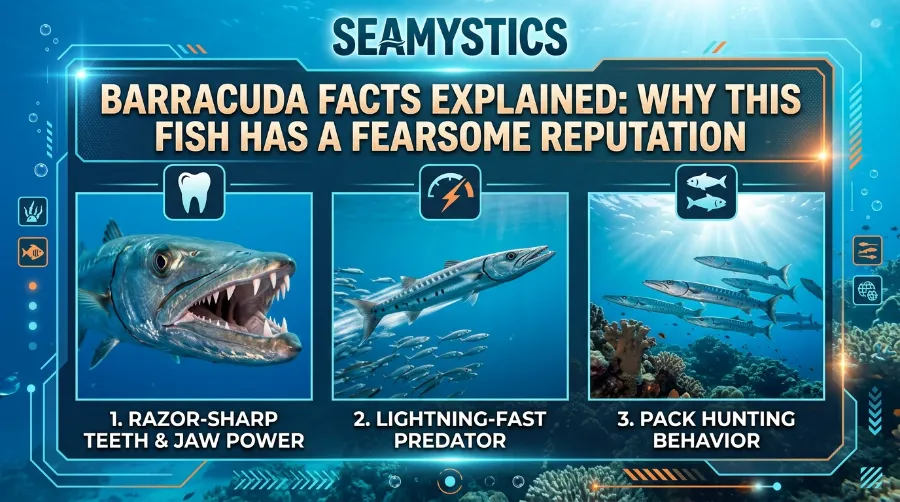
Picture a torpedo with an attitude. The body is long, muscular, and slightly flattened, built purely for a sudden lunge rather than a marathon swim. The lower jaw juts forward, giving the fish a permanent underbite, and behind it sit two rows of teeth: small, needle-like ones for gripping and larger, blade-like ones for slicing.
Cookiecutter Shark Facts: The Tiny Shark That Bites Whales
A few defining traits show up again and again in the research:
- Grows up to 6.5 feet and can weigh more than 100 lbs
- Silvery sides with a darker green, blue, or gray back for camouflage
- Solitary as adults, though juveniles often gather in loose groups
- Can live up to 14 years, which is unusually long for a mid-sized reef predator
Barracuda Speed Hunting: How Fast Is This Predator, Really?
Here is where the reputation earns its stripes. Barracuda speed hunting relies on acceleration rather than endurance. Multiple marine sources, including a fact sheet from Western Australia’s Department of Fisheries, place the Great Barracuda’s burst speed at roughly 58 km/h, or about 36 mph, which lines up closely with figures reported by Original Diving’s field guide to barracuda behavior.
Lionfish Facts: Why This Beautiful Fish Is an Ocean Threat
That number sounds impressive until you put it beside the rest of the ocean’s speed demons. NOAA Fisheries data credits the shortfin mako shark with speeds above 40 mph, and sailfish, swordfish, and marlin regularly clock estimates near 60 to 70 mph in short surges. So a barracuda is fast, arguably one of the fastest fish most divers will ever see up close, but it is not the ocean’s outright speed champion. It is, however, faster than a great white shark’s typical cruising burst, which is part of why the ambush strategy works so well in reef terrain where longer chases are not an option.
Moray Eel Facts: The Ocean’s Most Misunderstood Predator
The strategy behind that speed matters as much as the number itself. A barracuda spends most of its day barely moving, conserving energy while scanning the water with genuinely excellent eyesight. When a smaller fish drifts into range, it accelerates in a single explosive burst, a method sometimes called ram-biting, and often kills prey by shearing it in half on the first strike rather than wrestling with it. This is efficient, brutal, and over in under a second, which is exactly why so many eyewitness accounts describe barracuda attacks on other fish as “instant.”
Barracuda Habitat Facts: Where These Predators Patrol
Barracuda habitat facts explain a lot about why humans encounter this fish so often compared with, say, a deep-sea species most people never see. Great Barracuda favor shallow, structure-rich water: coral reefs, seagrass meadows, mangrove shorelines, and the edges of wrecks. They are found across the Atlantic, Indian, and Pacific Oceans, plus the Red Sea and Caribbean, generally staying in water warmer than about 16 to 17°C.
Goblin Shark Facts: The Living Fossil With a Retractable Jaw
Juveniles behave differently than adults, and that distinction matters for anyone trying to identify one. Young barracuda often shelter in mangroves and seagrass beds, sometimes tolerating brackish water, and can shift their coloration slightly to blend into these nursery habitats. As they mature, they move toward open reef edges and drop-offs, occasionally forming loose aggregations known as a “battery,” though adults are typically loners.
This preference for shallow, popular diving terrain, rather than the deep open ocean, is precisely why barracuda show up in so many snorkeling and diving photos. If you have ever wondered how a similarly reef-bound predator hunts by comparison, our moray eel facts guide covers another ambush specialist that shares the same coral neighborhoods but relies on scent and stealth instead of speed.
Barracuda vs Human: Separating Myth From Reality
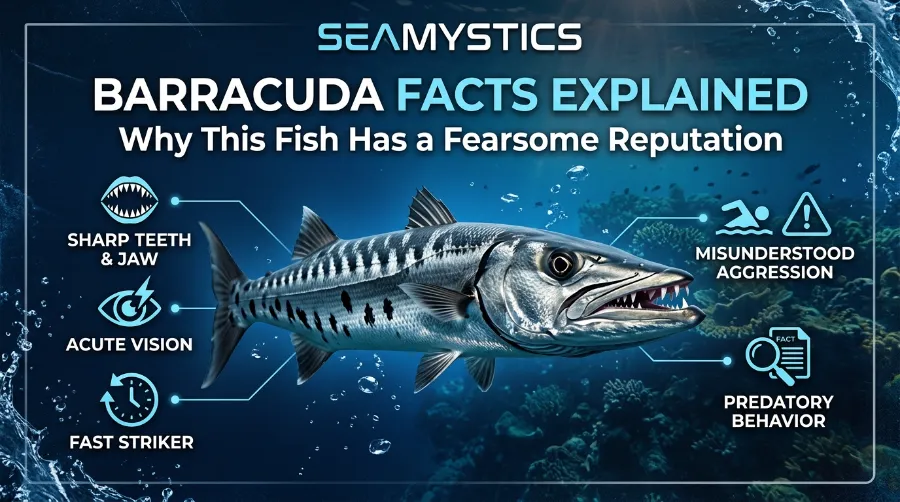
The barracuda vs human question is where most of the fear, and most of the misinformation, lives. Barracuda are famous for following swimmers and divers across a reef, sometimes for several minutes at a time, and that habit unsettles people far more than any actual bite risk warrants.
Researchers, including a documentation project published through the Global Coral Reef Alliance, have long noted that this trailing behavior likely stems from opportunism rather than aggression. Barracuda are part-time scavengers. If a diver disturbs the reef or a larger predator makes a kill nearby, a barracuda may follow simply hoping to scavenge leftovers, treating the human as a potential source of scraps rather than as prey.
According to the New World Encyclopedia’s summary of barracuda-human interactions, unprovoked attacks are extremely rare given that millions of divers and snorkelers share water with these fish every year without incident. When bites do happen, several patterns recur:
- Poor underwater visibility, where a barracuda mistakes a hand or foot for a fleeing fish
- Shiny jewelry or reflective gear, which mimics the flash of prey scales
- Spearfishing, where a struggling speared fish attracts a barracuda straight toward the diver
- Deliberate provocation, such as attempting to touch, feed, or corner the fish
Fatal incidents exist in the historical record but are exceptionally rare and decades apart, including a well-documented 1947 case near Key West, Florida, that is still cited by wildlife researchers today as one of the only confirmed examples. Comparing that to the far more publicized reputations of animals covered in our great white shark facts and tiger shark facts pieces puts barracuda risk in useful perspective. Sharks in that scale produce far more attacks annually worldwide, yet neither species should realistically top a diver’s list of everyday hazards.
Hammerhead Shark Facts: Why Their Head Shape Actually Helps Them Hunt
Barracuda Danger Facts: What Should Actually Worry You?
If bites are not the real risk, what is? Barracuda danger facts point to something far less dramatic than teeth: ciguatera poisoning. Large, reef-dwelling barracuda accumulate ciguatoxins by eating smaller fish that have themselves fed on toxic dinoflagellates. Because barracuda sit high on the reef food chain, their tissue can carry concentrated toxin levels, and eating a contaminated fish causes gastrointestinal and neurological symptoms that can last for weeks.
This is why many coastal regions, including parts of Florida and the Caribbean, advise against eating large Great Barracuda, particularly ones caught near reefs rather than open water. In practice, this makes the fish a bigger threat sitting on a dinner plate than lurking beside a dive fin.
Electric Eel Facts: How It Generates a Lethal Shock
For anyone weighing overall reef risk, it also helps to see how barracuda stack up against other commonly feared predators, such as the ones profiled in our hammerhead shark facts guide, or the full lineup on our ocean predator ranking hub, where relative danger is compared side by side rather than judged fish by fish in isolation.
How to Stay Safe Around Barracuda
None of this means barracuda deserve zero caution. A few sensible habits eliminate almost all realistic risk:
- Leave watches, rings, and shiny dive gear at home or covered when snorkeling in barracuda territory
- Avoid quick, splashy movements that mimic a struggling fish
- Never spearfish near a barracuda that is already circling, since it may associate the activity with an easy meal
- Do not attempt to hand-feed or touch a barracuda, no matter how curious it seems
- If one follows you, keep swimming calmly rather than turning it into a standoff
According to SeaWorld’s animal facts page on barracuda, the species is generally considered harmless to humans under normal circumstances, and most negative encounters trace back directly to one of the provoking factors above rather than to unprompted aggression.
Frequently Asked Questions
Are barracuda more dangerous than sharks?
No. Barracuda cause far fewer documented human injuries per year than several shark species, and confirmed fatalities are historically rare, spaced decades apart rather than clustering in modern records.
Why do barracuda follow divers?
Most researchers attribute this to scavenging opportunism and simple curiosity rather than stalking behavior, since barracuda often trail bigger predators hoping for scraps.
Can you eat barracuda safely?
Small, open-ocean barracuda are generally fine, but large reef-dwelling individuals carry a real risk of ciguatera poisoning, so many coastal advisories recommend avoiding bigger specimens.
How fast can a barracuda swim compared to a shark?
A Great Barracuda tops out around 36 mph in short bursts, faster than a great white’s typical acceleration but slower than a shortfin mako shark, which can exceed 40 mph.
Do barracuda attack without any provocation?
It happens, but it is uncommon. The clear majority of documented incidents involve shiny objects, poor visibility, or a diver spearfishing nearby.
Quick Quiz: Test Your Barracuda Knowledge
1. What is the approximate top burst speed of a Great Barracuda?
A) 15 mph
B) 36 mph
C) 60 mph
Answer: B — around 36 mph in short ambush bursts.
2. What is the main real-world danger barracuda pose to humans?
A) Frequent unprovoked attacks
B) Ciguatera poisoning from eating large specimens
C) Venomous spines
Answer: B — ciguatera poisoning is the far more common risk than bites.
3. Where do Great Barracuda typically prefer to live?
A) Deep open ocean, thousands of feet down
B) Coral reefs, seagrass beds, and mangroves
C) Freshwater rivers only
Answer: B — they favor shallow, structure-rich coastal habitat.
Conclusion
Barracuda earned their fearsome nickname honestly, thanks to a genuinely startling burst of speed, a mouthful of blade-like teeth, and an unnerving habit of trailing divers across a reef. Strip away the exaggeration, though, and the picture that emerges is closer to a highly efficient, largely indifferent predator than a monster waiting to strike. Respect the fish, skip the jewelry, and understand what its behavior actually means, and a barracuda encounter becomes one of the more memorable, and safest, parts of any dive.
References
- Western Australia Department of Fisheries, Great Barracuda Fun Fact Sheet
- Original Diving, “Top Ten Barracuda Facts”
- SeaWorld, Barracuda Animal Facts
- New World Encyclopedia, “Sphyraenidae” and “Barracuda” entries
- NOAA Fisheries, Fastest Animals in the Sea
- Global Coral Reef Alliance, documentation on Great Barracuda attack incidents
- WorldAtlas, Barracuda Facts and Fastest Ocean Animals