

If you have ever locked eyes with a moray eel poking out of a reef crevice, you already know the feeling. That gaping mouth, those needle teeth, the way it never seems to blink. Most divers assume they have just met one of the ocean’s angriest residents. In reality, the moray eel is one of the most misread animals on the reef, and the real moray eel facts are stranger, and far less scary, than the reputation suggests. After two decades studying reef predators, I still find new reasons to respect this animal every season.
TL;DR:
- Moray eels are not aggressive by nature. Their open-mouth “threat display” is actually how they breathe.
- They hunt using a second, hidden set of jaws in their throat, a trait shared with no other fish.
- Most bites on humans happen because of hand-feeding or poor visibility, not predatory attacks.
- Diet and hunting style change by species and habitat, from crab-crushing reef dwellers to open-water hunters.
Key Takeaways
| Topic | What the Research Shows |
|---|---|
| Species count | Roughly 200 recognized species across 16 genera |
| Typical size | Most average 5 feet; the slender giant moray reaches 13 feet |
| Signature trait | Pharyngeal jaws, a second set of jaws in the throat |
| Diet | Fish, crustaceans, octopus, some species crush shellfish |
| Habitat | Coral reefs, rocky shores, kelp forests, a few brackish zones |
| Human risk | Bites are rare and mostly linked to feeding or poor visibility |
| Lifespan | 10 to 30 years depending on species |
What Exactly Is a Moray Eel
Moray eels belong to the family Muraenidae, and despite the name, they are true fish, not snakes. Their bodies lack the pelvic and pectoral fins most fish rely on, which is why they move with that unmistakable ribbon-like glide. Consequently, they rely on thick, scaleless skin coated in protective mucus, which in some species carries a mild toxin.
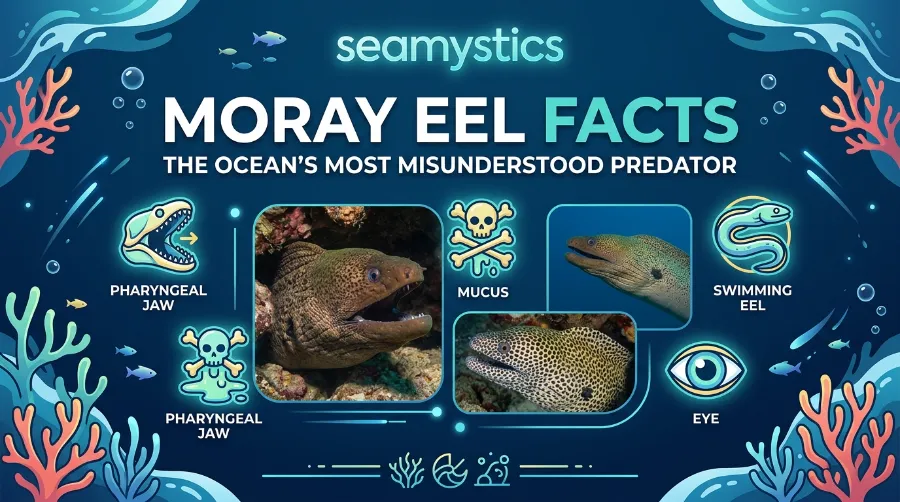
Because their heads are narrow, morays cannot generate the suction that most predatory fish use to swallow prey whole. That single anatomical limit shaped almost everything else about how this animal survives, hunts, and behaves, which brings us to the trait that defines the species.
Lionfish Facts: Why This Beautiful Fish Is an Ocean Threat
Moray Eel Behavior: Why the Open Mouth Isn’t a Threat
This is the single most misunderstood piece of moray eel behavior, and it shows up in nearly every diving forum. Morays constantly open and close their jaws while resting in a crevice, and almost every new diver reads that as aggression. It is not. Without gill covers, a moray has to actively pump water over its gills to breathe, so the gaping mouth is closer to steady breathing than a warning growl.
Actual aggression looks different. A moray that feels cornered will:
- Retreat deeper into its den rather than come forward
- Flatten its body against the reef
- Only strike if a hand or camera enters its immediate strike zone
Research from marine biologist Rita Mehta at UC Santa Cruz, first published in 2007, reshaped how scientists understood moray feeding behavior entirely. Her team used high-speed video and a fluoroscope to film reticulated morays feeding, and what they found looked closer to something from a horror film than ordinary fish biology, as UC Santa Cruz’s own science writers noted when covering the follow-up research.
Barracuda Facts Explained: Why This Fish Has a Fearsome Reputation
The Second Jaw: Moray Eel Bite Mechanics Explained
Here is the moray eel fact that separates this animal from every other fish in the ocean. Most bony fish use pharyngeal jaws, a secondary set of jaws in the throat, purely to crush food further after swallowing. Moray eels do something no other known animal does: they launch those throat jaws forward into the mouth to actively grab and drag prey down the gullet.
The process happens in a fraction of a second:
- The outer jaws clamp down on the prey first.
- Muscles connected near the eel’s skull and chin contract.
- The pharyngeal jaws slide forward through the throat, almost reaching the eel’s eye.
- Those inner teeth grip the prey and haul it backward toward the stomach.
Dissections have shown the eel relies on this internal ratcheting motion roughly 90 percent of the time it feeds. For prey too large to swallow this way, a moray will loop its own body into a knot, brace against the reef, and tear off bite-sized pieces, a technique closer to how a python handles oversized prey than anything typical of a fish.
For anyone worried about a moray eel bite, the actual risk to humans is low. A 2008 case study published in the Journal of Venomous Animals and Toxins found that injuries mostly affect fishermen handling netted or hooked eels, with divers and snorkelers making up a much smaller share, usually tied to hand-feeding or poor visibility rather than unprovoked attacks. If a bite does happen, do not pull straight back. The recurved teeth grip harder under tension, so the safer response is steady, gentle pressure to disengage, followed by immediate wound cleaning and a doctor’s visit, since bites carry a real infection risk.
Hammerhead Shark Facts: Why Their Head Shape Actually Helps Them Hunt
Moray Eel Habitat: Where These Predators Actually Live
Morays are far more adaptable than their coral-reef reputation suggests. While the highest species diversity sits in warm tropical reefs, individual species have carved out niches across a surprising range of environments.
- Coral reefs and rocky crevices: the classic habitat for species like the giant moray and green moray, offering both shelter and ambush points
- Kelp forests: home to the California moray (Gymnothorax mordax), found from Point Conception down through southern Baja California
- Seagrass beds and backreef flats: used by spotted and purplemouth morays, which researchers tracking the Belize Barrier Reef found leave their shelters at night to forage up to 100 meters away before returning by dawn
- Brackish and rare freshwater zones: a handful of species, most notably Gymnothorax polyuranodon, tolerate low-salinity water, an unusual trait for this family
Depth range matters too. Most morays stay within 200 meters of the surface, sticking close to shelter, though deeper-water and mesopelagic species do exist. If you are comparing hunting styles across reef predators, it is worth reading how tiger sharks cover open water versus how morays work reef structure instead, since the contrast says a lot about how differently the reef’s top hunters make a living.
Moray Eel Diet: What They Actually Eat and How
Diet varies noticeably by species, largely dictated by tooth shape. Most morays have long, curved teeth built for gripping slippery prey like fish, octopus, and squid. A smaller group, including the snowflake moray (Echidna nebulosa) and zebra moray (Gymnomuraena zebra), have blunt, molar-like teeth instead, built specifically for crushing crabs and other hard-shelled prey.
| Species | Primary Diet | Typical Habitat |
|---|---|---|
| Green moray | Fish, shrimp, crab, octopus | Reefs, seagrass, mud bottoms |
| Spotted moray | Fish, crustaceans, octopus | Shallow rocky and grassy areas |
| Snowflake moray | Crabs, hard-shelled invertebrates | Reef flats, lagoons |
| California moray | Small fish, octopus, crustaceans | Kelp forests, rocky reefs |
| Giant moray | Fish, crustaceans, other eels | Indo-Pacific reefs |
One of the more remarkable moray eel facts to emerge in the last twenty years involves teamwork most people would never associate with a solitary reef predator. A landmark 2006 study published in PLoS Biology documented giant moray eels and roving coral groupers actively hunting together in the Red Sea, a behavior previously known only in mammals and birds, as detailed in the full research record hosted by the National Institutes of Health. A hungry grouper will approach a resting moray and shake its head rapidly just centimeters from the eel’s face, essentially inviting it to hunt. More than half the time, the moray responds and follows. The grouper cannot reach fish hiding in reef crevices, and the moray struggles to catch fish that flee into open water, so together they close off every escape route. Researchers recorded groupers succeeding roughly five times more often when hunting alongside a moray than when hunting alone.
Electric Eel Facts: How It Generates a Lethal Shock
It is a genuinely rare example of interspecies cooperative hunting, and it reframes the moray from a solo ambush predator into something closer to a strategic reef partner, a nuance that most competing articles on this topic skip entirely.
Common Myths About Moray Eels, Corrected
Divers repeat a handful of claims about morays so often they have become accepted as fact. Most do not hold up.
- Myth: Morays are venomous. Most species are not. The mucus coating some morays does contain a mild toxin, but this is defensive, not offensive, and it is not injected through a bite.
- Myth: A moray bite means guaranteed danger. Bites are uncomfortable and infection-prone, but fatalities are essentially unheard of from the bite itself.
- Myth: Eating moray eel is always safe. It is not. Larger morays, particularly those over roughly 4 kilograms, can accumulate ciguatoxins in their tissue from the reef food chain, and ciguatera poisoning in humans can be severe.
- Myth: Morays hunt only alone at night. As the grouper research above shows, at least some species adjust their hunting schedule and even collaborate across species lines.
If you want a broader sense of how morays stack up against other apex hunters on the reef, our ocean predator rankings guide breaks down where they land compared to great white sharks and hammerhead sharks, two predators that rely on entirely different senses to hunt the same waters.
Cookiecutter Shark Facts: The Tiny Shark That Bites Whales
Diving With Morays Safely
Most encounters end without incident, but a few habits keep it that way. Dive operators across popular moray territory, from the Caribbean to Southeast Asia, tend to repeat the same core advice, and outlets like Scuba Diving magazine and dive resorts such as Murex Resorts in Lembeh echo it consistently:
- Never hand-feed a moray, even if a guide does it, since it teaches the eel to associate hands with food.
- Keep fingers and gear out of crevices you cannot see into.
- Photograph from a slight distance rather than crowding the den entrance.
- Move slowly and predictably near resting eels rather than making sudden motions.
Conservation-focused operators, including groups highlighted by Roatan Divers in Honduras, also point out that morays play a genuine ecological role, keeping reef fish and invertebrate populations balanced, which is one more reason not to disturb them for a photo.
Goblin Shark Facts: The Living Fossil With a Retractable Jaw
FAQ
Are moray eels aggressive toward humans?
No. Most incidents happen when a person’s hand enters a crevice or a moray has been hand-fed and mistakes fingers for food.
How long do moray eels live?
Typically 10 to 30 years, with some tracked spotted morays reaching at least 23 years in the wild.
Can a moray eel bite kill you?
It is extremely unlikely from the bite itself, though infection risk is real and should be treated promptly.
What is the biggest moray eel species?
The slender giant moray (Strophidon sathete), which can reach up to 13 feet in length.
Do moray eels have poor eyesight?
Yes, relatively. They rely heavily on smell to locate prey, which is part of why they hunt so effectively in low light and murky crevices.
Conclusion
The moray eel earns its reputation from a face built for hunting, not from any real hostility toward people. Once you understand the mechanics behind that constant open mouth, the hidden second set of jaws, and even its occasional teamwork with groupers, the animal stops looking like a monster and starts looking like what it actually is: one of the reef’s most efficient, adaptable predators. The next time you spot one holding still in a crevice, you are not looking at a threat. You are watching millions of years of specialized engineering, quietly breathing.
Quiz: Test Your Moray Eel Knowledge
- What allows moray eels to swallow large prey without suction?
A) Extra-wide gill covers B) Pharyngeal jaws C) Venomous saliva D) Flexible ribs - Which reef predator has been observed hunting cooperatively with giant morays?
A) Barracuda B) Grouper C) Sea turtle D) Clownfish - Why do moray eels keep their mouths open while resting?
A) To threaten intruders B) To regulate body temperature C) To breathe D) To display teeth for mating
Answers: 1) B – Pharyngeal jaws, 2) B – Grouper, 3) C – To breathe
References
- Mehta, R. and Wainwright, P. (2007), pharyngeal jaw feeding research, University of California, Santa Cruz
- Bshary, R. et al. (2006), “Cooperative Hunting in Groupers and Giant Moray Eels,” PLoS Biology, hosted via National Institutes of Health
- Barreiros, J.P. and Haddad Jr., V. (2008), “Bite by Moray Eel,” Journal of Venomous Animals and Toxins
- Scuba Diving Magazine, moray eel facts
- Murex Resorts, moray eel behavior notes
- Roatan Divers, moray eel conservation notes