
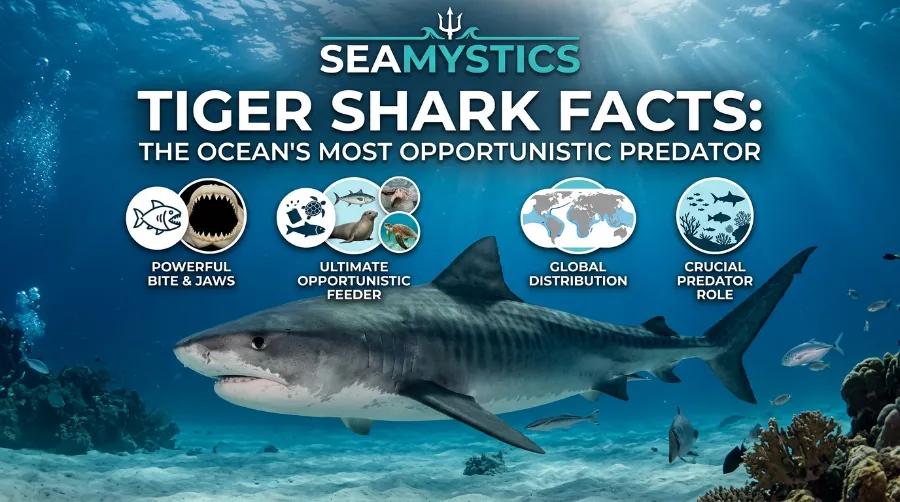

A fisherman off Maui once pulled up a tiger shark with a car license plate lodged in its stomach. That single detail sums up why these animals fascinate researchers more than almost any other shark: nothing in the ocean is truly off the menu for them. In this guide, we’re pulling together the tiger shark facts that actually hold up under scrutiny, drawn from recent tracking studies, fishery data, and firsthand observation, not recycled trivia. You’ll walk away knowing exactly how big they get, what they eat, where they live, and how they behave, along with a few surprises even longtime shark fans tend to miss.
TL;DR: Tiger sharks are large, wide-ranging predators that can grow past 16 feet, eat almost anything from sea turtles to old tires, and roam tropical and temperate waters worldwide. Recent tracking has revealed migrations of over 17,000 kilometers and a newly documented seasonal mating site off Maui. They’re currently listed as Near Threatened, mainly due to fishing pressure.
Key Takeaways
| Fact Category | What the Data Shows |
|---|---|
| Average size | 10 to 14 feet, 850 to 1,400 pounds; largest confirmed over 18 feet |
| Diet | Widest food spectrum of any shark: turtles, rays, birds, squid, even debris |
| Habitat | Tropical and temperate waters worldwide except the Mediterranean |
| Migration record | Over 17,000 km (10,500 miles) tracked in 468 days |
| Conservation status | Near Threatened (IUCN), population trend largely unknown |
| Human risk | Second only to great whites in recorded attacks, but incidents remain rare |
Tiger Shark Size Facts: Just How Big Do They Get?
Among the tiger shark size facts people ask about most, the numbers are genuinely impressive. On average, adults measure 10 to 14 feet long and weigh between 850 and 1,400 pounds, with females typically larger than males. Some individuals, however, push well past that. The tiger shark is capable of attaining a length over 5 meters, or roughly 16 feet 5 inches, and multiple accounts describe specimens reaching 18 to 25 feet. earth
Hammerhead Shark Facts: Why Their Head Shape Actually Helps Them Hunt

What sets tiger sharks apart visually is their pattern. Their vertical stripes appear mainly on juveniles and fade as the animal ages, so a heavily striped shark is almost always young, while a faded, nearly uniform gray adult is older. This single visual cue is one of the fastest ways divers and researchers tell age apart in the field. PBS
A few more numbers worth knowing:
- Litters range from roughly 10 to 80 pups per birth, depending on the mother’s size and region.
- Gestation lasts about 14 to 16 months, among the longest of any shark species.
- Lifespan can reach up to 50 years in the wild.
For comparison against other large predators, only the whale shark, basking shark, and great white consistently grow larger, which is why tiger sharks are often ranked as the fourth-largest predatory shark in the ocean.
Barracuda Facts Explained: Why This Fish Has a Fearsome Reputation
Tiger Shark Diet: Why They’re Called the Garbage Cans of the Sea
If there’s one trait that defines tiger shark behavior more than any other, it’s their appetite. The tiger shark is notable for having the widest food spectrum of all sharks, preying on crustaceans, fish, seals, birds, squid, turtles, sea snakes, dolphins, and even smaller sharks. That range alone separates them from more specialized hunters like the great white, which leans heavily on marine mammals. earth
Goblin Shark Facts: The Living Fossil With a Retractable Jaw
The tiger shark diet doesn’t stop at living prey, either. These sharks have been documented eating garbage, including metal, plastic, burlap bags, and almost anything else discarded in the sea. A widely cited case from Australia in May 2022 makes the point vividly: researchers watched a tagged tiger shark regurgitate an entire echidna, a spiny land mammal, confirming the animal genuinely will attempt almost anything that ends up in the water. One researcher involved in the 2020 to 2023 tagging project noted the sharks are essentially scavengers, having previously observed footage of one attempting to eat a rock for no apparent reason. oceanasbs
Their hunting toolkit backs this up. Tiger sharks use excellent senses of sight and smell to hunt, and their sharp, highly serrated teeth and powerful jaws let them crack the shells of sea turtles and clams, something few other sharks can manage. That bite force is a major reason turtles feature so heavily in their diet compared to other predators. PBS
Great White Shark Facts 2026: Separating Myth From Marine Science
Tiger Shark Habitat: Where These Predators Actually Roam
Tiger shark habitat spans an enormous range. They are found throughout the world in temperate and tropical waters, moving between open ocean and shallow coastal zones, with one notable gap: the Mediterranean Sea is essentially absent from their range. oceana
Recent tracking has completely rewritten how scientists understand their movement patterns. A Nova Southeastern University study tracking sharks over two years recorded one individual logging more than 27,000 miles, likely the longest track ever recorded for any shark, and found the animals travel about 4,660 miles round-trip annually between Caribbean reefs and the open mid-North Atlantic. That contradicted the older assumption that tiger sharks mostly hug coastlines. Fox News
Electric Eel Facts: How It Generates a Lethal Shock
A more recent study pushed the numbers even further. Researchers following 35 of the largest tiger sharks ever monitored, most of them adult females, recorded one individual traveling over 17,000 kilometers, roughly 10,500 miles, in just 468 days, a distance comparable to swimming from New York to Australia. georgiaaquarium
Quick regional snapshot:
- Atlantic populations range from Cape Cod down to Uruguay, including the Gulf of Mexico and Caribbean.
- Pacific populations cluster heavily around Hawaiian and central Pacific islands.
- Indian Ocean populations, including the Arabian Sea, face some of the heaviest fishing pressure recorded.
If you want the fuller picture of how tiger sharks compare to other apex hunters by range and role, our ocean predator ranking guide breaks that down species by species.
Tiger Shark Behavior: Not as Solitary as We Thought
For decades, tiger shark behavior was described as almost entirely solitary and nocturnal, with reproduction assumed to happen through chance encounters across vast ranges. A study released in January 2026 challenged that directly. Researchers from the University of Hawaii at Manoa’s Shark Lab identified what appears to be the first documented seasonal mating site for tiger sharks, based on six years of tracking data off Olowalu, Maui, revealing a predictable annual gathering of mature males and females rather than random encounters. earthsky
Lionfish Facts: Why This Beautiful Fish Is an Ocean Threat
Lead author Paige Wernli put it plainly: tiger sharks typically roam widely in patterns that can look random, which made the strong, consistent seasonal trend around Maui genuinely unexpected. This is exactly the kind of finding that reshapes conservation planning, since protecting a known mating aggregation site is far more actionable than trying to protect an entire ocean basin. earthsky
From a working-biologist perspective, this fits a pattern we see again and again in elasmobranch research: species we label “solitary” often turn out to have structured social behavior we simply hadn’t tracked long enough to notice. Acoustic tagging is doing for tiger sharks what it did for great whites a decade ago, quietly overturning textbook assumptions one tagged individual at a time.
Moray Eel Facts: The Ocean’s Most Misunderstood Predator
Conservation Status and Why It Matters
Tiger sharks currently sit at Near Threatened on the IUCN Red List, but that label understates regional pressure in places. A tiger shark population off the coast of Queensland, Australia has fallen by at least 71 percent, largely due to overfishing and bycatch. Fishery data from other regions tells a similar story. foursixty
A 2024-2025 study from the Arabian Sea, one of the world’s most heavily fished shark regions, found concerning signs. Length-frequency data from 629 tiger sharks landed at Cochin over 16 months in 2023 to 2024 showed fishing mortality and exploitation rates high enough that close to 95 percent of catches were immature individuals. That statistic matters more than it might first appear: removing sharks before they reach reproductive age is one of the fastest ways to collapse a slow-breeding species’ population. dakshin
Ocean Predators Ranked: From Reef Hunters to Deep-Sea Killers
Given their 14 to 16 month gestation and modest litter frequency, tiger sharks simply can’t rebound from heavy fishing the way faster-breeding fish can. For more on how bycatch and fishing gear specifically threaten large marine predators, our ocean threats overview covers the mechanics in more depth.

A Quick Note on Human Encounters
Tiger sharks do rank second only to great whites in recorded attacks on humans, and that reputation is well earned given their indiscriminate feeding habits. But the actual numbers stay small worldwide each year, and most encounters are non-fatal. Context matters more than headlines here: you are still far more likely to be hurt driving to the beach than by a tiger shark once you’re in the water.
Cookiecutter Shark Facts: The Tiny Shark That Bites Whales
Frequently Asked Questions
How big do tiger sharks actually get?
Most adults reach 10 to 14 feet and 850 to 1,400 pounds, though confirmed individuals have exceeded 18 feet.
What do tiger sharks eat the most?
Diet varies by region, but turtles, rays, bony fish, squid, and smaller sharks make up the bulk of it, alongside occasional inedible debris.
Where do tiger sharks live?
Tropical and temperate waters worldwide, from coastal reefs to open ocean, with the Mediterranean Sea as a notable exception.
Are tiger sharks dangerous to humans?
They’re capable of serious harm and rank second in recorded attacks after great whites, but incidents remain statistically rare.
How long do tiger sharks live?
Estimates put maximum lifespan around 50 years in the wild.
Are tiger sharks endangered?
They’re listed as Near Threatened, with some regional populations, like parts of Queensland, showing declines over 70 percent.
Conclusion
Tiger sharks earn their reputation as the ocean’s most opportunistic predator honestly. Between an almost limitless diet, migrations spanning tens of thousands of kilometers, and behavior patterns researchers are still actively rewriting, there’s genuinely more to learn here than most marine species offer. If you’re building out a broader picture of ocean hunters, start with our homepage for the full Sea Mystics species library, or dive into the ocean predator ranking to see how tiger sharks stack up against orcas, great whites, and other apex hunters.
Quick Quiz: Test Your Tiger Shark Knowledge
1. What is the average length of an adult tiger shark?
A) 5 to 8 feet
B) 10 to 14 feet
C) 20 to 25 feet
Answer: B
2. What makes tiger sharks unique compared to most other shark species?
A) They only eat fish
B) They have the widest food spectrum of all sharks
C) They live exclusively in the Mediterranean
Answer: B
3. What did the 2026 University of Hawaii study discover?
A) A new tiger shark species
B) The first documented seasonal mating site for tiger sharks
C) That tiger sharks never migrate
Answer: B
4. What is the tiger shark’s current IUCN conservation status?
A) Least Concern
B) Near Threatened
C) Critically Endangered
Answer: B
5. How far did the longest recorded tiger shark migration track?
A) About 500 miles
B) About 5,000 miles
C) Over 17,000 kilometers (roughly 10,500 miles)
Answer: C
References
- Oceana, “Tiger Shark,” oceana.org/marine-life/tiger-shark/
- Shark Angels, “Tiger Shark,” sharkangels.org/tiger-shark/
- Circle Divers, “Tiger Shark Facts,” circledivers.com/blog/tiger-shark-facts
- National Geographic, “Tiger Shark,” nationalgeographic.com/animals/fish/t/tiger-shark/
- EarthSky, “Tiger Shark Mating Site Identified Off Maui,” January 2026
- ScienceDaily / Nova Southeastern University, tiger shark migration tracking study
- Georgia Aquarium, “Secret Journeys of Giant Tiger Sharks”