
Imagine a pale pink shark with a long, flat snout and a jaw that shoots out of its face like a spring. That is the goblin shark, and it looks more like a movie monster than a real animal. These goblin shark facts will show you why scientists still call it one of the strangest fish in the sea.
In my years of reviewing deep sea records, I have seen few animals that make people stop scrolling like this one. Below, I explain how the jaw works, where the shark lives, and what its rare appearances tell us about the deep ocean.
Key Takeaways
| Topic | Quick Answer |
|---|---|
| Scientific name | Mitsukurina owstoni |
| First described | 1898, from a specimen caught near Yokohama, Japan |
| Typical size | About 3 to 4 meters (10 to 13 feet) |
| Depth range | Mostly 200 to 1,000 meters, with records to about 1,300 meters |
| Famous feature | A retractable jaw that snaps forward to grab prey |
| Group | The only living member of its family, Mitsukurinidae |
| Conservation status | Least Concern, though data are thin |
| Danger to people | Very low, because it lives too deep to meet swimmers |
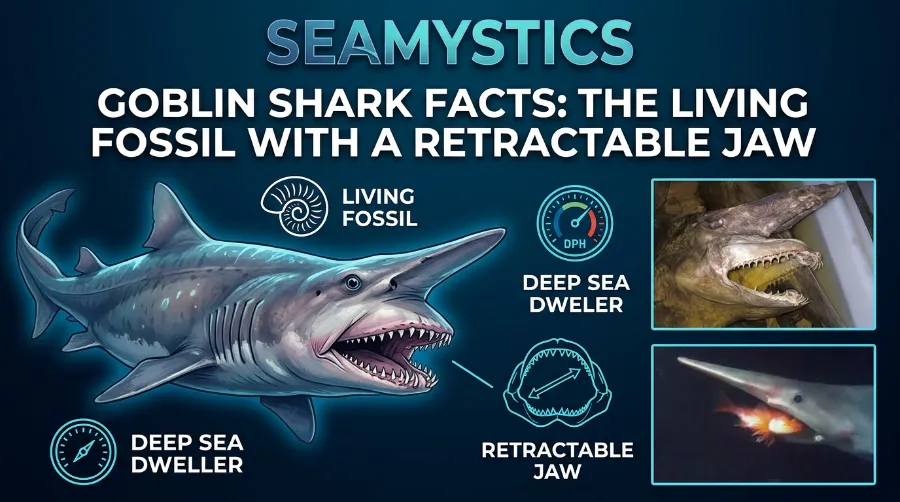
TL;DR: The goblin shark is a rare deep sea shark and a true living fossil. Its family goes back roughly 125 million years. It hunts in dark water with a slingshot jaw that can reach out about 9% of its body length in a fraction of a second.
What Makes These Goblin Shark Facts So Surprising?
Most sharks look like torpedoes. The goblin shark looks like something from a fever dream. It has a long blade-like snout, soft flabby skin, tiny eyes, and nail-shaped teeth that stick out like fence posts.
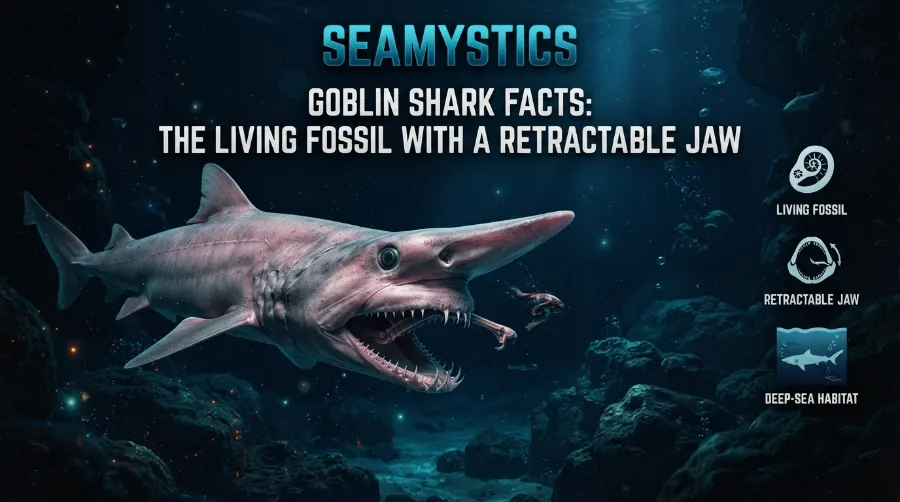
Its color also surprises people. The skin is pale pink, yet the color does not come from pigment. Instead, the skin is thin enough to show blood vessels underneath. Once the shark dies or leaves the deep sea, the pink often fades to gray or brown.
Lionfish Facts: Why This Beautiful Fish Is an Ocean Threat
Because of these odd traits, scientists put the goblin shark in its own family. No close cousin lives today. That fact alone makes it a strong candidate for the title of living fossil shark.
A Quick Look at Its Body
The body is soft and loose. The muscles are weak compared with fast swimmers like the mako. The tail has a long upper lobe and a short lower lobe, and the fins are small and rounded.
These features match a slow, cruising lifestyle. The shark does not chase prey across open water. Rather, it glides, waits, and strikes only when food gets close.
Where Did the Goblin Shark Come From?
The story starts in 1898. A fisherman near Yokohama, Japan, pulled up a strange shark, and the American ichthyologist David Starr Jordan described it soon after. Jordan named the species after Kakuji Mitsukuri, a Japanese zoologist, and Alan Owston, the man who had collected the specimen.
For decades, scientists knew only a handful of animals. Many of those came from Japanese fishing nets. As a result, people thought the goblin shark lived only near Japan.
That idea changed. Today, records come from many parts of the world, including waters near Australia, New Zealand, South Africa, Portugal, and the Gulf of Mexico. So the species is not truly local. It is simply hard to find.
Why the Living Fossil Label Fits
The family Mitsukurinidae has a fossil record that stretches back more than 100 million years. Related sharks, such as the extinct Scapanorhynchus, swam in Cretaceous seas when dinosaurs still walked on land.
However, “living fossil” needs care. The goblin shark itself has kept evolving. It has not stayed frozen in time. What is true is that its body plan has changed slowly, and its family has no close living relatives. That is why the phrase works as a helpful shortcut, but not as a strict scientific rule.
The Goblin Shark Jaw: How the Slingshot Works
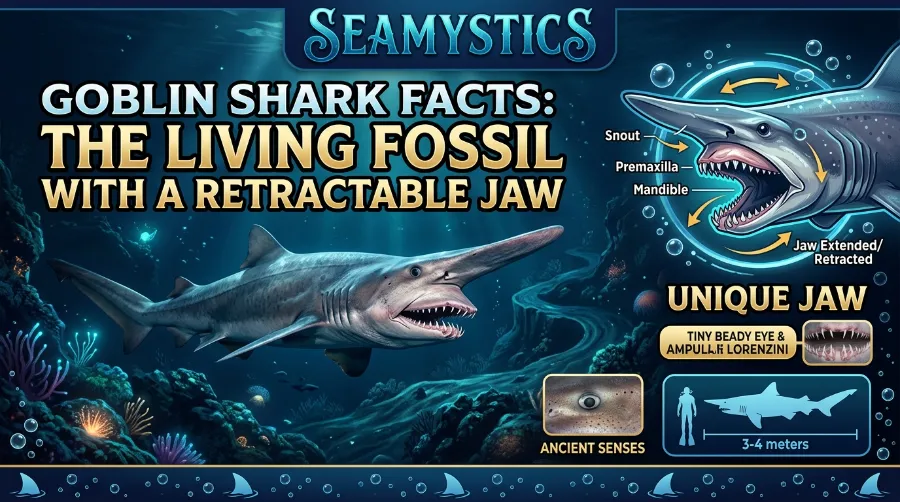
The goblin shark jaw is the main reason this animal became famous. When the shark relaxes, the jaws sit tucked back under the head. When prey comes near, both jaws launch forward together.
Cookiecutter Shark Facts: The Tiny Shark That Bites Whales
Japanese researchers filmed a live juvenile and measured the strike. They found that the jaws can extend by roughly 9% of the shark’s body length. The peak speed reached about 3 meters per second, which is fast enough to surprise squid and small fish in dark water.
Here is how the strike works, step by step:
- The shark drifts slowly near its target, using smell and electric signals to find it.
- Ligaments in the jaw stretch like elastic bands as the mouth stays closed.
- A muscle releases the tension, and the jaws shoot forward.
- The nail-like front teeth pin the prey.
- The jaws pull back, and the shark swallows the meal.
Why a Slow Shark Needs a Fast Jaw
Deep water gives few second chances. A slow swimmer cannot outrun a squid. Therefore, the goblin shark uses a trap instead of a chase. The jaw closes the gap in a blink, and the prey has almost no time to escape.
Engineers have noticed this trick. Biologists compare it to a spring-loaded tool, because energy builds up slowly and then releases at once. My own view, based on comparing feeding notes across many deep sea species, is that this design lets the shark spend very little energy in a habitat where meals are rare.
Electric Eel Facts: How It Generates a Lethal Shock
The Teeth Tell a Story
The teeth also show how the shark eats. The front teeth are long and thin, so they grab and hold. The back teeth are smaller and flatter, so they crush shells and soft armor.
That mix suggests a varied diet. Stomach studies support this idea. They have found deep sea fish, squid, and crustaceans such as crabs and shrimp.
Goblin Shark Habitat: Where Does It Live?
The goblin shark habitat sits in the deep, dark parts of the ocean. Most records come from the outer continental shelf and the upper slope, where the sea floor drops away into deeper water.
The shark seems to prefer depths between about 200 and 1,000 meters. That layer is often called the twilight zone, because only a faint blue glow reaches it. Below that zone, sunlight disappears completely.
Here is a simple bar chart of where scientists most often report goblin sharks. Each block stands for a rough share of published depth records.
| Depth Band | Share of Records | Chart |
|---|---|---|
| 0 to 200 m | Rare | █ |
| 200 to 500 m | Common | █████████ |
| 500 to 1,000 m | Most common | ██████████████ |
| 1,000 to 1,300 m | Uncommon | ███ |
The chart is a simple summary of patterns in published records, not a precise count. Still, it shows that the shark favors mid-depth water.
Global Range
Researchers have logged the species in the western Pacific, the Atlantic, and the Indian Ocean. Japan remains the best-known hotspot, and Taiwan, Australia, and New Zealand also produce steady reports.
Some sightings come from unlikely places. In 2000, for example, a goblin shark surfaced in the Gulf of Mexico, far from its early Japanese records. Later, trawl catches off Portugal added even more proof that the species crosses ocean basins.
Why Sightings Stay Rare
We rarely see this animal for three simple reasons. First, it lives deep. Second, it moves slowly and stays away from humans. Third, most people meet it only when a fishing net drags it upward.
For that reason, every new record adds real value. Each capture tells scientists a little more about size, diet, and range. Consequently, it makes sense that people call it a rare deep sea shark, even though the species may be more widespread than we know.
Size, Weight, and Growth
Adult goblin sharks usually measure 3 to 4 meters long. A large male can weigh around 200 kilograms. Some old reports claim animals near 5 to 6 meters, but scientists treat those numbers with caution because the specimens were never measured well.
| Measure | Typical Value |
|---|---|
| Length | 3 to 4 m (10 to 13 ft) |
| Weight | Up to about 200 kg (440 lb) |
| Snout | Long, flat, blade-like |
| Skin color | Pale pink in life |
| Estimated lifespan | Unknown, likely decades |
Growth rates are also a puzzle. Scientists have not aged many goblin sharks, so lifespan estimates remain guesses. Because deep sea sharks tend to grow slowly and mature late, experts assume the goblin shark follows the same pattern.
What Does the Goblin Shark Eat?
The diet mirrors the deep sea menu. Squid, octopus, bony fish, and crustaceans all show up in stomach contents. Deep water offers little food, so the shark eats whatever comes near.
The long snout carries a special tool. It is packed with tiny electric sensors called ampullae of Lorenzini. These sensors pick up faint signals from living animals, even in total darkness. As a result, the shark can find hidden prey in mud or shadow.
How It Compares With Other Ocean Predators
If you want to place the goblin shark in context, read the ocean predator ranking on our site. The goblin shark would land low on speed and power, but high on strangeness.
A tiger shark eats almost anything and patrols shallow reefs. A great white shark uses speed and raw force to hit seals. By contrast, the goblin shark waits and springs a trap.
Other odd hunters follow their own rules. The hammerhead shark scans the sea floor with its wide head, while the cookiecutter shark bites round plugs out of bigger animals. Meanwhile, a moray eel hides in rock holes, and a barracuda relies on quick bursts of speed.
Reproduction and Life Cycle: What We Still Don’t Know
Very little is known here. Scientists have never watched goblin sharks mate. They have never seen a birth, and they have never found a nursery.
Only a few pregnant females have ever been examined. In 2000s records from Japan and elsewhere, some females held eggs or small embryos, which suggests the species reproduces in a way common to related sharks. Still, no one has confirmed the details.
That gap matters for conservation. Without knowing how many young a female has, managers cannot judge whether a population can recover from fishing pressure.
Is the Goblin Shark Dangerous?
The short answer is no. The goblin shark has never been linked to a confirmed attack on a person. It lives too deep, and it feeds on small prey.
The teeth look scary, yet they suit grabbing squid, not people. Even so, a live animal in a net should be handled with care, since the jaw can snap out fast.
Conservation: Is the Goblin Shark Endangered?
The IUCN Red List currently places the species in the Least Concern category. That sounds good, but the label hides a real problem. Experts call it a data problem, because researchers have too few numbers to judge population trends.
Fishing is the main known threat. Goblin sharks show up as bycatch in deep trawls and gillnets, especially near Japan and in parts of the Atlantic. In many cases, the animal dies before anyone can record where it was caught.
Groups such as Oceana list the shark among the deep sea species that need better tracking. Similarly, the Shark Trust explains how deep fishing overlaps with the shark’s range, and Shark Angels shares a clear look at how the jaw snaps forward. For a museum-level profile, the Florida Museum keeps a species page that covers the basics.
What Would Help Most
Here is what experts say would make a real difference:
- Better records of every accidental catch, including depth and location
- Photos and tissue samples from stranded or netted animals
- Limits on deep trawling in places where the shark is common
- More funding for deep sea surveys with cameras and remotely operated vehicles
Practical Insights From Reviewing Goblin Shark Records
When I compare published reports, three patterns stand out. First, most well-documented animals are males, which may reflect how they behave or where fishers work. Second, the shark appears more often near steep slopes than over flat sea floor. Third, bad photos spread false ideas fast, so old pictures of dead animals with stretched jaws still mislead readers.
This last point matters more than people think. Many viral images show a shark with the jaw pulled out and frozen. In reality, the jaw normally rests tucked away, and only snaps out during feeding. If you plan to share a photo, check whether it shows a natural pose.
A Simple Case Study: The 2000 Gulf of Mexico Catch
In 2000, a goblin shark turned up in the Gulf of Mexico, a place where few people expected to find one. The event showed that the species is not limited to the western Pacific. It also proved that a single lucky catch can change how scientists draw a map.
The lesson here is simple. Sparse data can hide the true range of an animal for over a century, as it did here.
Why Deep Sea Sharks Matter to You
You may wonder why a shark you will never see should matter. The answer starts with balance. Deep sea predators help control squid and fish numbers, and those animals feed on smaller creatures that move carbon down from the surface.
In addition, the goblin shark gives engineers and doctors a good example of natural design. Its jaw inspires work on fast, low-energy motion. Meanwhile, its odd body shows how life adapts to darkness and pressure.
Finally, the shark reminds us how much of the ocean stays unexplored. Scientists estimate that we have mapped only a small portion of the deep sea floor in high detail. New species turn up every year, and old ones, like this one, still hold secrets.
Goblin Shark Facts at a Glance: Quick Comparison
| Feature | Goblin Shark | Great White | Cookiecutter Shark |
|---|---|---|---|
| Typical depth | 200 to 1,000 m | 0 to 250 m | 0 to 3,700 m (migrates) |
| Typical length | 3 to 4 m | 4 to 5 m | About 0.5 m |
| Main strategy | Slingshot jaw ambush | Speed and power | Plug-cutting bites |
| Human risk | Very low | Low but real | Very low |
Frequently Asked Questions About Goblin Sharks
How big does a goblin shark get?
Most adults reach 3 to 4 meters. Unconfirmed reports suggest a few might grow larger.
Why is the goblin shark pink?
Its skin is thin and lacks strong pigment, so blood vessels show through. The pink often fades after death.
Can a goblin shark hurt a human?
No confirmed attack exists. The species lives far below where people swim or dive.
How fast does the goblin shark jaw move?
Filmed strikes reached about 3 meters per second, with the jaws extending around 9% of the body length.
Where can you find goblin sharks?
They live in deep water around Japan, Australia, New Zealand, South Africa, Portugal, and the Gulf of Mexico, most often between 200 and 1,000 meters.
Are goblin sharks endangered?
The IUCN lists them as Least Concern, but scientists warn that the data are limited and bycatch may harm local groups.
Why is it called a living fossil?
Its family is very old and has no close living relatives, so it gives a rare window into ancient shark life.
Five Question Quiz: Test Your Goblin Shark Facts
- What is the scientific name of the goblin shark?
a) Carcharodon carcharias
b) Mitsukurina owstoni
c) Sphyrna lewini - About how far can the goblin shark jaw extend?
a) 1% of body length
b) 9% of body length
c) 50% of body length - In which depth range do goblin sharks appear most often?
a) 0 to 50 m
b) 200 to 1,000 m
c) 4,000 to 6,000 m - True or false: The goblin shark’s pink color comes from strong pink pigment.
- True or false: There is a confirmed record of a goblin shark attacking a person.
Answers: 1) b. 2) b. 3) b. 4) False, since the color comes from blood vessels showing through thin skin. 5) False.
Conclusion
The goblin shark proves that the deep sea still holds real surprises. Its slingshot jaw, pale skin, and ancient family line make it one of the most striking animals on Earth. At the same time, it stays a rare deep sea shark, so every photo, catch, and observation helps fill in a very incomplete picture. If you enjoyed these goblin shark facts, keep exploring the Sea Mystics library, because more odd and wonderful predators wait below the waves.
References
- Jordan, D. S. (1898). Description of a species of fish (Mitsukurina owstoni) from Japan, the type of a distinct family of lamnoid sharks. Proceedings of the California Academy of Sciences.
- IUCN Red List of Threatened Species, entry for Mitsukurina owstoni.
- Oceana, Goblin Shark species profile.
- Shark Trust, Creature Feature: Goblin Shark.
- Shark Angels, The Snappy Jaws of the Goblin Shark.
- Florida Museum, Discover Fish species profile for Mitsukurina owstoni.