

A great white surfaced twenty feet from my research skiff off Guadalupe Island the first time I studied one up close. It did not thrash or lunge. Instead, it looked at us, turned, and slipped back under the swell like it had somewhere better to be. That single moment undid almost everything I thought I knew about this animal, and it is why I still spend a third of every year in a cage watching them.
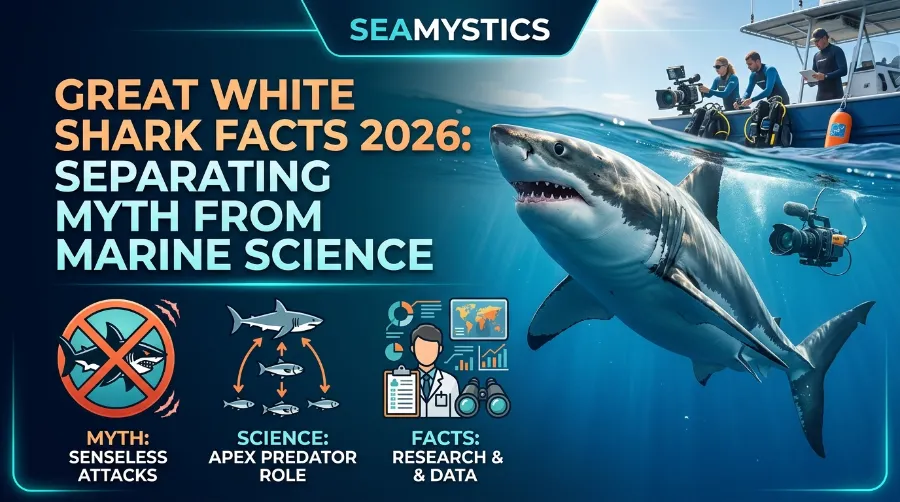
Great white sharks carry more myth per square inch of skin than almost any animal on Earth, and most of it traces back to a movie rather than a marine biology textbook. This guide pulls apart real great white facts, the great white behavior patterns researchers track today, and the great white attack myths that refuse to die, using current data instead of recycled trivia. You will also see where the science on great white size and population has genuinely shifted in recent years.
TL;DR
Great whites (Carcharodon carcharias) grow to roughly 15 to 20 feet. Numbers are recovering across parts of the US Atlantic and Pacific coasts after decades of decline. Fatal encounters remain far rarer than public perception suggests. ISAF confirmed 65 unprovoked bites worldwide in 2025, a small fraction of total ocean users, and most were brief exploratory bites rather than sustained predatory attacks.
Key Takeaways
| Fact | Detail |
|---|---|
| Average adult length | 15–20 ft (4.6–6 m) |
| Average adult weight | 1,800–4,200 lbs (800–1,900 kg) |
| Teeth | Around 300 arranged in rows, constantly replaced |
| Top speed | Up to 25 mph in short bursts |
| Lifespan | 40–70+ years |
| 2025 unprovoked bites worldwide | 65 confirmed (ISAF) |
| Conservation status | Vulnerable (IUCN); recovering in parts of its range |
What Great White Sharks Actually Are
The great white shark belongs to the lamnid family, alongside the mako and porbeagle, and it is built for cool, oxygen-rich water rather than the warm tropics people associate with “shark-infested” beaches. Its torpedo-shaped body, partially warm-blooded circulatory system, and oversized liver make it the largest predatory fish alive today. That liver alone can weigh close to a quarter of the shark’s total body mass.
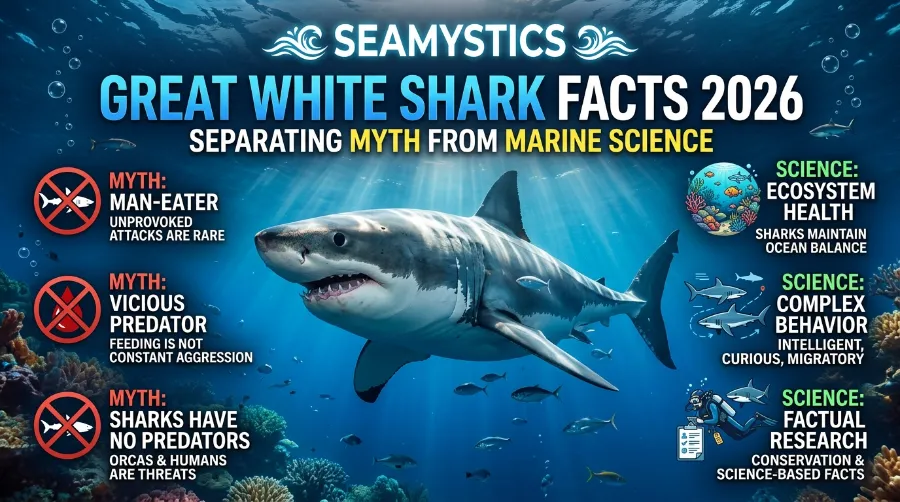
Few articles mention how much that warm-blooded trait, called regional endothermy, actually matters. A great white keeps its muscles and eyes several degrees warmer than the surrounding ocean, so it hunts effectively in cold water where most fish would move sluggishly. This single adaptation separates great white behavior from nearly every other shark species, including the tiger shark it often gets confused with in casual conversation.
Barracuda Facts Explained: Why This Fish Has a Fearsome Reputation
Great White Size, By The Numbers
Sensational headlines love to round up. Field measurements tell a steadier story:
- Adult females typically run 15 to 21 feet and grow noticeably larger than males of the same age.
- Adult males average 11 to 13 feet.
- Confirmed weights cluster between 1,800 and 4,200 pounds, with outliers reported near 5,000 pounds.
- Newborn pups measure 4 to 5 feet at birth, letting them hunt fish and small rays from day one.
For a size comparison against other apex predators sharing the same waters, our ocean predator ranking breaks down size and bite force by species. Our companion piece on tiger shark facts is worth a look too, since the two are frequently mixed up by non-divers.
Great White Behavior: What Twenty Years In The Water Taught Me
Most of what people call “shark behavior” is actually shark reaction, filmed out of context. Great whites rely on a mix of senses most people never learn about, and that toolkit explains a lot of what looks mysterious from the surface.
Electroreception lets them detect the faint electrical field of a heartbeat from several feet away, through organs called the ampullae of Lorenzini. This is part of why a great white can find a hidden stingray under sand without ever seeing it. Scent plays an equally large role: field research summarized by the Shark Trust suggests these sharks can detect a drop of blood diluted across an area roughly the size of a swimming pool. None of that makes them mindless killing machines. It makes them cautious, deliberate hunters that test unfamiliar objects before committing to them, which explains why so many “attacks” on humans amount to a single bite followed by the shark swimming off.
Tiger Shark Facts: The Ocean’s Most Opportunistic Predator
Patterns From Recent Tagging Studies
A few behavioral patterns stand out from tracking data collected over the last decade:
- Site fidelity: individual sharks return to the same coastal aggregation sites, such as Guadalupe Island or Cape Cod, year after year.
- Seasonal migration: many Pacific great whites travel to a mid-ocean zone nicknamed the “White Shark Café” to feed and, researchers suspect, breed.
- Depth cycling: tagged sharks regularly dive below 1,000 feet during the day and surface at night, a pattern still not fully explained.
- Social hierarchy: larger, older sharks get first access to a carcass, while younger sharks wait their turn instead of fighting for it.
Groups like Ocearch have made this kind of tracking data public in recent years. Their maps have quietly rewritten assumptions about migration routes that field biologists held just fifteen years ago.
Moray Eel Facts: The Ocean’s Most Misunderstood Predator
Great White Attack Myths, Corrected With 2025 Data
This is the part most competitor blogs skip or oversimplify, so let’s use the newest numbers available. ISAF investigated 105 alleged shark-human interactions worldwide in 2025 and confirmed 65 as unprovoked bites, with 29 classified as provoked. A provoked bite happens when a person initiates contact with a shark, such as during spearfishing, while trying to touch or feed one, or while removing one from a net.
That single distinction dismantles a large chunk of shark-attack mythology. A meaningful share of what people casually call “shark attacks” actually involves a human-initiated encounter, not an ambush.
Cookiecutter Shark Facts: The Tiny Shark That Bites Whales
Myth 1: Great whites are the most dangerous shark to humans
Great whites appear in more recorded bites than most species largely because they are large, coastal, and easy to identify afterward. Bull sharks and tiger sharks operate in shallower, more crowded waters and get implicated in a comparable share of serious encounters, even though headlines rarely name them.
Myth 2: A shark attack is almost always fatal
Nine of the confirmed unprovoked bites worldwide in 2025 proved fatal, against a ten-year average of roughly six deaths a year. The vast majority of bites, including most attributed to great whites, are survivable single strikes, not the sustained attacks shown in films.
Lionfish Facts: Why This Beautiful Fish Is an Ocean Threat
Myth 3: Great whites hunt humans as prey
Stomach content studies consistently find almost no human remains in great white diets. Researchers, including those cited by the World Wildlife Fund, point to a simpler explanation: most bites on surfers and swimmers are investigative or mistaken-identity strikes, where a shark briefly confuses an unfamiliar silhouette at the surface for a pinniped.
Myth 4: Shark numbers are exploding and beaches are more dangerous than ever
The real story runs more nuanced. Global unprovoked bites in 2025 sat close to the recent five and ten year averages rather than spiking dramatically. Much of the increase researchers noted ties back to more people in the water and more sharks recovering in specific regions, not a sudden behavioral shift.This data covers all shark species, not just great whites, but it puts the “shark attack epidemic” myth in proportion. The US and Australia dominate the count because they have the most ocean users, not because sharks are hunting more aggressively there.
Hammerhead Shark Facts: Why Their Head Shape Actually Helps Them Hunt
Great White Facts Even Divers Get Wrong
A handful of details rarely make it into competitor roundups, despite being well documented:
- Great whites are ovoviviparous. Pups develop inside eggs that hatch within the mother, and she gives live birth to a litter of 2 to 10 pups.
- They can go over a month between meals after a large feed, since a single seal can supply enough calories for roughly six weeks.
- Dermal denticles cover their skin, reducing drag through tooth-like scales. Competitive swimwear brands copied the same idea in the 2000s, before it was banned from Olympic competition.
- Bite force estimates for great whites exceed 4,000 psi in some studies, though live bite-force data on this species remains limited compared to lab-tested species like the bull shark.
- Cage-diving encounters off South Africa and Guadalupe Island now fund a meaningful share of tagging research, meaning ecotourism directly subsidizes the conservation science protecting the species.
Ocean Predators Ranked: From Reef Hunters to Deep-Sea Killers
Population Recovery: A Regional Story, Not a Global One
Population science on this species has swung back and forth for over a decade, and it deserves an honest accounting rather than whichever number sounds best. Early Stanford-led estimates from the 2010s suggested alarmingly low numbers along the Eastern Pacific. Florida shark researcher George Burgess later reassessed that data and argued it undercounted the population by roughly tenfold, based on broader tagging across known aggregation sites.
Goblin Shark Facts: The Living Fossil With a Retractable Jaw
NOAA-backed research covering the Western North Atlantic has since pointed toward genuine recovery. Researchers credit the 1997 federal ban on targeted great white fishing, along with rebounding seal populations, as the two biggest drivers. Separately, genetic sampling by Australia’s CSIRO estimated the east coast Australian population at roughly 5,460 sharks, with a plausible range up to nearly 12,800 once juveniles were factored in.
Electric Eel Facts: How It Generates a Lethal Shock
The IUCN still lists the species as Vulnerable globally. Mediterranean populations in particular remain a fragile, declining “ghost population,” even as North American numbers trend upward. Recovery is real in places, but it isn’t universal, so treating it as a single global trend line oversimplifies the data.
FAQ
How big do great white sharks get?
Most confirmed adults measure 15 to 20 feet, with females larger than males. Reports beyond 21 feet exist but are not consistently verified.
Are great white sharks endangered in 2026?
The IUCN lists them as Vulnerable. Some regional populations, such as the Western North Atlantic, are recovering, while others, including parts of the Mediterranean, remain fragile.
How many great white shark attacks happened in 2025?
ISAF confirmed 65 unprovoked shark bites worldwide across all species in 2025, with the USA and Australia accounting for the largest shares.
Do great white sharks attack humans on purpose?
Most evidence points to investigative or mistaken-identity bites rather than predatory hunting of humans, since human tissue doesn’t match a great white’s typical fat-rich prey profile.
What is the biggest threat to great white sharks?
Bycatch in commercial fishing gear and declining prey availability remain the two most cited threats, alongside historic targeted hunting in some regions.
Quiz: Test Your Great White Shark Knowledge
1. What is the average length of an adult female great white shark?
A) 8–10 ft B) 15–21 ft C) 25–30 ft
Answer: B — Females typically measure 15 to 21 feet, larger than males.
2. How many unprovoked shark bites did ISAF confirm worldwide in 2025?
A) 12 B) 65 C) 200
Answer: B — ISAF confirmed 65 unprovoked bites globally in 2025.
3. What sensory organ helps great whites detect a heartbeat’s electrical field?
A) Lateral line B) Ampullae of Lorenzini C) Olfactory bulb
Answer: B — The ampullae of Lorenzini detect faint electrical signals from prey.
4. What is the IUCN conservation status of the great white shark?
A) Least Concern B) Vulnerable C) Extinct in the Wild
Answer: B — Vulnerable, with regional variation in recovery.
5. What primarily explains why most “shark attacks” on surfers are non-fatal?
A) Sharks are usually asleep B) Most bites are investigative, single strikes C) Great whites cannot bite humans
Answer: B — Most bites are a single exploratory strike rather than a sustained attack.
Conclusion
A 1975 film built the great white shark’s reputation, not field data, and that gap between story and science is exactly where public fear still lives. The real picture, drawn from tagging programs, ISAF’s 2025 figures, and decades of population research, shows a slow-moving recovery in some regions, a species still genuinely vulnerable in others, and behavior far more cautious than predatory. Understanding the actual great white facts doesn’t make the ocean feel smaller. It makes it easier to respect on its own terms.
References
- Florida Museum of Natural History, International Shark Attack File, 2025 Worldwide Summary
- World Wildlife Fund, Great White Shark Species Profile
- Shark Trust (sharks.org), Great White Shark Research Blog
- CSIRO, East Coast Australia White Shark Population Study
- NOAA Fisheries / PLOS ONE, Western North Atlantic White Shark Population Study
- IUCN Red List, Carcharodon carcharias Assessment