


Imagine a fish that can light up a string of bulbs, stun a horse-sized animal’s nerves, and leap out of the water to zap a threat. It sounds like a comic book, but it is real, and the Amazon holds it. These electric eel facts will show you how the animal makes so much power, why it needs it, and what the latest science says. I am Dr. Rabica, and I have spent two decades reading, teaching, and writing about fish physiology. Few animals still surprise me the way this one does.
Key Takeaways
| Topic | Quick Fact |
|---|---|
| True identity | A knifefish, closer to catfish than to real eels |
| Species count | Three known species since 2019 |
| Record voltage | Up to 860 volts (Electrophorus voltai) |
| Body length | Up to about 2.5 m (8.2 ft) |
| Habitat | Slow, muddy freshwater in the Amazon and Orinoco basins |
| Air breathing | Yes, it gulps air at the surface |
| Main uses of shock | Hunting, defense, sensing, and communication |
| Danger to people | Painful and risky, but rarely deadly by itself |
TL;DR: An electric eel is a South American knifefish that stacks thousands of muscle-like cells into a living battery. Together they can release up to 860 volts in a burst that lasts about two thousandths of a second. The eel uses it to find prey, freeze it, and defend itself.
What an Electric Eel Really Is
First, a small correction. The electric eel is not a true eel. It belongs to the knifefish group, and it is more closely related to catfish and carp than to other eels. Swedish naturalist Carl Linnaeus described it in 1766, and for more than 250 years people believed only one species existed. mongabay

That changed in September 2019. A team led by Carlos David de Santana of the Smithsonian studied 107 specimens from Brazil, French Guiana, Guyana, and Suriname. They showed that the group has three distinct species: Electrophorus electricus, E. varii, and E. voltai. You can read the plain-language summary from Cornell’s college news team, which worked on the study. mongabay
Lionfish Facts: Why This Beautiful Fish Is an Ocean Threat
Size matters here, too. These fish reach about 2.5 meters (8.2 feet) and can weigh around 20 kilograms (44 pounds). Their bodies look like a long, dark tube with a flat anal fin that runs almost the full length of the belly. That fin lets them swim forward or backward without turning around, which helps in tight, murky water.
If you like slippery hunters, you may also enjoy our guide to the moray eel. Morays are true eels, and the contrast shows how differently a fish can hunt.
Electric Eel Habitat: Where It Lives and Why It Matters
The electric eel habitat covers the Amazon and Orinoco river basins in northern South America. You will find these fish in slow creeks, swamps, floodplain pools, and muddy river edges. Clear, fast rivers are not their first choice. They prefer quiet, shallow, low-oxygen water where few other large predators can survive.
Low oxygen is not a problem for them. An electric eel breathes air through its mouth, and most of its oxygen comes from surface gulps. This habit lets it live in stagnant pools that would suffocate many fish. It also explains why keepers of these animals must leave open air space above the water.
Water type also shapes the shock. Researchers noted that E. voltai lives in the highland regions of the Brazilian Shield, and its huge voltage may be an adaptation to the lower conductivity of highland waters. Soft, low-mineral water carries current poorly, so a bigger push helps. In my view, this is one of the neatest links between habitat and body design in any freshwater fish. enn
Here is a quick habitat summary:
- Region: Amazon and Orinoco basins, plus nearby highland streams
- Water: Slow, shallow, warm, and often muddy
- Diet: Fish, crabs, insects, and small amphibians
- Activity: Mostly nocturnal, so it hunts in the dark
- Air access: Needed, since it must surface to breathe
Electric Eel Voltage: The Numbers Behind the Shock
Now for the number everyone wants. Before 2019, the best record for the group was 650 volts. Then the Smithsonian team measured a wild E. voltai, and they recorded a discharge of 860 volts, the highest found in any animal. For comparison, a US wall outlet gives about 120 volts, and most of Europe uses about 230 volts. Chart 1 above shows the gap. sci
Voltage is only half the story, though. Current, measured in amps, decides how much harm a shock does. An adult eel can push roughly one amp for a very short pulse. That is strong, yet the pulse is so brief that a healthy adult human usually survives a single zap. Repeated shocks, water, and panic add the real danger.
| Source | Approximate Voltage | Notes |
|---|---|---|
| US wall outlet | 120 V | Continuous supply |
| EU wall outlet | 230 V | Continuous supply |
| Electrophorus electricus | Up to 650 V | Older record, based on early field work |
| Electrophorus voltai | Up to 860 V | 2019 record, highland Brazilian Shield |
| Single electric eel cell | About 0.15 V | Thousands work in series |
Each pulse lasts only around 1 to 2 milliseconds. A hunting eel can fire dozens of pulses per second, so the effect on prey feels far longer than the pulse looks on paper.
How Electric Eel Shocks Work: Inside a Living Battery
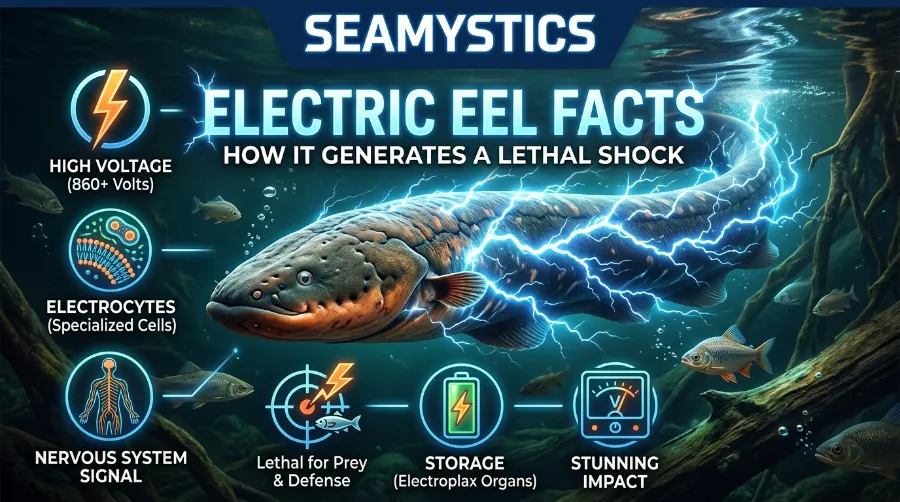
So how does an electric eel shock happen? The answer sits in special cells called electrocytes. Think of them as flat, coin-shaped batteries that stack side by side. Each one makes a tiny voltage, about 0.15 volts. On their own, they do little. When thousands fire together, the tiny pushes add up, just like batteries in a flashlight.
The Three Electric Organs
The eel carries three electric organs. They fill about 80 percent of the body, which means most of the animal is battery, and the vital organs sit crowded near the head.
- Main organ: Runs along the lower body and makes the high-voltage blasts.
- Hunter’s organ: Sits nearby and helps with strong pulses.
- Sachs’ organ: Makes a weak field, used like radar to sense the surroundings.
The Firing Sequence
The steps below show the process in plain order:
- The brain sends a nerve signal to the electric organ.
- Nerve endings release a chemical that opens tiny gates on one side of each electrocyte.
- Charged particles rush through the gates and flip the cell’s voltage for a split second.
- Thousands of cells do this together, which stacks the tiny voltages.
- Current flows out through the water from the tail end (positive) to the head end (negative).
This design is why scientists like to compare the eel to a battery. Inventor Alessandro Volta built the first true battery in 1800, and researchers say his design took inspiration from the electric fish. Mongabay’s news report covers how E. voltai got its name as a tribute to him.
Three Ways the Eel Uses Its Shock
An eel does not only zap. It uses electricity like a toolkit, and this is where the real biology gets clever.
Low Voltage for Sensing
The eel sends out weak pulses all the time, much like a bat uses sound. Objects in the water bend the electric field, and sensors on the skin read the change. This helps it find hiding fish in total darkness. Sharks use a similar sense through tiny jelly-filled pores. You can learn more about that in our hammerhead shark guide.
High Voltage for Hunting
For the kill, the eel switches to strong bursts. In 2014, biologist Kenneth Catania at Vanderbilt University reported in the journal Science that the eel makes a pair of quick pulses that force prey muscles to twitch. That twitch reveals where the hidden prey sits, then a longer burst freezes it. In effect, the eel takes control of the prey’s nerves. Scientific American’s report on the eel’s shocking secrets explains this trick well.
Curling and Leaping for Defense
Catania also found that a curled eel focuses current on a target, which roughly doubles the electric field on a struggling fish. In 2016 he showed that eels can leap out of the water and press their chin against a threat. Since air resists current more than water does, the leap sends the current straight into the target, and it packs a stronger punch. Zoos and aquariums can also explain these habits to visitors, since the behavior is easy to watch in a large tank.
Electric Eel Science: Studies That Changed What We Know
Reading the research, I find that four case studies shaped modern electric eel science.
Humboldt’s horses, 1800. Explorer Alexander von Humboldt watched local fishers drive horses into a pool near Calabozo, Venezuela, to tire the eels. Several horses collapsed and some reportedly died. The story is dramatic, but it also tells us that a swarm of tired eels can deliver repeated, harmful shocks.
Goblin Shark Facts: The Living Fossil With a Retractable Jaw
Catania’s hunting studies, 2014 to 2016. Careful lab work showed that the shock acts as remote control, and that eels can leap and curl to raise the shock’s force. These studies moved the story from myth to measurable science.
The 2019 species split. The Nature Communications paper (doi 10.1038/s41467-019-11690-z) used voltage as one clue for naming a species, which was new. You can find the paper through its DOI link.
Group hunting, 2021. Brazilian researchers filmed a group of roughly 100 E. voltai in the Iriri River herding small fish into shallow water, then striking together. Eels were long seen as loners, so this finding forced many of us to rethink their social life.
Bio-inspired engineering also grew from this work. A 2017 team at the University of Fribourg built a soft, gel-based power source that copies the eel’s stacked cells and can reach about 110 volts. Someday, such devices could help power tiny implants.
Are Electric Eels Dangerous to People?
A wild adult can hurt you, but deaths are rare. The bigger risks are secondary. A painful shock can cause a fall, a panic, or drowning. Heart trouble adds another risk for people with existing conditions. Repeated shocks from an angry, cornered eel raise the danger.
Simple safety rules help:
- Do not wade through muddy Amazon pools at night.
- Never touch a wild eel, even a small one.
- Avoid handling one in a tank without training and insulated gear.
- Seek medical care after any strong shock, especially with chest pain.
Most eels just want to avoid you. The shock costs them energy, and they need time to recharge after big bursts.
How the Eel Fits Among Ocean and River Predators
Electric eels are freshwater hunters, yet they make a great point of comparison with sea predators. A great white shark relies on raw power and speed. The eel relies on a built-in weapon that works at a distance. If you want to see how these hunters stack up, browse our full ocean predator ranking, where we compare bite, speed, and stealth.
Cookiecutter Shark Facts: The Tiny Shark That Bites Whales
Speed hunters also give a useful contrast. The barracuda charges in fast and strikes with teeth. The eel waits, senses, and freezes. Both are efficient, but they solve the same problem in opposite ways.
Practical Insights From Reading the Research
A few points stand out when you compare the studies side by side, and I think they are worth sharing.
First, voltage numbers in headlines often mislead. A record such as 860 volts describes a peak measured in one wild animal under field conditions. Most eels in aquariums fire far less. Second, size and health change output. Bigger, healthier fish produce stronger shocks, which is why the biggest recorded numbers come from wild adults.
Third, the eel’s habits explain its design. It lives in dark, murky water where eyes help little, so electricity replaces sight. In my opinion, that is the best way to remember the animal: a fish that swapped vision for a power grid.
Finally, always check the source of any shocking claim. A story about a “lethal” shock may skip the fact that pulses last only milliseconds. Good science communication keeps both the thrill and the numbers.
Latest Research Snapshot
Since the 2019 species split, researchers have kept refining how many species exist and how their voltage compares. Studies continue on how electrocytes work at the molecular level, and on how the group hunts. Keep an eye on peer-reviewed journals and museum news pages, since new measurements can change the record numbers. When you read a fresh claim, check the year, the species named, and whether the number came from a wild fish or a lab animal.
Frequently Asked Questions
How many volts can an electric eel produce?
The record is 860 volts, measured in an E. voltai in 2019. Older records for E. electricus sit near 650 volts.
Is an electric eel really an eel?
No. It is a knifefish and shares more ancestry with catfish and carp.
Where does an electric eel live?
It lives in the slow, muddy waters of the Amazon and Orinoco basins in South America.
How does an electric eel avoid shocking itself?
Its vital organs sit near the head, away from the main current path, and fatty tissue helps insulate them. The current also flows mostly through the water.
Can an electric eel kill a human?
It rarely does directly. Drowning after a shock, or repeated shocks, create the main danger.
Do electric eels hunt in groups?
Yes, at least E. voltai does. A 2021 study in Brazil filmed group hunting in the Iriri River.
How long does an electric eel live?
Studies and aquarium records suggest about 10 to 15 years in the wild, and longer under human care. Exact ages vary by source.
Conclusion
To sum up, this fish is a living power plant with a simple recipe: thousands of tiny cells, firing together, in murky water where it needs the extra edge. These electric eel facts show a species that senses, hunts, and defends itself with the same tool. The 2019 discovery of E. voltai and the 2021 group hunting study prove that we still have much to learn. Next time you see a headline about a “lethal shock,” you will know the numbers behind it. For more predator science, start with our Sea Mystics home page and keep exploring the deep.
Quick Quiz
- How many known species of electric eel exist today?
a) One b) Two c) Three d) Five - Which organ helps the eel sense its surroundings with weak pulses?
a) Main organ b) Sachs’ organ c) Liver d) Swim bladder - What record voltage did E. voltai reach?
a) 220 V b) 650 V c) 860 V d) 1,200 V - True or false: An electric eel is a true eel.
- True or false: Electric eels breathe air at the surface.
Answers: 1) c. 2) b. 3) c. 4) False, it is a knifefish. 5) True.
References
- de Santana, C. D. et al. (2019). Unexpected species diversity in electric eels with a description of the strongest living bioelectricity generator. Nature Communications. https://doi.org/10.1038/s41467-019-11690-z
- Cornell College of Agriculture and Life Sciences (2019). Scientists shocked to discover two new species of electric eel. https://cals.cornell.edu/news/2019/09/scientists-shocked-discover-two-new-species-of-electric-eel
- Mongabay (2019). Shocking news: there are actually three species of electric eel in the Amazon. https://news.mongabay.com/2019/09/shocking-news-there-are-actually-three-species-of-electric-eel-in-the-amazon-not-one/
- Scientific American. Shocking secrets of the electric eel. https://www.scientificamerican.com/article/shocking-secrets-of-the-electric-eel/
- Catania, K. C. (2014). The shocking predatory strike of the electric eel. Science.
- Catania, K. C. (2016). Leaping eels electrify threats, supporting Humboldt’s account of a battle with horses. PNAS.