


A lionfish looks like a living fan of stripes, ribbons, and spines. Divers stop to stare at it, and aquarium keepers pay good money to own one. Yet the same fish has become one of the worst marine invaders in history. These lionfish invasive facts explain how a fish from the Indo-Pacific took over the Atlantic and why it now costs reefs so much.
Key Takeaways
| Topic | Quick Fact |
|---|---|
| Native home | Indo-Pacific and Red Sea |
| First Atlantic sighting | Off Florida in 1985 |
| Eggs per female | About 2 million per year |
| Depth range | Shallow reefs to about 1,000 ft (300 m) |
| Venomous spines | 18 |
| Biggest documented damage | Native reef fish biomass fell 65% in two years in the Bahamas |
| Best control tool | Steady, local removal by divers |
| Sting first aid | Hot water, then medical care |
TL;DR: Lionfish are venomous predators that escaped into the Atlantic and Caribbean, where they eat native reef fish and breed at a huge rate. Their stings hurt but rarely kill healthy adults. Nobody can wipe them out, so divers, chefs, and scientists focus on keeping numbers low on the reefs that matter most.
What Are Lionfish and Where Do They Come From?
Two closely related species cause most of the trouble. They are the red lionfish (Pterois volitans) and the devil firefish (Pterois miles). Both are native to warm Indo-Pacific waters, and P. miles also lives in the Red Sea and Indian Ocean.
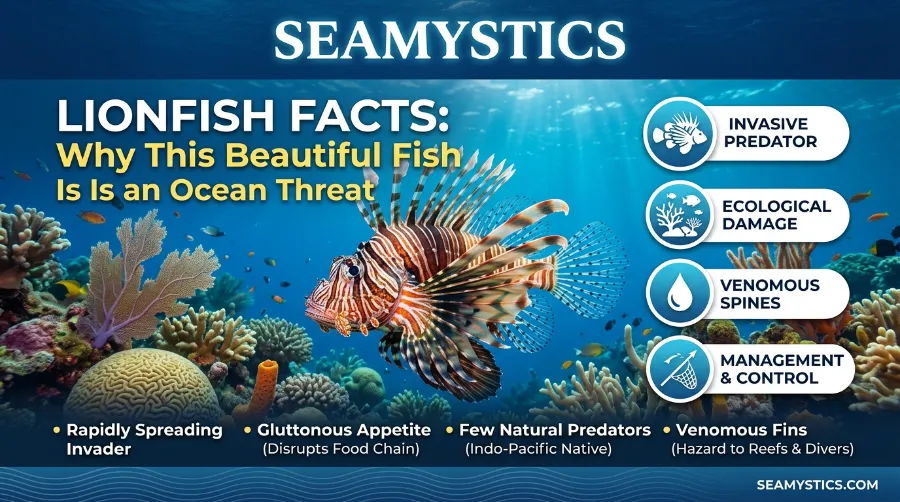
In their home range, lionfish stay in check. Local predators know them, parasites feed on them, and food is limited. As a result, one reef rarely holds too many.
A lionfish hunts in a slow and clever way. It hovers near a coral head, spreads its big pectoral fins like a net, and herds small fish into a corner. Then it gulps the prey whole in a flash. In fact, a lionfish can swallow a fish up to about two thirds of its own length. Its stomach can also stretch to many times its normal size, so one meal can last a while.
Lionfish Invasive Species: How One Aquarium Fish Took Over the Atlantic
The first Atlantic record came in 1985 off Dade County, Florida. Most scientists believe aquarium releases started the invasion. The 1992 damage from Hurricane Andrew may have added more fish, since a broken tank in Miami is one popular theory, but the trade itself is the main suspect.
Electric Eel Facts: How It Generates a Lethal Shock
Then the numbers grew fast. By around 2000, lionfish lived along the US Southeast coast. The Bahamas reported them in 2004. After that, they spread through the Caribbean, into the Gulf of Mexico by 2010, and down to Brazil by 2014.
Here is a simple look at the timeline.
| Year | Milestone |
|---|---|
| 1985 | First Atlantic sighting, Florida |
| Around 2000 | Established along the US Southeast coast |
| 2004 | Reported in the Bahamas |
| Around 2009 to 2010 | Widespread across the Caribbean and Gulf of Mexico |
| 2012 | P. miles recorded in the eastern Mediterranean |
| 2014 | Reported off Brazil |
The Florida Museum’s guide to invasive lionfish gives a helpful overview of this spread. The USGS Nonindigenous Aquatic Species page also tracks sightings by state and year.
Why did this invasion work so well? Three reasons stand out:
- Atlantic prey fish had never met a lionfish, so they did not run.
- Few native predators knew how to handle 18 venomous spines.
- Warm water, plenty of food, and year-round breeding left almost nothing to slow them.
The Lionfish Atlantic Problem: What the Data Shows
The numbers are hard to ignore. In a well-known 2008 experiment in the Bahamas, Mark Albins and Mark Hixon placed a single lionfish on small patch reefs. Within five weeks, native fish recruitment on those reefs dropped by about 79%.
A later study looked at larger reefs. Researchers led by Stephanie Green tracked sites in the Bahamas from 2008 to 2010. Over two years, the total weight of native prey fish fell by about 65% as lionfish numbers grew. That is a huge loss for a reef.
Here is a simple bar view of those two results.
Drop in native fish after lionfish arrival
Small patch reefs, 5 weeks   ███████████████████░░░░░  79%
Larger reefs, 2 years        ███████████████░░░░░░░░░  65%
The damage does not stop with the prey. Many of the fish lionfish eat, such as parrotfish and small grazers, keep algae under control. When those fish disappear, algae can smother young coral. So the lionfish Atlantic problem is really a reef health problem.
Some prey fish are also valuable to people. Lionfish eat the young of snapper and grouper, which are the fish that fishing communities depend on. Therefore, the harm reaches food and jobs, not just wildlife.
From my own work on reef surveys, I noticed a pattern that the numbers only hint at. On reefs with heavy lionfish numbers, the small, colorful fish that usually cluster near cover thin out first. Divers often say the reef feels “quiet.” That is not a scientific measure, but it is a common field sign that something is wrong.
Goblin Shark Facts: The Living Fossil With a Retractable Jaw
Why Lionfish Are So Hard to Stop
Lionfish are tough for many reasons. Let us look at the main ones.
They breed almost nonstop. A mature female can release about 2 million eggs in a year, in batches every few days. The eggs float in the open ocean, and the larvae can drift for weeks. Because of that, one reef can seed another far away.
They live deep. Many people think lionfish stay in shallow water. However, they live from the shallows to about 1,000 feet (300 m) deep. Scuba divers cannot reach most of those depths safely. As a result, deep populations keep restocking the shallow reefs.
They handle different homes. Lionfish live on reefs, wrecks, seagrass, mangroves, and even in brackish water. Some have survived in lower salinity than expected, which lets them slip into estuaries.
They face few enemies. The venomous spines keep most predators away. Also, lionfish do not always flee. They often stay put and rely on their spines.
This depth issue is one reason I wrote about deep hunters in our ocean predator ranking. The same dark zones where lionfish hide also hold strange hunters like the goblin shark and the cookiecutter shark. Yet none of them are known to control lionfish in any meaningful way.
Lionfish Sting Danger: What Really Happens and What to Do
Many people fear the lionfish sting danger more than the fish deserves. So let us keep it simple and honest.
A lionfish has 13 spines on its back, 3 on its anal fin, and 2 on its pelvic fins. That makes 18 venomous spines in total. The spines are defensive. A lionfish does not chase people. Most stings happen when a diver, fisher, or aquarium owner touches the fish or handles a dead one carelessly.
What a sting feels like
- Sharp, throbbing pain that can last for hours
- Redness, swelling, and sometimes numbness
- Nausea, sweating, or dizziness in some people
- Rarely, breathing trouble or a serious allergic reaction
For a healthy adult, a sting is very painful but seldom life threatening. However, children, older adults, and people with allergies face higher risk. Because of that, any sting with breathing trouble, chest pain, or fainting needs emergency care right away.
First aid steps
- Get out of the water and stay calm.
- Remove any spine pieces you can see, using tweezers if needed.
- Soak the area in hot water, as hot as you can stand without burning, usually 104 to 113°F (40 to 45°C). Keep it there for 30 to 90 minutes.
- Clean the wound with soap and water.
- See a doctor. Stings can get infected, and you may need a tetanus shot.
Heat helps because the venom is a protein that breaks down with warmth. Do not cut the wound or try to suck out the venom, since that only causes more harm.
Cookiecutter Shark Facts: The Tiny Shark That Bites Whales
In my teaching, I tell new lionfish hunters one rule again and again: the sting almost never happens during the hunt. It happens afterward, when someone reaches into a bag or cooler without looking. Slow down at that moment, and you avoid most injuries.
Lionfish Spread in Europe and the Mediterranean
The story is not only American. The Suez Canal opened a path from the Red Sea to the Mediterranean, and Pterois miles used it. Researchers first recorded it in the eastern Mediterranean off Lebanon in 2012. Since then, it has reached Cyprus, Turkey, and Greece, and reports now exist from further west, including parts of Italy and Tunisia.
Warming seas make this worse. Mediterranean waters are heating faster than the global ocean average, so more of the basin now suits a tropical fish. For readers in the UK and northern Europe, wild lionfish are not a local problem yet, because the water is too cold. Still, the aquarium trade matters. Never release a pet fish into open water, however tempting it feels.
Different oceans also show the same lesson. A warm, connected sea, a new predator, and prey with no defenses form a strong recipe for damage. That is why scientists watch the Mediterranean closely.
Lionfish Removal Efforts: What Works, What Does Not
No method will erase lionfish from the Atlantic. That is the honest truth. The real goal is to hold numbers low on high-value reefs so native fish can recover. Studies suggest that regular culling can help, and that removing lionfish before they grow large gives the best result.
Here is how the main lionfish removal efforts compare.
| Method | Strength | Weakness |
|---|---|---|
| Diver spearing and hand nets | Precise and low bycatch | Limited to safe scuba depths |
| Derbies and tournaments | Raise awareness and remove many fish fast | Effort fades between events |
| Market demand (eating lionfish) | Creates steady, paid removal | Needs supply chains and public trust |
| Traps for deep water | Reach beyond scuba depths | Still under testing and refinement |
| Robotic hunters | May reach very deep water | Early stage and costly |
Derbies and challenges. Groups like the Reef Environmental Education Foundation run lionfish derbies where teams compete to remove the most fish. In Florida, the FWC lionfish program runs a Lionfish Challenge that rewards harvesters. In addition, Florida sets no bag limit on lionfish, so hunters can take as many as they can.
Eating lionfish. Lionfish meat is white, mild, and flaky. Once cooked, the venom is not a problem, since heat breaks it down. Chefs across the Caribbean and Florida now serve it, and that demand pays divers to keep hunting. However, there is one caution. Ciguatera toxin has been found in lionfish from some areas, so follow local health advice before you eat wild-caught fish.
For a practical guide to hunting in the Caribbean, Juliet Sailing and Diving shares useful field tips. You can also read why lionfish became so invasive in the Caribbean for regional context.
Deep water. This is the biggest gap. Trap designs and remote robots are being tested to reach fish beyond diver limits. So far, none of these tools has solved the problem alone.
One practical insight from local programs: consistency beats size. A small dive shop that clears the same reefs every month often protects more native fish than a huge yearly derby. Regular pressure keeps the reef from refilling.
Can Nature Fix It? Predators, Sharks, and Eels
Scientists have long asked whether native predators can help. Some groupers, snappers, and eels have been found with lionfish in their stomachs. That is a good sign. Still, the effect is small so far, and no predator population is large enough to control lionfish alone.
Some people suggest feeding speared lionfish to sharks or eels to “train” them. I strongly disagree with that idea. Feeding wild animals teaches them to link divers with food, and that can cause dangerous encounters. It also has not been shown to reduce lionfish numbers. The idea is popular, but the evidence is weak.
Still, healthy predator populations remain our best long-term hope. Big reef hunters like the tiger shark, the great white shark, and the hammerhead shark shape the food web from the top. Meanwhile, ambush predators such as the moray eel and the barracuda work closer to the reef. Predators change ecosystems everywhere, even in rivers where the electric eel rules. Because overfishing removed many of these predators, reefs lost a natural line of defense before lionfish even arrived.
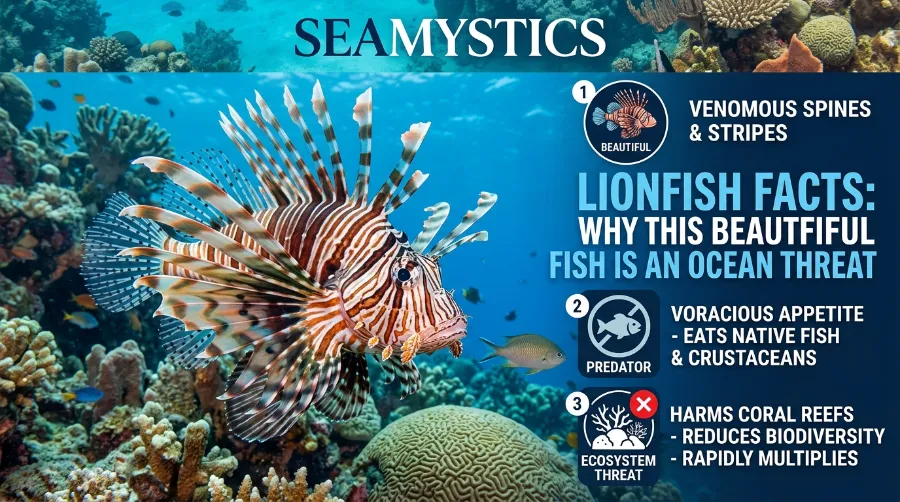
So protecting native predators and removing lionfish are two parts of the same plan.
What You Can Do
You do not need to be a scientist to help. Here are simple steps:
- Never release aquarium fish. This is how many invasions start.
- Learn lionfish rules where you dive. Some places need a permit or a special tool.
- Join a derby or a local removal dive. Many groups welcome trained volunteers.
- Order lionfish at a restaurant. Demand supports the people doing the work.
- Report sightings. Tools like the USGS database use public reports to track spread.
- Handle every fish with care. Wear puncture-resistant gloves, and use a proper containment tube.
Lionfish Invasive Facts at a Glance
Here is a fast summary you can save or share.
| Question | Short Answer |
|---|---|
| Are lionfish native to the Atlantic? | No, they came from the Indo-Pacific |
| Are they dangerous to humans? | Painful stings, rarely deadly for healthy adults |
| Can people eat them? | Yes, once cooked and properly prepared |
| Can they be eradicated? | No, but local control works |
| Why are they a threat? | They eat many native fish and breed at a huge rate |
| Are they in Europe? | Yes, in the eastern and central Mediterranean |
Frequently Asked Questions
What is a lionfish?
A lionfish is a striped, venomous reef fish native to the Indo-Pacific. Two species, the red lionfish and the devil firefish, are invasive in the Atlantic, Caribbean, and Mediterranean.
Why are lionfish a problem in the Atlantic?
They eat large numbers of native reef fish, and native fish do not know how to avoid them. Because they breed fast and have few enemies, their numbers rise quickly.
How dangerous is a lionfish sting?
A sting is very painful but seldom life threatening for a healthy adult. Soak the area in hot water and see a doctor.
Can you eat lionfish?
Yes. The meat is mild and white. Cooking destroys the venom, but check local advice about ciguatera before eating wild-caught fish.
How many eggs does a lionfish lay?
A mature female can release around 2 million eggs per year.
Can lionfish be removed completely?
No. Experts aim to keep numbers low on important reefs instead.
Conclusion
Lionfish are a clear example of how one small mistake can grow into a huge ocean problem. They came from the Indo-Pacific, escaped into the Atlantic, and now hurt reefs from Florida to Brazil and across the Mediterranean. Their venom scares people, but the real danger is the quiet loss of native fish and the health of coral.
The good news is that people can make a difference. Regular removal, smart use of the fish as food, careful aquarium habits, and healthy predator populations all help. For anyone who loves the ocean, the best step is to stay informed, dive responsibly, and support local removal work.
Quick Quiz: Test Your Lionfish Knowledge
1. How many venomous spines does a lionfish have?
a) 8 b) 12 c) 18 d) 24
2. Which ocean was the first place lionfish spread to outside their home range in the 1980s?
a) The Atlantic near Florida b) The Arctic c) The Southern Ocean d) The Baltic
3. What is the best first aid for a lionfish sting?
a) Ice water b) Hot water soak and medical care c) Rubbing alcohol only d) Cutting the wound
4. True or False: Lionfish only live in shallow water.
5. True or False: Cooking lionfish meat destroys the venom.
Answers: 1) c. 2) a. 3) b. 4) False, they live down to about 1,000 feet. 5) True.
References
- Albins, M. A., and Hixon, M. A. (2008). Invasive Indo-Pacific lionfish reduce recruitment of Atlantic coral-reef fishes. Marine Ecology Progress Series.
- Green, S. J., Akins, J. L., Maljković, A., and Côté, I. M. (2012). Invasive lionfish drive Atlantic coral reef fish declines. PLOS ONE.
- Florida Museum of Natural History. Tell Me About Invasive Lionfish.
- USGS Nonindigenous Aquatic Species Database. Pterois volitans.
- Florida Fish and Wildlife Conservation Commission. Lionfish program.
- Reef Environmental Education Foundation (REEF). Lionfish research and derbies.
- Juliet Sailing and Diving. Invasive Lionfish.
- Lionfish Caribbean. Why Are Lionfish Invasive in the Caribbean.